
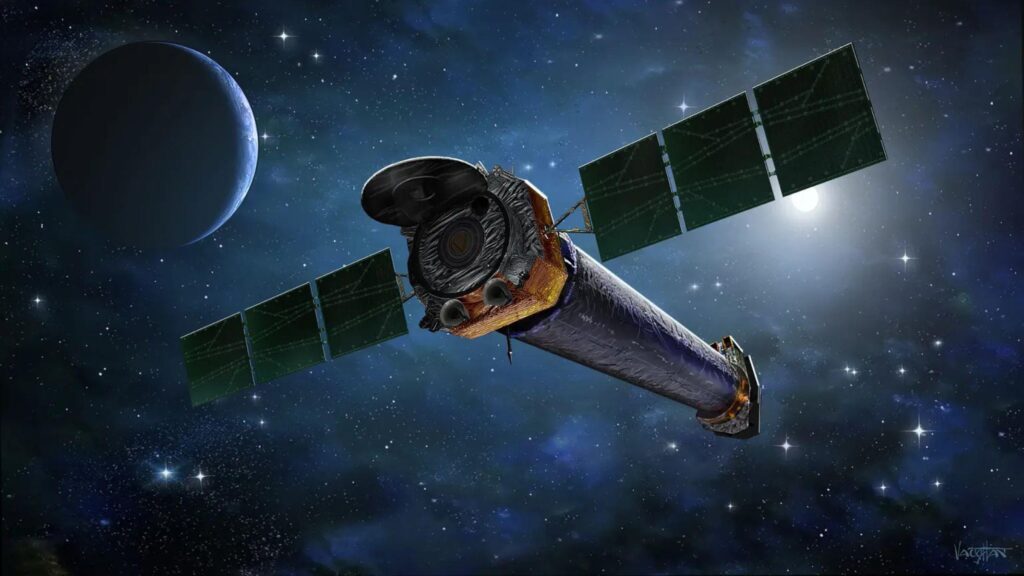

Astronomers, with the aid of NASA’s Chandra X-ray Observatory, have revealed two striking supernova stories: one hints at a fresh remnant near the Milky Way’s center, while the other shows long-studied wreckage in a nearby galaxy changing in ways no one expected. Together, the findings show that supernova remains are more dynamic, and more revealing, than scientists had assumed.
 Sgr C the location of this supernova wreckage is highlighted in blue (Credit: NASA/CXC/UCLA/Z. Zhu et al/ESA)
At the heart of the Milky Way, researchers think they may have found a supernova remnant buried in the crowded region around the supermassive black hole, Sagittarius A*. The candidate lies about 26,000 light-years from Earth and shows up as a compact blob of X-ray emission, likely hidden inside a larger cloud of expanding gas. If confirmed, it would be one of the closest supernova remnants ever found to the galaxy’s central black hole, a region typically packed with fast-moving gas, dense clouds, and tangled magnetic fields.
The object is believed to be roughly 1,700 years old and expanding at about 2 million miles per hour, according to the reports. That speed, combined with its location, makes it an unusually valuable clue about how massive stars die in one of the most extreme environments in the Milky Way. Observations from Chandra and ESA’s XMM-Newton were central to the discovery, and previous infrared work had already hinted that a shell of gas was present there.
 Galaxy M83 in X-ray and Optical Light. (Credit: NASA/CXC/SAO/ESA/STScI)
The second case comes from Messier 83, a spiral galaxy where Chandra watched 22 X-ray sources tied to supernova remnants over 14 years. Roughly half of them changed brightness, a surprise because supernova remnants are usually thought of as relatively stable clouds of expanding debris. So instead of simple fading echoes, the data shows that there’s the possibility that some of the X-rays come from surviving companion stars that lived through the explosion. What this could mean is that some seemingly ordinary remnants are actually crowded systems still busy rearranging themselves.
For astronomers, the two findings can provide a bigger picture whereby supernova remnants are not just rubble piles left behind by dead stars, but active laboratories where shock waves, stellar leftovers, and surrounding gas keep interacting.