
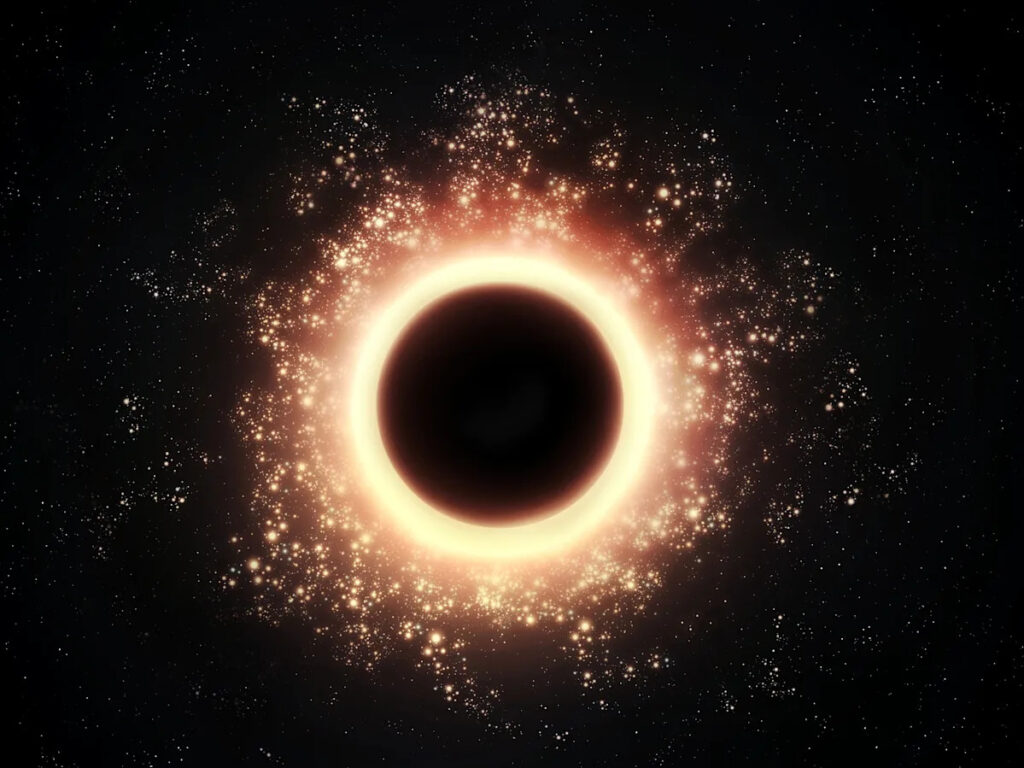
A new study suggests that the collapse of a dying star may not always end in the formation of a black hole, but could instead give rise to an entirely new universe.
Two physicists at Goethe University Frankfurt in Germany have used Albert Einstein’s general theory of relativity to model how ultra-compact stars could form during a stellar collapse.
Einstein’s theory of gravity—known as general relativity—describes how massive objects warp spacetime, shaping phenomena such as black holes and the collapse of dying stars.
Their findings, published this month in Physical Review D, offer a potential answer to a long-standing query about alternative outcomes when massive stars reach the end of their life cycles.
A statement from Goethe University Frankfurt said the physicists, “have provided the first answer to a question that scientists have been debating for 25 years: how do gravastars [gravitational vacuum stars] form during the collapse of ordinary matter?”
How Stars Die
When a star exhausts its hydrogen fuel, its fate depends largely on its size. NASA explains that the life of a star is governed by a balance between outward pressure and inward gravity.
“For stars, it’s a balance between the radiation pressure of their fuel-burning cores pushing outward, and their gravity pulling inward. When stars run out of fuel, gravity wins this struggle,” the space agency says.
Black holes are among the most extreme objects in the universe. NASA describes them as, “huge concentrations of matter packed into very tiny spaces,” where gravity is so powerful that, “nothing–not even light–can escape.”
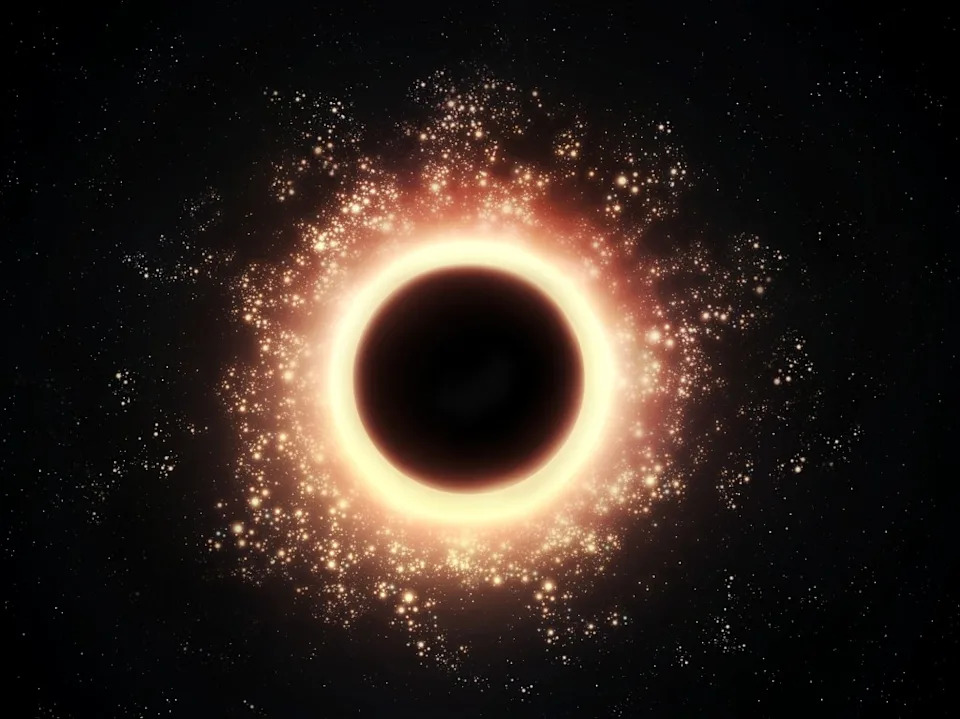
Stock image: An illustration of a supermassive black hole at the center of a galaxy.
An Alternative to Black Holes
However, the new study suggests there may be another possible outcome.
“The collapse of a star at the end of its life cycle could lead not only to a black hole, but also to an ultra-compact star–a so-called gravastar–which resembles a black hole from the outside,” the university statement said.
Gravastars, short for “gravitational vacuum stars,” have been theorized for decades however, their formation has remained unclear. According to the researchers’ calculations, gravitational collapse does not necessarily have to end in a black hole.
Instead, “a new mini universe” could form within the collapsing star. This process involves forces similar to those described by the Big Bang Theory, which holds that the universe began around 13.8 billion years ago from an extremely hot, dense state and has been expanding ever since.
A Universe Within a Star
The researchers behind the latest study, Daniel Jampolski and Luciano Rezzolla, have presented what the university describes as the first dynamic solution to Einstein’s equations that could explain this process.
“The solution has shown that the collapse may trigger the creation of a mini universe inside the collapsing matter not very different from the Big Bang from which our universe has emerged,” the university noted.
This miniature universe, like our own, would expand due to dark energy. That expansion would counteract the inward pull of gravity, eventually halting the collapse before a black hole can form. In effect, the system reaches a balance between collapse and expansion, producing what the researchers describe as a stable gravastar.
Jampolski, who first identified the solution in his master’s thesis, said the process occurs at a very late stage of collapse.
“The Big Bang of the emerging universe can unfold once the star has already collapsed almost to the point of becoming a black hole,” he said in the statement.
He added that it becomes easier to imagine such an event when matter has already been compressed to extreme levels, allowing new physical effects to emerge.
Despite the implications of the study, the researchers emphasized that black holes remain the most widely accepted explanation for stellar collapse.
“Looking for alternatives to black holes should not suggest a skepticism towards black holes, which still represent the most natural and simplest solution to the fate of gravitational collapse,” Rezzolla, a professor of theoretical astrophysics at Goethe University, said in the statement.
Do you have a tip on a science story that Newsweek should be covering? Do you have a question about stars? Let us know via life@newsweek.com.
Related Articles