
For years, space architecture was treated mostly as a question of placement: where to put a spacecraft, and how reliably it could hold position. That framing is now too narrow. A growing number of missions need to reposition, retask, inspect, avoid threats, persist, support logistics or simply preserve options as the operating environment changes. The community is taking maneuver more seriously — and that shift is overdue.
But the maneuver conversation still carries a blind spot: Propulsion is treated too generically.
Whether a spacecraft can move is the easy question. The harder one is how much useful maneuver capability it retains across the life of the mission. A satellite that can complete a single transfer, one repositioning event or one contingency burn may still be badly matched to a mission that depends on repeated maneuvering over years. The question that matters is not “Can it move?” but “How much maneuver margin will it have left once the original plan changes?”
That is the difference between maneuver and sustained maneuver.
Sustained maneuver, as used here, means preserving useful maneuver decisions across the life of a mission. It is not a doctrine term. It is a practical way to describe missions that need more than a single burn or a one-time transfer. These are missions where operators must keep enough capability in reserve to act later: to reposition, preserve access, avoid a threat, support inspection, respond to new tasking or keep operating after the mission has evolved.
Maneuver margin is the useful propulsion reserve that remains after the real mission has taken its toll. Planned operations consume it. So do contingencies, degradation, qualification limits, restart uncertainty and power, thermal and end-of-life constraints. A propulsion system can look more than sufficient at launch and still leave operators with too little freedom years later.
That is why propulsion for sustained maneuver should be judged across the full mission, not at the moment of purchase or launch. For mission owners, program offices, spacecraft primes, spacecraft companies and the propulsion and mission-architecture teams that support them, the practical takeaway is simple: define the mission envelope before locking in the propulsion answer.
Several variables shape that judgment. Specific impulse sets how efficiently propellant is used; total impulse sets how much cumulative maneuver the system can deliver. Lifetime determines whether it can keep supporting the mission over years, while restart confidence becomes decisive when maneuver events are separated by long dormancy or irregular use. Duty cycle matters too: Not every mission needs constant thrust, but many need credible thrust the moment it is called upon. Qualification evidence is its own variable, because a paper capability is not the same as a system trusted in flight. And power, thermal limits, integration burden and supply-chain confidence all determine whether the “best” choice on paper is actually usable.
No propulsion architecture resolves all of those trades at once.
Chemical and solid propulsion stay essential where urgency, high thrust, simplicity or immediate tactical response dominate. Hall-effect propulsion is often the practical electric choice where transfer time, thrust-to-power, product availability or an established vendor baseline drives the program. Servicing and refueling, meanwhile, may reshape how future architectures think about lifetime, logistics and repositioning.
Gridded-ion propulsion belongs in a different part of the trade space.
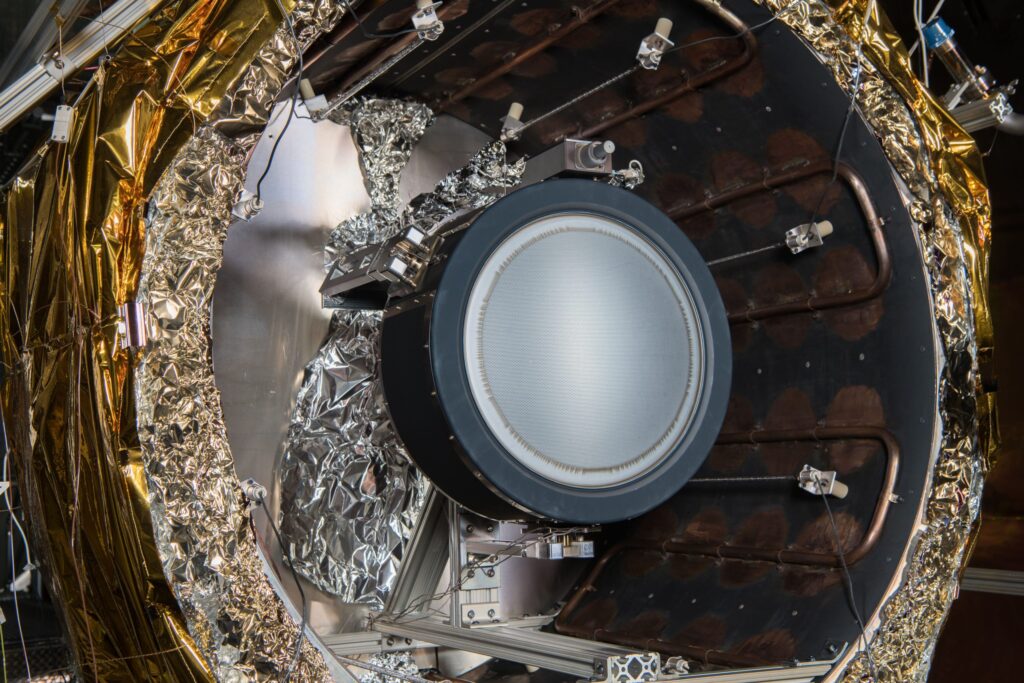
A gridded-ion thruster, like those we’re developing at Desert Works Propulsion, ionizes propellant inside a discharge chamber. Electrostatic grids then extract and accelerate those ions into a focused beam and a neutralizer adds electrons so the spacecraft does not build up charge. The result is an electric-propulsion approach known for efficient propellant use and long-life potential.
None of which makes gridded ion the right answer everywhere. When the only priority is fast transfer or the lowest near-term integration risk, it is usually not the first choice. Its real lane is elsewhere: missions where high delta-V, long service life, total impulse, restart confidence, qualification credibility and preserved maneuver margin matter more than a single headline thrust number.
That lane deserves renewed attention from mission owners, program offices, primes, spacecraft companies and technical teams working on missions where maneuver margin must survive for years, not just through a single event.
Gridded-ion propulsion carries deep NASA heritage, and that heritage is valuable: It offers real lessons in high-efficiency electric propulsion, long-duration operation, life testing and flight use. But heritage alone is not a product. The opportunity is not to copy a legacy engine and assume it fits a modern mission. It is to translate proven gridded-ion physics and flight-operational lessons into mission-fit hardware, test evidence, life models and qualification paths for today’s Earth-orbital, GEO, cislunar, commercial and national-security needs.
This distinction matters. Some legacy gridded-ion systems were shaped by planetary and deep-space requirements: missions that rewarded very long life, conservative operating regimes, wide throttling ranges, and demanding qualification profiles. Modern sustained-maneuver missions may operate under different constraints: different power levels, different operating points, different integration assumptions, different evidence packages. A system optimized for one mission class should not be assumed to fit another without a fresh requirement-fit trade.
This is where the conversation needs to get specific.
“Maneuver” is not a single requirement. A spacecraft that needs urgent repositioning is not solving the same problem as one that needs efficient cumulative maneuver over years. A transfer vehicle, a servicing craft, a long-duration satellite, a cislunar logistics platform, and a custody or inspection asset may all need mobility, but not the same propulsion answer.
The right starting point is the mission envelope. Mission owners, program offices, spacecraft primes, spacecraft companies and propulsion teams should ask: How much delta-V is actually required, and over how many maneuvers? How long must the system stay useful? How much power is available, and how often must it restart? How much propellant margin must survive planned operations? What qualification evidence will the buyer trust, what integration burden can the spacecraft accept and which failure modes matter most?
This is the lens we apply at Desert Works Propulsion: not “which engine wins,” but which propulsion path fits the mission. DWP is focused on translating NASA-proven gridded-ion heritage into practical U.S. hardware, test evidence and qualification paths for missions where high delta-V, long life, and total impulse matter.
The goal is not to crown gridded ion as the default answer. It is to make sure the technology is evaluated where it belongs. As missions grow more mobile, contested, long-lived and logistics-aware, buyers should define the mission envelope before they lock in the propulsion answer — and where maneuver margin has to last for years, gridded-ion propulsion deserves a serious requirement-fit evaluation.
Michael J. Patterson is founder and chief engineer of Desert Works Propulsion and a former NASA Senior Technologist for In-Space Propulsion. He has four decades of electric propulsion experience, including leading NASA ion propulsion programs, such as the NSTAR & NEXT engines flown on Deep Space 1, Dawn and DART.
SpaceNews is committed to publishing our community’s diverse perspectives. Whether you’re an academic, executive, engineer or even just a concerned citizen of the cosmos, send your arguments and viewpoints to opinion (at) spacenews.com to be considered for publication online or in our next magazine. If you have something to submit, read some of our recent opinion articles and our submission guidelines to get a sense of what we’re looking for. The perspectives shared in these opinion articles are solely those of the authors and do not necessarily represent their employers or professional affiliations.
Related