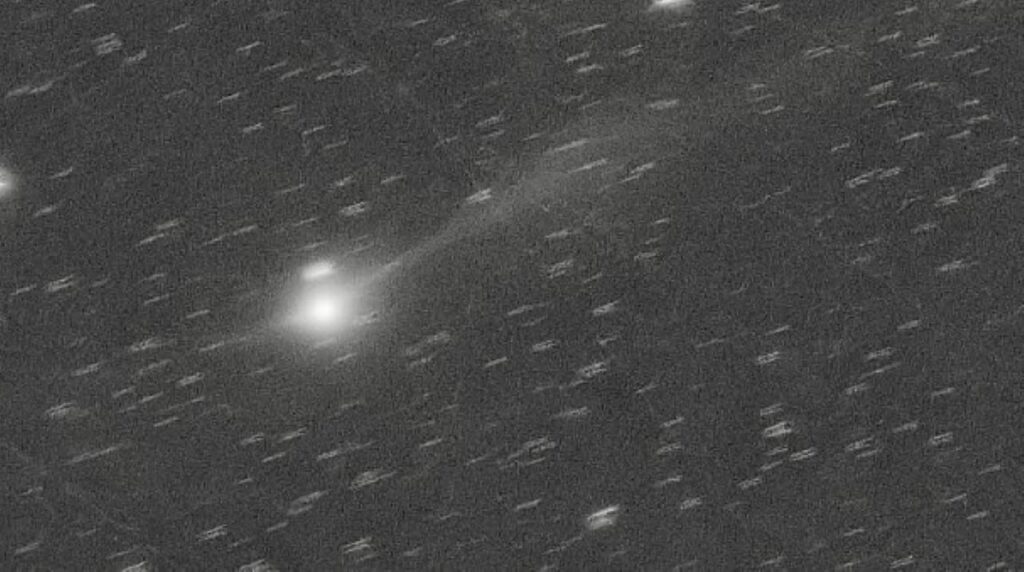
The ATLAS observatory, operating from the Río Hurtado region, in Chilean territory, recorded the arrival of comet 3I/ATLAS on July 1, 2025. This celestial body represents only the third confirmed visitor from outside our cosmic neighborhood, following the famous ‘Oumuamua (discovered in 2017) and 2I/Borisov (identified in 2019). Traveling at an impressive speed of approximately 100,000 kilometers per hour in relation to our star king, the object caught the immediate attention of the scientific community. The North American space agency activated its space security teams shortly after noticing an unusual movement pattern accompanied by the emission of radio frequencies.
Experts linked to the European Space Agency (ESA) and the University of Hawaii estimate that the cosmic visitor is a piece of rock and ice ejected from its home star countless millennia ago. Current estimates indicate that the comet’s heart has dimensions that vary between 320 meters and 5.6 kilometers in length. This entire central structure travels through the vacuum surrounded by a dense cloud composed of cosmic dust and volatile gases.
 NASA – Photo: LaserLens/Shutterstock.com
Displacement with non-gravitational influences towards the center of our system.
One-way route, meaning that the celestial body will never return after this passage.
Point of closest proximity to our planet scheduled for December 19, 2025, maintaining a safe margin of 270 million kilometers.
First analyzes detail the physical structure of the distant visitor
The primary identification as a possible risk occurred through equipment at the University of Hawaii’s Astronomy Institute, which constantly scans the sky. Shortly afterwards, additional observations carried out by the Hubble Space Telescope confirmed that the celestial body is of medium size. This scale of magnitude puts it on the same level as many local comets that are usually followed by amateur astronomers around the world.
Contrary to what was seen with 2I/Borisov, which presented an intense release of gases, the new study target demonstrates much greater structural stability. The small fluctuations recorded in its displacement speed and apparent brightness are direct consequences of asymmetric jets. These jets occur when frozen material on its surface reacts to solar heat and is violently launched into outer space.
Frequency capture reveals the chemical signature of the celestial body
An important observation milestone occurred on October 24, 2025, when the MeerKAT radio telescope complex, installed in South Africa, intercepted transmissions in the 1.6 GHz band. Far from being an artificial communication, this specific frequency is a classic signature generated by the breakdown of hydroxyl molecules, a natural process that happens when the comet’s frozen water passes directly into the gaseous state under starlight.
With this discovery, the scientific community was able to definitively attest to the active nature of the visitor. The pattern of waves captured maintains remarkable constancy and remains under daily scrutiny by ground teams. This sublimation activity completely rules out the hypothesis that the object was just an inert rocky asteroid, also eliminating any theory about sources of interference of non-natural origin.
Global task force unites the largest space agencies on the planet
NASA’s Planetary Defense Coordination Office organized an emergency committee with global experts in August 2025. This rapid mobilization follows strict international security guidelines, created specifically to deal with the approach of space masses whose origins and behaviors are not fully understood by astronomers.
To unlock the chemical secrets of this traveling rock, scientists trained the powerful mirrors of the Very Large Telescope and the James Webb space observatory on the target. The main objective of these high-tech scans is to compare the elements present in the intruder’s gas cloud with the chemical composition of comets that were born in our own cosmic neighborhood.
Passage route guarantees absolute safety for our planet
The orbital dynamics of 3I/ATLAS are characterized by an open trajectory, which means it will dive towards the Sun and be thrown back into deep space. During its closest approach to Earth, the distance that will separate us from the comet will be almost twice as great as the space between our planet and Mars.
Exhaustive calculations carried out jointly by the North American space agency and its European partners guarantee that the chance of collision is absolutely zero. After bypassing our main star, the frozen rock will resume its solitary journey through the interstellar void, leaving behind only the valuable data collected by our measuring instruments.
Continuous monitoring promises to revolutionize modern astrophysics
Researchers continue to closely monitor how the rock’s internal structure reacts as ambient temperatures rise. The heat emitted by the Sun is the main driver behind the physical changes recorded in recent weeks. By cross-referencing this new information with the databases of former visitors ‘Oumuamua and 2I/Borisov, experts hope to better understand how other planetary systems expel their debris into the galaxy.
Light spectrum readings are helping to define the level of reflectivity of the core’s surface, a crucial piece of data for creating virtual models of the formation of planets in distant areas of the universe. As long as the celestial body is within range, the global network of radio telescopes will keep their antennas pointed at it. Each new variation in the waves captured serves to refine theories about the dynamics and composition of worlds that orbit other stars.