
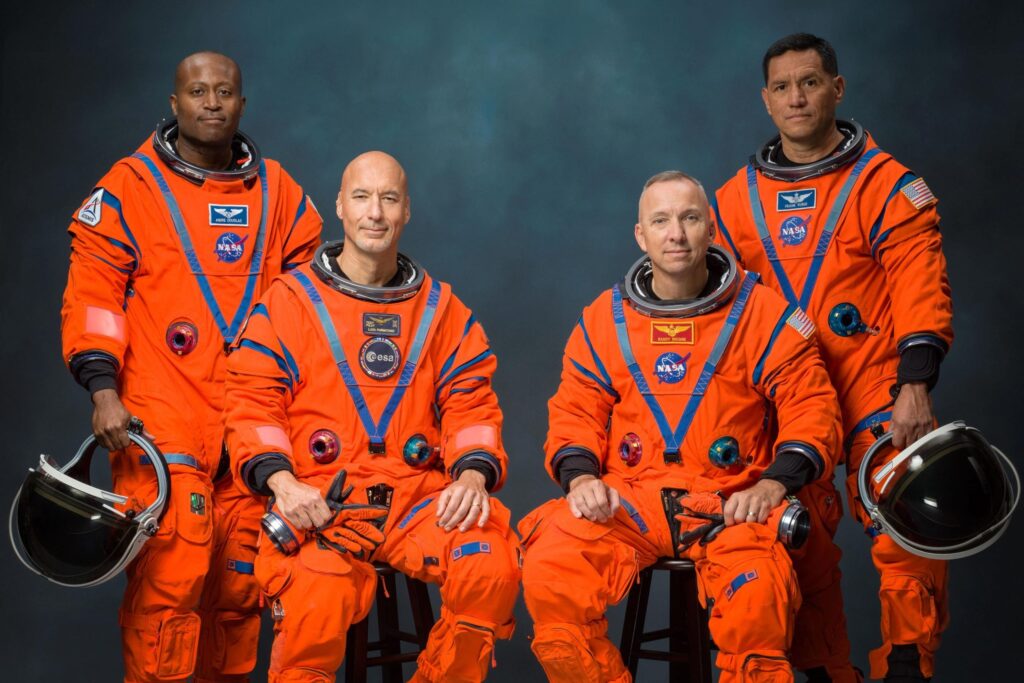
 The Artemis III crew poses for an official portrait (from left: Andre Douglas, Luca Parmitano, Randy Bresnik, Frank Rubio). Credit: NASA/Bill Stafford
NASA’s newly announced Artemis III crew is preparing for one of the most complex space missions ever attempted on the road back to the Moon.
NASA has unveiled the crew for Artemis III and shared new details about what could become one of the most challenging human spaceflight missions ever attempted. Scheduled for 2027, the mission will carry out a series of demanding tests in Earth orbit that are considered crucial for Artemis IV, the first planned crewed expedition to the Moon’s South Pole in 2028.
Artemis III will launch aboard NASA’s SLS (Space Launch System) rocket from Kennedy Space Center in Florida, carrying astronauts in the Orion spacecraft to low Earth orbit. Once Orion completes initial system checks, it will perform its first rendezvous and docking demonstrations with test versions of commercial lunar landers being developed by Blue Origin and SpaceX.
The mission will involve multiple launches of some of the most powerful rockets ever built and will test how Orion works with the lunar landers. Engineers will evaluate software, communications, propulsion systems, and other critical hardware needed for future Moon missions.
The Artemis III crew consists of:
NASA astronaut Randy Bresnik, commanderESA (European Space Agency) astronaut Luca Parmitano, pilotNASA astronaut Andre Douglas, mission specialistNASA astronaut Frank Rubio, mission specialist
NASA astronaut Bob Hines has been assigned as the backup crew member. The astronauts will immediately begin training on Orion systems while also helping support development and operational planning for the Blue Origin and SpaceX test landers.
“Today we take another bold step in humanity’s return to the Moon, building on the extraordinary foundation laid by the Artemis II astronauts,” said NASA Administrator Jared Isaacman. “Their achievements reignited global excitement for exploration, and now they pass the torch to the Artemis III team, Randy, Luca, Frank, and Andre. Artemis III will demonstrate the power of American innovation and international partnership as we test complex rendezvous and docking operations and advance the technologies that will one day carry us deeper into the solar system. This mission will require the most awe-inspiring coordination of heavy-lift rocket launches in history, drawing on the talent and capability of teams across government and the spaceflight community. The Artemis III astronauts, alongside ESA and our international partners, and the tens of thousands of the best and brightest across the agency and industry, are ushering in a new Golden Age of exploration carrying forward the hopes and dreams of the next generation just as the Apollo astronauts did for so many of us.”
First ESA Astronaut Assigned to Artemis
The announcement marks the first time an ESA astronaut has been assigned to an Artemis mission.
“Artemis III will push the boundaries of spacecraft operations in orbit. Luca’s assignment as pilot reflects the depth of European expertise in human spaceflight and draws on his extensive operational experience in high-pressure situations,” said Josef Aschbacher, ESA’s director general. “At the same time, ESA’s European Service Module will once again provide the critical capabilities that power Orion, demonstrating Europe’s enduring role at the very heart of the Artemis program. The news out of Houston today is a powerful recognition of ESA’s role in enabling humanity’s return to the Moon – and a key advancement in our partnership with NASA. Europeans can take pride in being part of this exciting journey.”
Artemis III Hardware and Mission Preparations
NASA and its partners continue to make steady progress toward the 2027 flight.
This summer, engineers plan to join Orion’s crew module and service module and install the spacecraft’s docking system, which will fly for the first time. Testing of the heat shield is also ongoing, with individual heat shield blocks undergoing ultrasonic inspections and installation.
Work on the SLS rocket is advancing as well. Teams are integrating the engine section with the rest of the core stage before installing four RS-25 engines later this summer. All solid rocket booster segments have arrived at Kennedy Space Center, and upgrades to the mobile launcher remain on schedule. Rocket stacking is expected to begin this summer. NASA is also designing and building a spacer that will replace the upper stage for Artemis III.
Blue Origin is developing a crewed lunar version of its Blue Moon lander, while SpaceX is building a crewed lunar variant of Starship. Both companies are producing test vehicles for Artemis III. NASA continues to work closely with both providers throughout design, development, testing, and evaluation while sharing expertise gained from previous missions.
During the announcement event, NASA and its commercial partners also discussed planned Artemis III operations. Agency officials said the mission will help increase flight frequency, expand production capabilities, and strengthen the supply chain supporting the Artemis program.
Testing the Future of Lunar Exploration
Artemis III builds on the successful Artemis II mission completed in April and will help prepare NASA for future human missions to Mars.
The mission will feature a carefully timed sequence of launches. First, Blue Origin’s lander pathfinder, designed to remain in orbit for weeks, will launch and wait for the crew. Orion will then carry the astronauts into Earth orbit aboard SLS. The spacecraft will rendezvous with the Blue Origin test lander and remain docked for approximately two days while crews conduct demonstrations, tests, and evaluations, including entering the lander itself.
After separating from the Blue Origin vehicle, Orion will wait for the arrival of SpaceX’s Starship pathfinder. Once Starship reaches orbit, it will rendezvous and dock with Orion for about a day of inspections, testing, and systems verification.
Following completion of both docking campaigns, Orion and its crew will depart orbit and return to Earth. The spacecraft is expected to splash down in the Pacific Ocean, where recovery teams from NASA and the U.S. Navy will retrieve the astronauts.
The mission is currently expected to last about two weeks, although the final duration will depend on launch timing and the success of rendezvous and docking operations.
Meet the Artemis III Astronauts
This will be Randy Bresnik’s third journey into space. He first flew aboard space shuttle Atlantis on the STS-129 mission to the International Space Station in 2009. Later, he launched aboard Soyuz MS-05 from Kazakhstan and served as a flight engineer for Expedition 52 before commanding Expedition 53. A California native and graduate of The Citadel with a mathematics degree, Bresnik was selected by NASA in 2004. The retired U.S. Marine colonel has accumulated more than 7,000 flight hours in 95 aircraft types and currently helps oversee development and testing of Artemis spacecraft and systems.
Luca Parmitano also will make his third spaceflight. Selected by ESA in 2009, he first traveled to the International Space Station aboard Soyuz in 2013 as part of the Italian Space Agency’s (ASI) first long-duration station mission. He returned in 2019 aboard Soyuz MS-13 and served as commander of Expedition 61, becoming both the first Italian and the third European to command the station. Parmitano earned degrees in political science and experimental flight test engineering and has logged more than 2,000 hours across 40 aircraft types.
Frank Rubio will make his second trip to space. He launched to the International Space Station aboard Soyuz MS-22 in September 2022 and returned in September 2023 after spending 371 days in orbit, setting a record for the longest single spaceflight by an American astronaut. Selected by NASA in 2017, Rubio is a physician, aviator, and longtime U.S. Army officer.
Artemis III will be Andre Douglas’ first mission to space. Chosen by NASA in 2021, he previously served as a backup and closeout crew member for Artemis II. Douglas earned a mechanical engineering degree from the U.S. Coast Guard Academy along with four postgraduate degrees, including a doctorate in systems engineering from George Washington University. His background includes Coast Guard operations and advanced work on autonomous vehicles and space systems at the Johns Hopkins University Applied Physics Laboratory.
Backup astronaut Bob Hines will train alongside the primary crew and could step into the mission if needed. Hines previously served as pilot of NASA’s SpaceX Crew-4 mission to the International Space Station. Selected by NASA in 2017, he is a U.S. Air Force colonel with more than 27 years of experience as a fighter pilot, instructor pilot, and test pilot.
Building Toward the Moon and Mars
Through the Artemis program, NASA plans to send astronauts on increasingly ambitious missions that will expand exploration of the Moon, support scientific research, create economic opportunities, and establish a lasting human presence on the lunar surface. The knowledge gained from these missions is also expected to help pave the way for the first crewed journeys to Mars.
Never miss a breakthrough: Join the SciTechDaily newsletter.
Follow us on Google and Google News.