
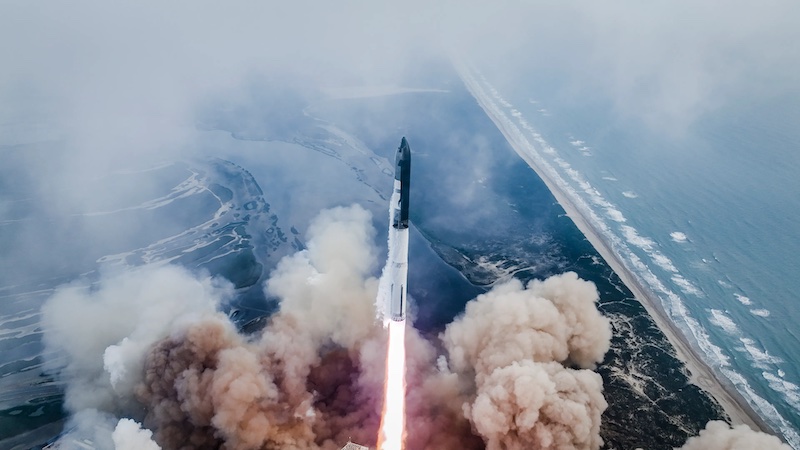
Friday, SpaceX broke the record for history’s most valuable IPO. Surpassing Saudi Aramco’s 2019 public listing, the company raised $75 billion and is now valued at around $2.1 trillion. Investors were drawn to SpaceX’s dominance in rocket launches, satellite internet (via Starlink), and emerging space infrastructure. Yet its long-term significance has less to do with stock pricing than with what the company represents. Ever since extraterrestrial voyage became possible during the Space Age, outer space has been viewed primarily as a government frontier—a domain of geopolitical and military strategy. SpaceX and a growing ecosystem of other companies is transforming that frontier into something different: an arena for commerce, transportation, communications—and profit.
The scale of this emerging “space economy” is already remarkable. SpaceX is the industry’s flagship company, but Blue Origin is also developing reusable launch vehicles and lunar infrastructure. Rocket Lab specializes in satellite deployment. Planet Labs runs satellite fleets that photograph the earth. Meanwhile, companies that aren’t directly tied to the space economy still utilize it, such as John Deere, which uses satellites to guide its farming equipment. Commercial ventures now include broadband internet, weather forecasting, navigation services, cargo transportation, telecommunications and space tourism. Annual orbital launch traffic volume has gone from the dozens during the government-funded era into the hundreds, with thousands of satellites being deployed. Entire investment funds and ETFs have emerged to grant exposure to this sprawling industry.
This marks a dramatic departure from the historical role of space. The modern Space Age began amid the tensions of the Cold War. When the Soviet Union launched Sputnik 1 in 1957, the event shocked the United States not because of its commercial implications but because it demonstrated advanced rocket technology with clear military applications. The subsequent race to the Moon was fundamentally a contest between rival political systems. Even after the Cold War ended, space remained heavily dominated by governments, with China, the European Union, and others joining the competition. The largest spenders of direct space expansion were national agencies and defense departments, with launch vehicles developed primarily through public funding. For decades, the assumption was that space was too expensive and strategically important to be left to private enterprise. While the government R&D component has not disappeared—often agencies contract with the aforementioned companies – the frontiers of the industry are in fact being driven by private enterprise.
The projected growth of the space economy is much debated—in fact, the valuation spikes on day one for SpaceX (which is viewed as an industry proxy), are a testament to this, given that the stock spiked over 30% from its opening price before dipping back down at closing. Yet, even the more conservative forecasts are enormous. A widely cited study by McKinsey & Company projects that the global space economy could nearly triple from $630 billion in 2023 to $1.8 trillion by 2035 (this figure seems laughable now, given that SpaceX’s market cap already exceeds it). As the authors conclude, “the true impact of space technologies will extend far beyond the realm of space itself,” instead creating infrastructure improvements to countless earth-based businesses.
Still, one of the most intriguing questions is how far humanity’s expansion can go into space itself. Proposals have been advanced for establishing permanent settlements on the Moon, mainly as a means of ensuring humanity’s survival should Earth ever face large-scale disaster. And SpaceX founder Elon Musk has repeatedly argued that humanity should become a multi-planet species and has made the colonization of Mars a long-term company goal.
The largest challenge in this transition will be the same one that confronted national land boundaries and maritime commerce: determining ownership and rights of access. Unlike those territories, which have been carved out by centuries of war, treaties and laws, outer space remains governed by a relatively sparse legal framework created before large-scale commercial activity was imaginable. The cornerstone is the United Nation’s Outer Space Treaty of 1967, which prohibits nations from claiming sovereignty over the Moon, planets, or other celestial bodies. Yet it says little about private ownership.
More recently, countries including the United States, Luxembourg and Japan have passed laws recognizing private rights to resources extracted from space, much as fishermen can own the fish they catch on the seas without owning the ocean itself. Meanwhile, orbital right of way is largely managed through international coordination of radio frequencies by the International Telecommunication Union, while launch licensing and collision-avoidance is administered in a fairly decentralized manner by national governments. As thousands of satellites, space stations, lunar missions, and eventually resource-extraction enters the market, policymakers will face pressure to create more robust regulations. Whether that leads to clear property rights frameworks or galaxy-level regulatory capture remains to be seen.
There is certainly a role for governments in establishing basic rules and international cooperation. Yet there is also a strong argument for restraint. Much of the appeal of outer space lies in its frontier status—as a place where entrepreneurs, investors, and abnormally brave tourists can experiment. The absence of a comprehensive governing framework has not deterred investment—if anything it may have attracted it. Like the American West or the early days of the Internet, the relative openness of space has encouraged risk-taking and bold visions, with SpaceX being today’s big example.

About Scott Beyer
Scott Beyer is a Columnist Fellow at Independent Institute. He is the founder and CEO of the Market Urbanism Report and host of the Market Urbanism Podcast.