
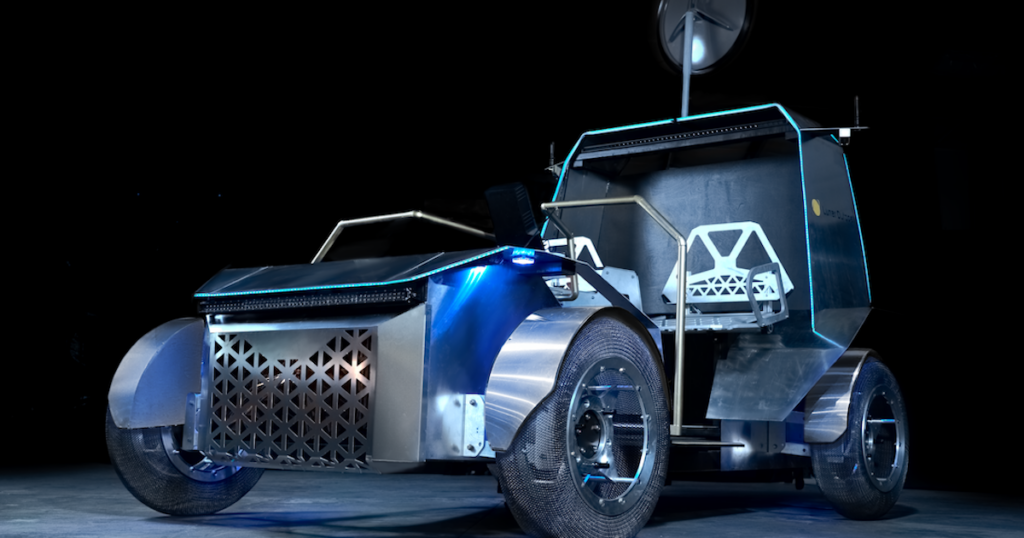
NASA is racing to build a permanent settlement near the lunar south pole. The space agency claims its Moon base will cover “hundreds of square miles,” meaning mobility will be key. Enter Pegasus, one of two Lunar Terrain Vehicles (LTVs) chosen by NASA to fly to the Moon with the first Artemis astronauts.
Built by Lunar Outpost, Pegasus will navigate the harsh, jagged terrain of the lunar south pole autonomously, with an astronaut behind the wheel, or via teleoperation commands beamed from Earth.
In an interview with New Atlas, AJ Gemer, co-founder and CTO of Lunar Outpost, said Pegasus will “extend the range and duration of human activity on the lunar surface in a way that wasn’t possible during Apollo.”
It will achieve this by leveraging a state-of-the-art autonomous thermal management system, allowing it to withstand the Moon’s wild swings in temperature.
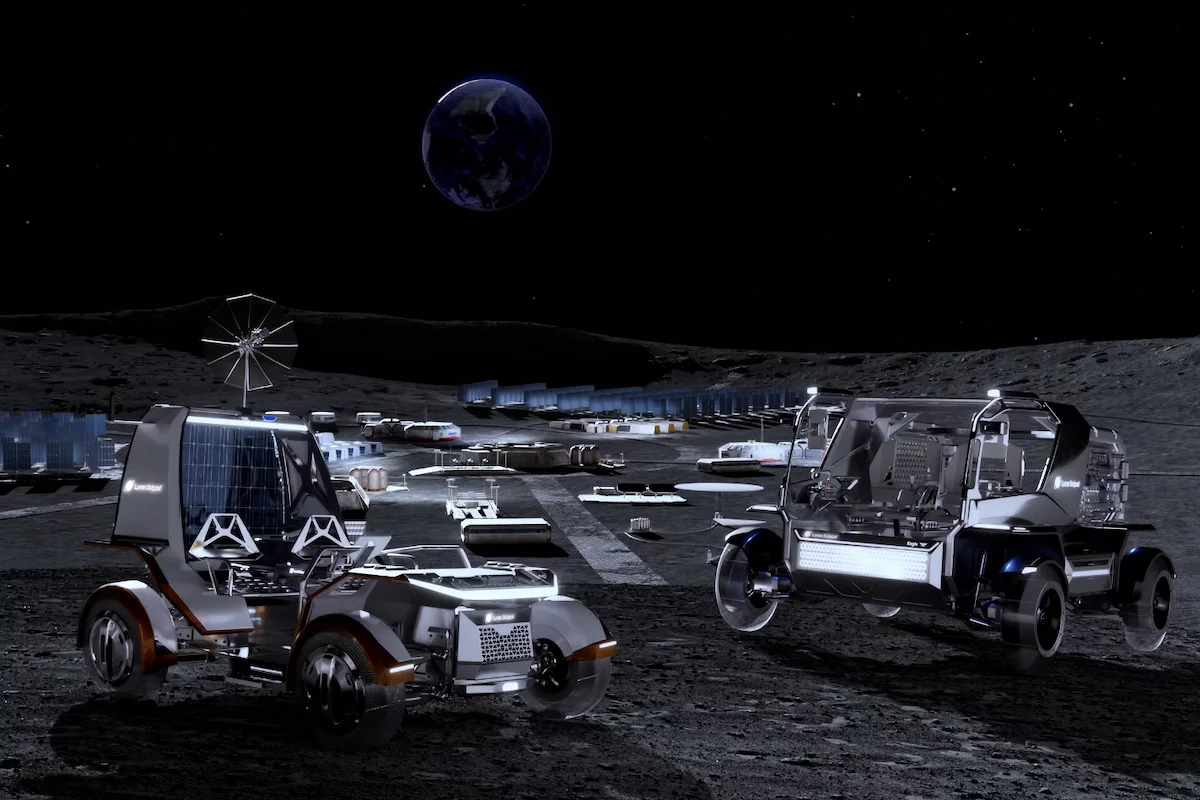
An artist’s render of the Pegasus (left) and Eagle (right) LTVs on the lunar surface
Lunar Outpost
On May 26, NASA announced a High Achievability Mission task order under its Lunar Terrain Vehicle Services (LTVS) contract. The space agency awarded Astrolab US$219 million and Lunar Outpost $220 million to develop their Crewed Lunar Rover and Lunar Outpost Pegasus rovers, respectively.
To accelerate NASA’s crewed landing timeline, both firms were tasked with building simplified lunar rovers. They were to deliver them sooner and at a lower cost. In Lunar Outpost’s case, it based Pegasus on its larger Eagle LTV.
NASA’s revised plan forced Lunar Outpost to move quickly. The company leveraged digital twin technology to iterate upon its existing designs and make a more compact lunar rover.
“When NASA adjusted the LTV requirements significantly and compressed the timeline, our team did what they do best and rose to the challenge in a very short window,” Gemer recalled. “This included developing high-fidelity digital twins and multiphysics simulations, building two full-scale Pegasus prototypes, and performing two rounds of human-in-the-loop testing. That ensured we could meet [NASA’s] new mass, volume, and performance constraints within schedule.”
Pegasus is a “sporty,” smaller version of the Eagle LTV, itself informed by GM’s Hummer EV. Lunar Outpost is building the buggy in partnership with GM, Goodyear, and Leidos.
“Building any vehicle for the lunar surface is an extreme engineering challenge, regardless of scale,” Gemer emphasized. “What made it possible to move quickly is that we weren’t starting from zero.”
Instead, Pegasus builds on years of “flight heritage across our Explorer-class rover missions, prior mission operations, and extensive autonomy and mobility testing,” he continued. “That foundation allowed us to rapidly adapt to NASA’s updated LTV requirements.”
The result far surpasses the Apollo-era Lunar Roving Vehicle (LRV). According to Lunar Outpost, Pegasus and Eagle can operate for at least a year and traverse 100x the distance of the Apollo LRVs, which drove a combined total of 56.2 miles (90.4 km) across three missions – Apollo 15, 16, and 17.
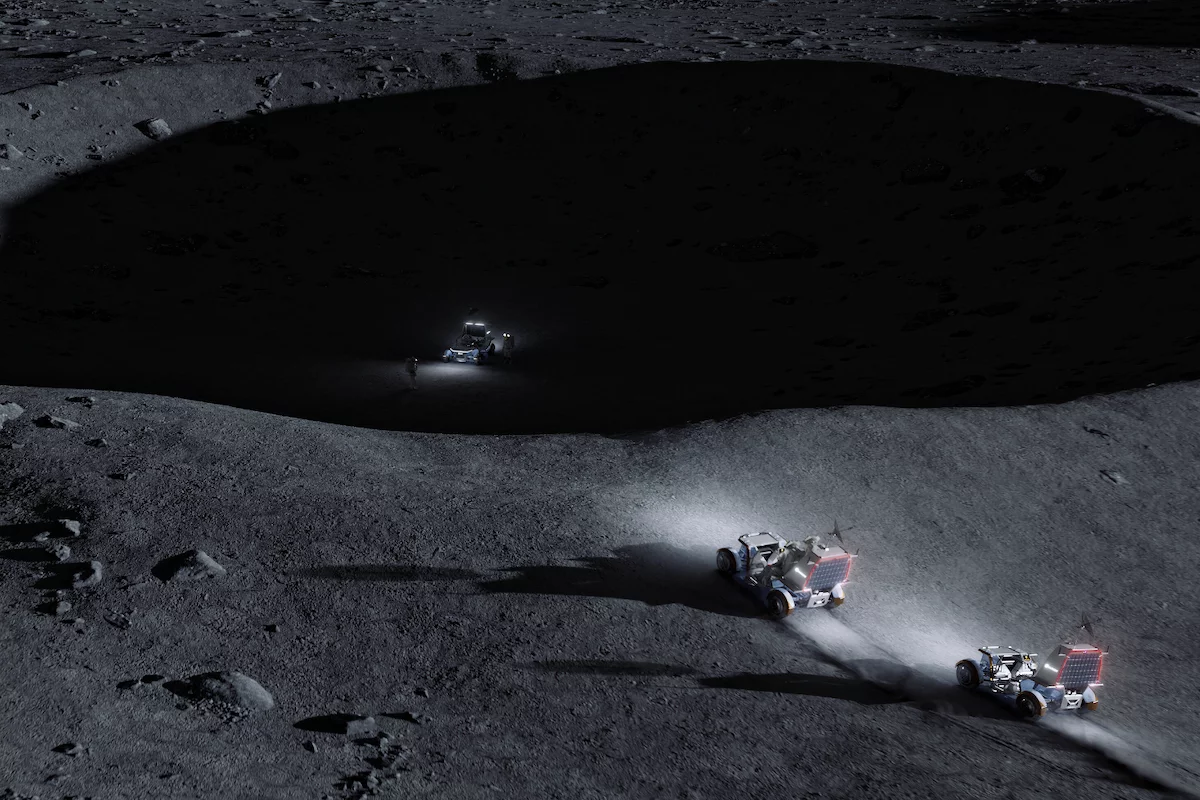
Pegasus expeditions will drive Artemis astronauts into freezing, shadowed craters
Lunar Outpost
A key aspect of NASA’s requirements is that the rovers must also be able to withstand the harshest environments possible. This includes driving through freezing, permanently shadowed craters to search for lunar water ice. The world’s leading space powers have their sights set on the lunar south pole due to the abundance of water ice stored in these craters. However, the logistics of harvesting water from these craters is a key challenge.
NASA’s Lunar Reconnaissance Orbiter has measured temperatures lower than -410 °F (-246 °C) within these craters. Surface temperatures can also go as high as 250° F (121 °C).
As Gemer points out, the lunar south pole “presents some of the most extreme operating conditions in the Solar System.”
To manage these contrasting temperatures, Pegasus’ thermal management system will operate autonomously at all times – even when the buggy is driven by an astronaut.
“Pegasus was designed from the ground up for that environment, leveraging Lunar Outpost’s Autonomous Thermal Control Systems and extensive portfolio of thermal control technologies,” Gemer explained.
NASA needs Lunar Outpost to deliver a fully flight-qualified Pegasus rover by November 2027. Barring more delays, Blue Origin’s Blue Moon Mark 1 lander will then deliver it to the lunar south pole.
Gemer is looking forward to a successful mission. According to the Lunar Outpost CTO, mission success would be instrumental in shifting “lunar exploration from short-duration exploration toward the sustained operations required to establish a permanent American Moon Base.”
The stakes are incredibly high. The first LTVs may determine whether NASA can secure water ice and establish a lasting foothold on the Moon. If successful, they would help lay the groundwork for humanity’s expansion deeper into the Solar System.
Source: Lunar Outpost