
This story was originally published by BridgeMichigan, a nonprofit and nonpartisan news organization. Sign up for a free BridgeMichigan newsletter here.
By Paula Gardner, Bridge Michigan
When the U.S. recently sent its first crewed rocket mission into space in 50 years, Michigan-made products went along for the ride.
Blades and nozzles in the four engines of the Artemis II rocket came from Moeller Aerospace in Harbor Springs, a state supplier to NASA contractors. Elmet Technologies in Lewiston tooled more equipment. And NASA used solar particle forecasts from the University of Michigan.
All told, at least 78 Michigan-based entities contributed to the mission, said Mark Ignash, director of strategic initiatives at Michigan’s Office of Defense and Aerospace Innovation. That includes two companies in Madison Heights — Harcourt Industries, Inc., and Thermal Wave Imaging, Inc. — that have contributed to NASA’s Artemis program.
“These are companies we don’t realize that we’ve got in our backyard,” Ignash told Bridge Michigan.
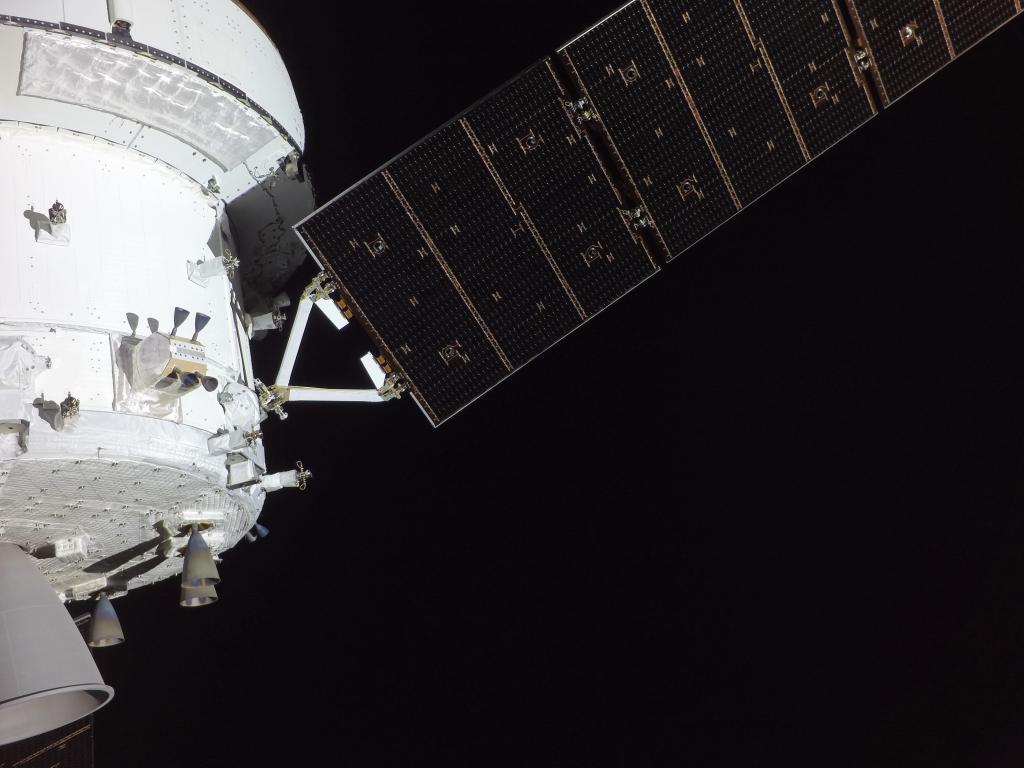
 In this image provided by NASA, Artemis II Pilot Victor Glover is photographed in the Orion spacecraft during the Artemis II lunar flyby on Monday, April 6, 2026. (NASA via AP)
Ignash is looking to change that by creating a space sector to grow business in Michigan.
He and other officials say the nation’s growing space economy — serving telecommunications, navigation and even agriculture, along with celestial research — is a bold new frontier for economic development.
“We are in the second space race, commercially and in defense, and people just don’t realize that yet,” Ignash said.
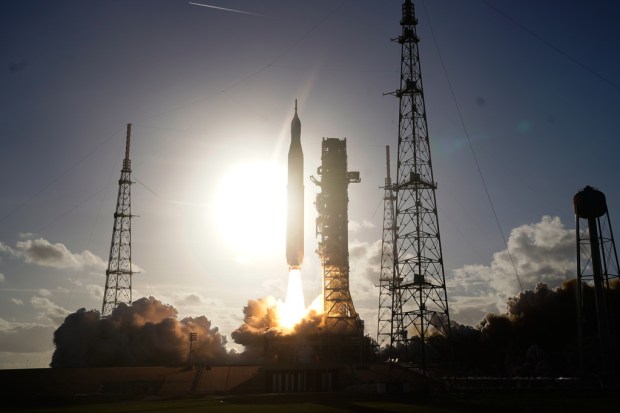 The NASA Artemis II SLS (Space Launch System) rocket with the Orion spacecraft launches at the Kennedy Space Center, Wednesday, April 1, 2026, in Cape Canaveral, Fla. (AP Photo/John Raoux)
The Michigan Economic Development Corp. is seeking proposals to establish the state’s first Space Innovation Hub. With up to $1.2 million budgeted for the first year, the hub is an early step towards connecting and growing the space-centered business in the state.
Space offers a rich opportunity for the state, given the research, engineering and industrial expertise needed to make it work, Ignash said.
Nationally, space-related spending — such as satellites and rockets — is projected to grow to $1.8 trillion by 2035, up from about $630 billion in 2023, according to the World Economic Forum.
Space is one part of the strategic plan to spur defense and aerospace development announced in February by Gov. Gretchen Whitmer.
“From our skilled workforce and world-class universities to our robust supply chains, advanced testing environments, and manufacturing infrastructure, Michigan has unique capabilities and assets,” Whitmer said in introducing the plan.
The other pillars of the state plan, aviation and unmanned systems, or drones, are more familiar to the average person and within business circles, Ignash said.
But increased commercialization of space is a game-changer today, he added.
“We’ve not seen this kind of space activity since the 1960s,” Ignash said.
Back then, Michigan had a big role in development, including from the missile lab near Willow Run Airport to research and manufacturing ties to the Apollo spacecraft.
Research is still taking place across several universities, and Michigan manufacturers still produce space-related parts and technology — including Houghton’s Orbion, which was just purchased for its electric propulsion systems. In Madison Heights, Harcourt provides heavy0duty industrial tooling hardware used in assembling the massive components of the Artemis flight systems, and Thermal Wave Imaging uses thermal sensors and imaging to inspect rocket components for hidden cracks, gaps and structural defects without damaging hardware.
By creating a space hub, the state envisions a physical location but other connections, such as data sharing, that can reach across both peninsulas.
Collaboration around space-related endeavors is already increasing, with a state networking group growing from a dozen participants to 150 this year. Specialty areas include space research, remote sensing and digital engineering.
Another area for potential growth is in-space assembly and manufacturing, known as ISAM. This is the work — done by humans or robots — performed after a launch that keeps equipment usable for later projects.
Not on the list of expected opportunities: rocket launch sites, such as the one touted in a $2.5 million study announced in 2019 that prompted an ongoing criminal investigation four years later. However, a test site could be considered, according to a 2025 plan.
The state will be evaluating bidders for the space hub after the June 1 deadline.
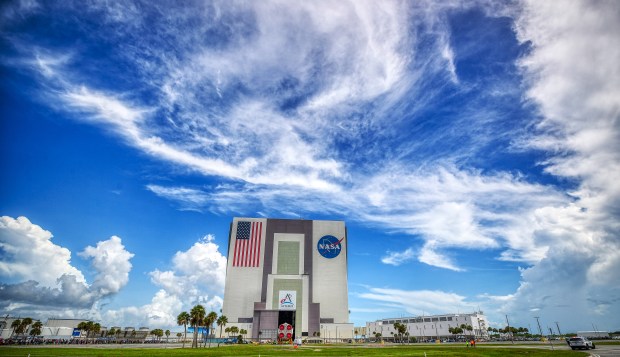 The Core Stage for NASA’s Space Launch System rocket is moved from the Pegasus barge to the Vehicle Assembly Building, on Tuesday, July 23, 2024.
(Ricardo Ramirez Buxeda/ Orlando Sentinel)
Over the coming years, Ignash said, he hopes that today’s momentum turns into Michigan receiving more federal funding through NASA and other programs.
“We’re not creating a sector here,” Ignash said. “We are really just putting some wind behind the sails and saying, if we all unify in a single direction, we can probably do a lot more.”