
The nature of time has long puzzled scientists, and now one researcher at the University of Birmingham has constructed a mini-universe in a laboratory to get to the bottom of this and other fundamental questions about gravity and quantum mechanics.
Revealed in a recent paper published in Physical Review Research, Professor Giovanni Barontini created a universe in a sealed quantum system to answer the lingering questions of “what is time?” with a laboratory model. His work creates an intriguing new testbed for exploring the nature of our universe from beginning to end, and all the phenomena in between.
Creating a Universe
Physicists have long puzzled over how a sequence of events could be understood in a universe without an external clock. The new work demonstrates how to move purely theoretical work into a practical laboratory environment, allowing exploration of deep questions about time and quantum physics.
In the new paper, Professor Barontini describes creating a miniature universe from 24,000 atoms held at just several degrees above absolute zero. Such temperatures are essential to many quantum explorations, including quantum computing technologies.
In this quantum system, the hermetically sealed cloud of ultracold atoms acts like a miniature universe. A thin barrier divides this tiny universe in half, while two lasers set to different frequencies bombarded it to create an observed bright region and an unobserved dark region.
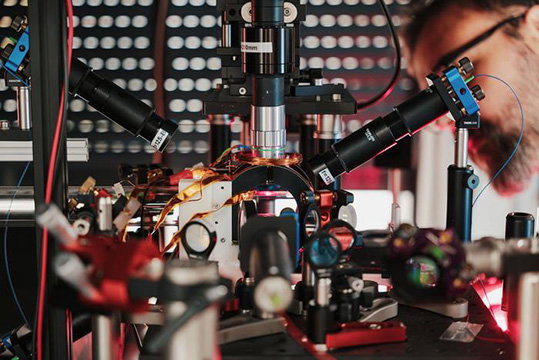 For his research, Professor Barontini created simulations of a “miniature universe” from 24,000 atoms held at just several degrees above absolute zero (Image Credit: University of Birmingham).
Internal Time
Crucial to the experiment, Barontini did not measure time externally but instead waited for the internal relationship between the particles to generate time within this new universe. This idea comes from theoretical physics concepts such as the Wheeler-DeWitt equation, which posits that the universe exists in an ever-steady quantum state exhibiting both wave- and particle-like behavior, without an external time.
Barontini observed the bright side behaving similarly to our universe, albeit on “fast-forward,” repeating a cycle of Big Bangs and Big Crunches, continually expanding and collapsing back in on itself. Since the sequence of events could be reconstructed entirely within the quantum system without reference to a laboratory clock, this shows that time emerges from the system itself, created by the disorder of spreading atoms, rather than being an external function.
Investigating Quantum Time
Time moved forward in a single direction, with the increase or decrease in particles in the bright sector as they moved into the dark sector and back again, indicating an arrow of time. Yet, when the atomic distribution remained steady, Barontini observed a halt in time, leading him to describe what he witnessed as “entropic time.”
While this version of time corrects the order of events, it is not steady; it varies with the system’s entropy level. Notably, Schrödinger’s equation, the linchpin of quantum theory, still works in entropic time.
“In some theories of the universe, especially quantum gravity, time doesn’t appear as a built‑in feature,” Barontini said. “Yet in everyday life, time flows from past to future – why is this so, when most basic laws of physics work the same way forwards and backwards?”

“This study provides the first controlled experimental evidence that ‘time’ can be defined by changes within a system rather than as the external ‘ticking clock’ we think of as time,” Barontini concluded. “It offers new insight into the nature of time in quantum gravity that could be used to describe dynamics just as effectively as conventional time.”
Moving forward, such artificial universes could be used to probe the mysteries of our own universe, including its earliest moments, the emergence of time, and even black holes.
The paper, “Testing the Problem of Time with Cold Atoms,” appeared in Physical Review Research on June 11, 2026.
Ryan Whalen covers science and technology for The Debrief. He holds an MA in History and a Master of Library and Information Science with a certificate in Data Science. He can be contacted at ryan@thedebrief.org, and follow him on Twitter @mdntwvlf.