
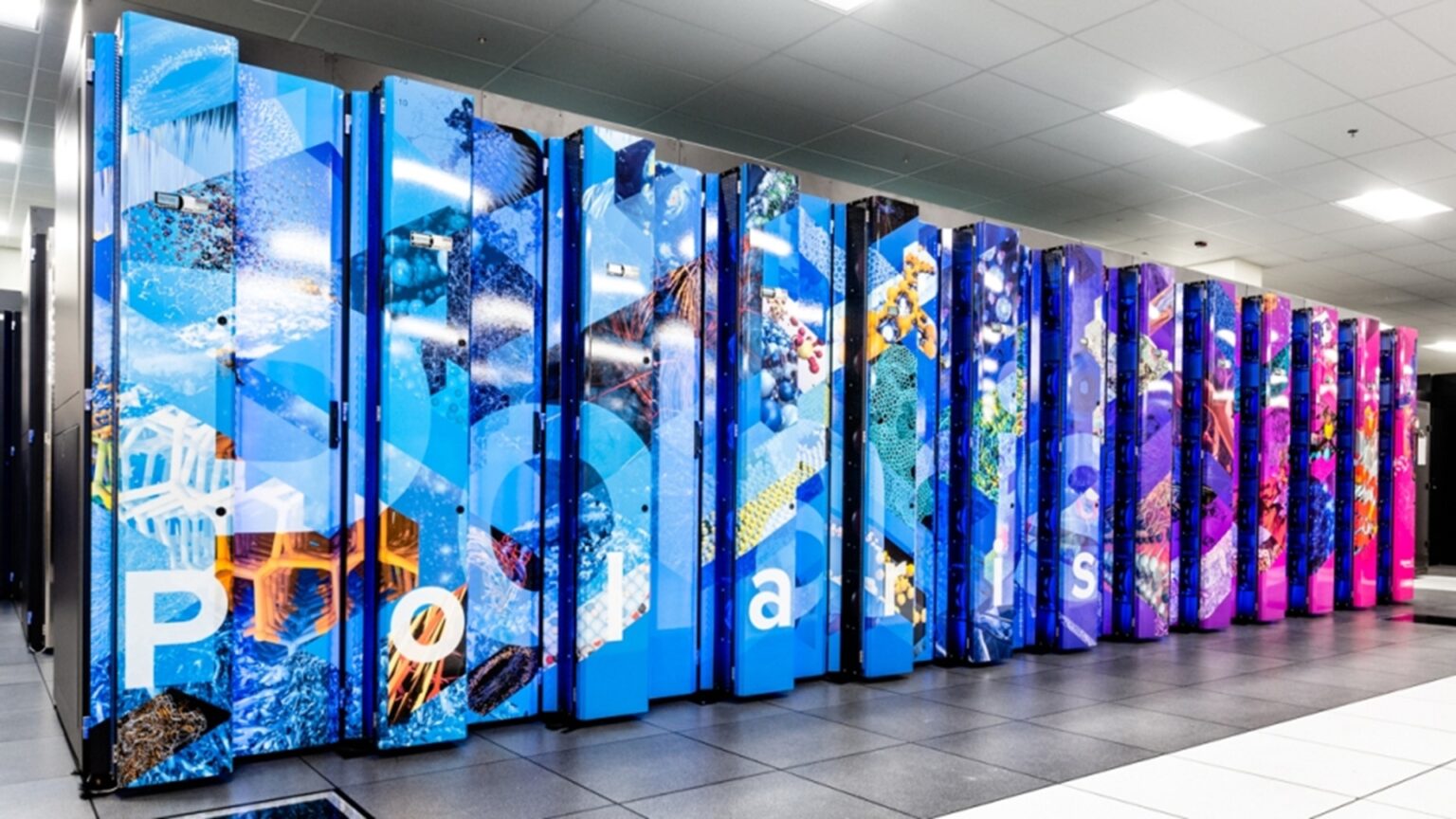
Scientists in the US have utilized the Polaris supercomputer to generate the most detailed three-dimensional (3D) images of the pion, the lightest particle made of quarks.
The study, which helped reveal the internal structure of a pion in unprecedented detail, was conducted by a research team at the US Department of Energy’s (DOE) Argonne National Laboratory (ANL).
Pions are subatomic particles that play a significant role in holding atomic nuclei together. “Pions mediate the strong force that binds nucleons, that is, the protons and neutrons that account for an atom’s mass,” Yong Zhao, PHD, an ANL physicist and principal investigator of the project, said.
According to the Zhao and the team, the findings reveal not only how quarks are arranged within the particle, but also offer new clues on how visible matter forms from fundamental particles. The latter is considered one of the biggest mysteries in physics.
Mapping the pion
Pions are among the lightest and simplest subatomic particles. They are governed by the strong force, which binds protons and neutrons together inside the atomic nuclei. This force accounts for 98 percent of the mass of the visible universe.
They’re also composed of a quark and an antiquark. Yet, despite their importance, scientists have struggled to examine their internal structure because experimental data remains limited. To overcome this challenge, ANL and Brookhaven National Laboratory researchers turned to large-scale computer simulations.
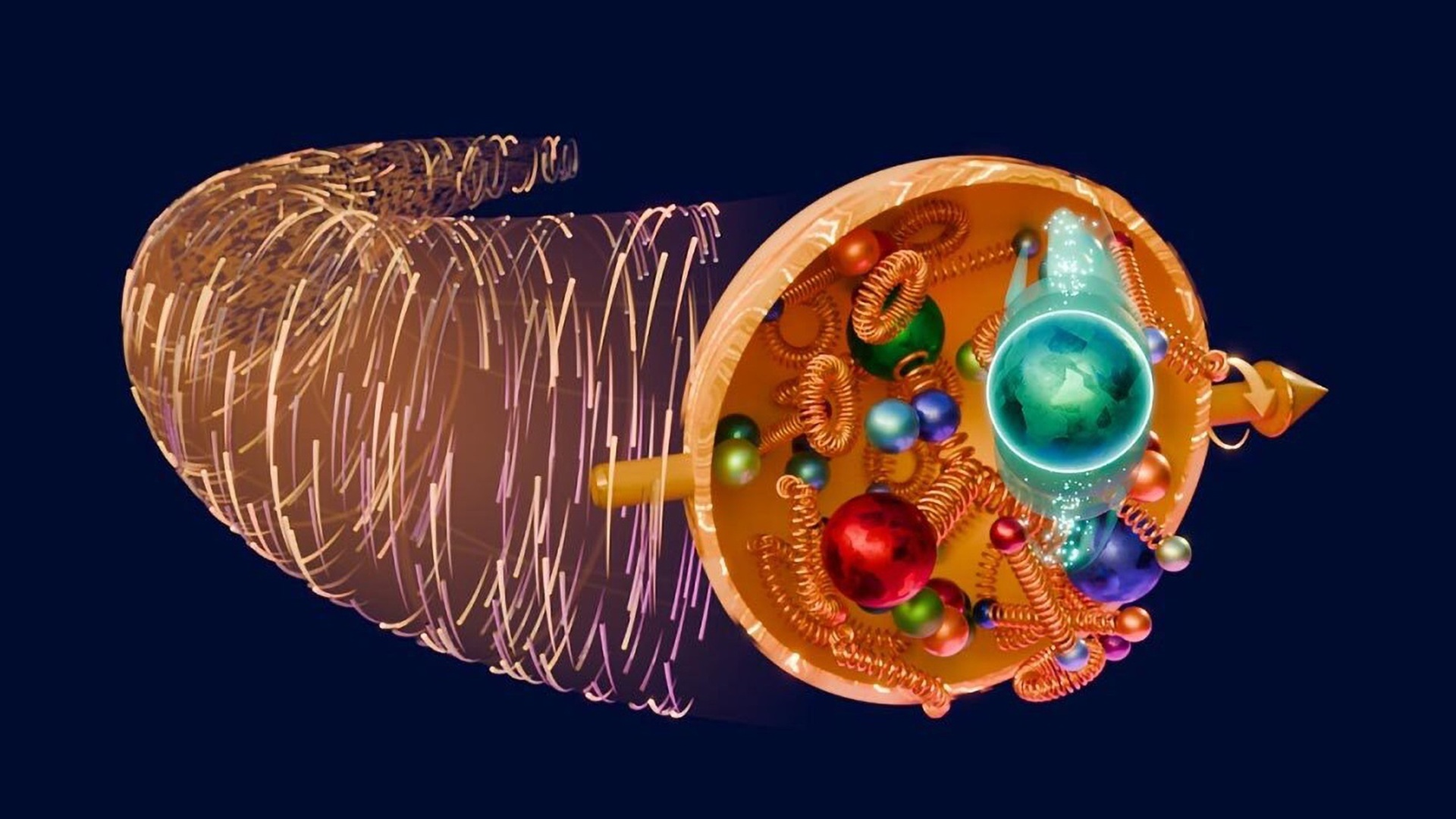 Graphic showing the transverse motion of a quark (green sphere) inside a proton whose spin is aligned with its direction of motion (large yellow arrow).
Credit: Valerie Lentz / Brookhaven National Laboratory.
The team combined advanced theoretical models with the computing power of Polaris. This reportedly recreated the pion’s internal structure in remarkable detail.
Zhao pointed out that examining the pion’s multidimensional structure provides a deeper insight into the particle’s fundamental properties. “By probing the pion’s internal structure, we gain a deeper understanding of how quarks and gluons are confined to create visible matter,” he said.
The simulations generated high-resolution 3D images that showed how quarks are distributed throughout the particle. Understanding this structure is essential for explaining how quarks and gluons combine to create the visible matter that makes up the universe.
A new perspective
For the project, the group simulated hundreds of snapshots of four-dimensional (4D) spacetime with lattice quantum chromodynamics. This is a technique that places particles and fields on a vast computational grid.
“This is a task possible only with large-scale parallel computing power like that of ALCF supercomputers,” Zhao said in a statement. “We thereby obtained high-resolution images of the quark structure in a moving pion.” The images showed how quarks carrying different fractions of the pion’s momentum are distributed across the particle.
The team modeled how quarks move both along the pion’s direction of motion and across it. The simulations relied on lattices with millions of grid points. “The simulation captures hundreds of snapshots of our 4D spacetime, represented on a lattice with millions of grid points,” Zhao added.
The calculations revealed the quark generalized parton distribution (GPD) of the pion. This is a mathematical framework that describes how quarks are distributed in both momentum and space. The resulting maps provided a detailed 3D picture of the particle.
As per Zhao, one notable finding was that the pion’s transverse size decreases as its momentum increases. The team also found that the pion appears smaller than the proton at moderate momentum values.
“Our next step is to use the ALCF’s Aurora supercomputer to map the proton in three dimensions,” Zhao concluded. “Protons, together with neutrons, make up all the atomic nuclei that compose the visible matter in our universe.”
The study has been published in the Journal of High Energy Physics.