
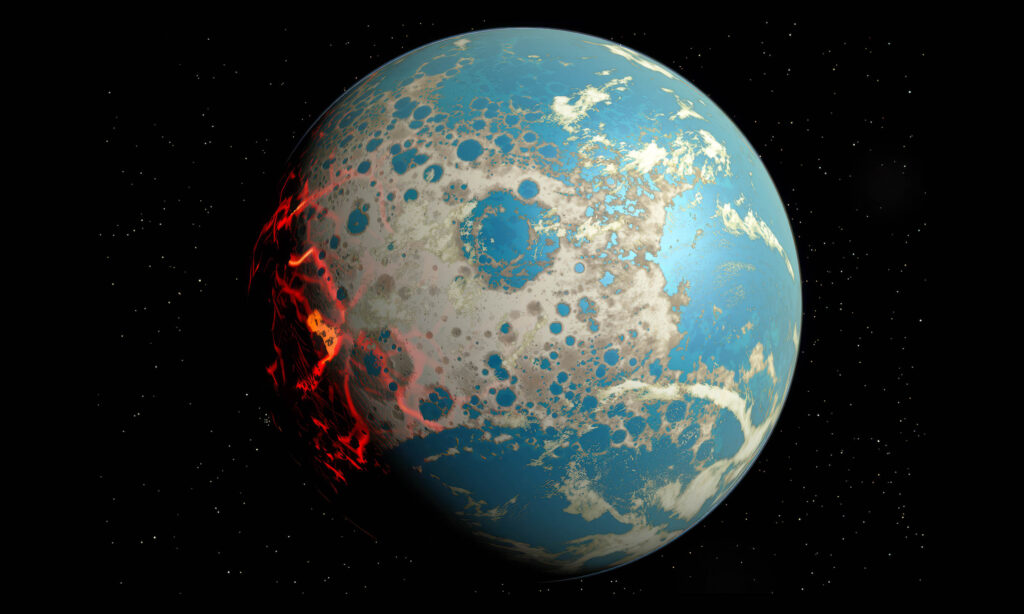
Asteroid strikes carry a grim reputation. The rock that struck near the Yucatán about 66 million years ago helped kill off the dinosaurs, and that catastrophe is what most people think of when a giant collision comes up.
Go back far enough, though, and the opposite seems true. On the newborn Earth, the same kind of violence that ends worlds may have done something far stranger and helped life get its start.
When asteroids ruled the skies

Earth came together about 4.5 billion years ago, and the stretch that followed was anything but calm.
During its first few hundred million years, the early Earth took a relentless beating from the leftover rock and metal still swarming the young solar system.
Almost none of that ancient crust survives today, so most of what we know comes from the Moon’s cratered face.
Planetary scientist Amanda Alexander of the Southwest Research Institute (SwRI) and her colleagues set out to model what all those asteroid impacts did to the ground itself.
They were not gentle landings. A large strike shattered enormous volumes of rock and vaporized part of the surface, throwing molten material across the landscape and leaving the crust fractured for miles below.
That kind of pounding continued throughout the planet’s first 2.5 billion years.
A fractured young planet
All that breaking left the rock riddled with fractures and open pore space. Shock waves from each collision splintered the solid crust, and that damage allowed water to work its way down into rock that had once been sealed tight.
Geologists call rock that lets fluid pass through it permeable. The team wanted to know exactly how much of the young crust impacts opened up this way and how deep the damage reached.
Earlier work had already shown that individual craters could fracture the ground beneath them.
What no one had done was add it all up and measure how permeable the entire upper crust became during an era of constant bombardment.
Heat, water, and possibility
Each asteroid impact also poured tremendous heat into the ground. Added to the warmth already rising from Earth’s interior, that heat would have driven hot fluids through the shattered rock. It was exactly the kind of setting where prebiotic chemistry, the reactions that lead up to life, could get underway.
These are hydrothermal systems, underground networks of hot, circulating water much like the plumbing beneath the geysers of Yellowstone National Park.
By the team’s calculations, one large impact could drive up to 100 times the hydrothermal activity Yellowstone produces today.
The idea that impacts fed hot-water systems is not new, and one study of a giant ancient crater found that its plumbing likely operated for hundreds of thousands of years.
“While often considered catastrophic in the context of dinosaur extinction, impact bombardment was also likely critical for creating environments for prebiotic chemistry,” said Alexander.
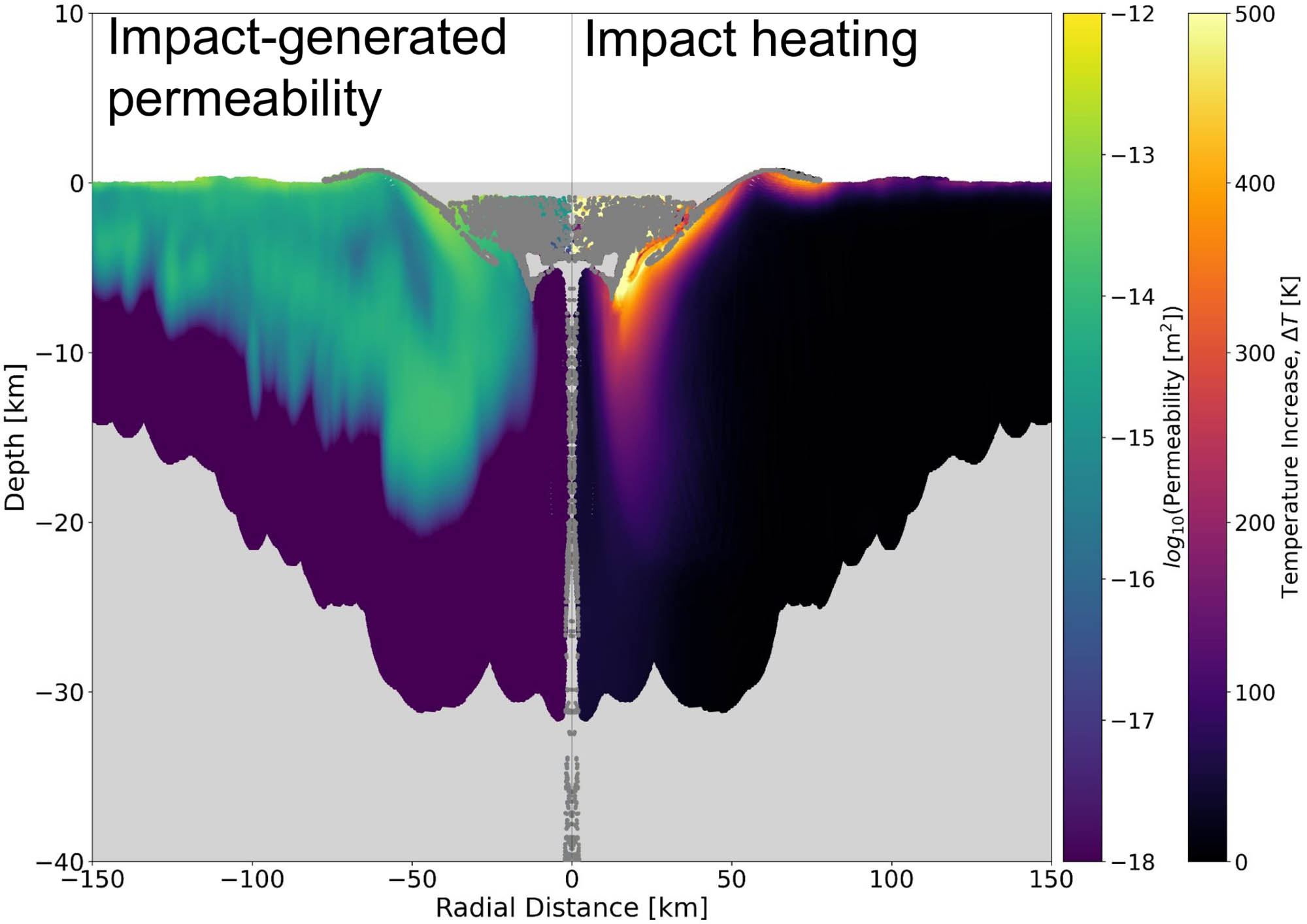 Scientists modeled the early impact history of Earth, seeking insight into potential origins of life. Based on the models, a 6-mile (10-kilometer) asteroid striking the early Earth at 9 miles per second (15 km/second) creates a crater with impact-generated permeability (left) and heat profiles (right) that could create hydrothermal conditions capable of supporting the evolution of life. Credit: SwRI. Click image to enlarge.Simulating Earth’s earliest asteroid impacts
To pin down real numbers, the researchers ran a large batch of simulations on a physics program built to track how hard rock shatters under a violent blow. Then they sent virtual asteroids slamming into the surface. Every size, every speed.
Each run varied the conditions that would have differed across the young planet.
The team changed how thick the crust was, how warm it grew with depth, and what it was built from, since the early surface was mostly basalt, a dark volcanic rock.
Some runs covered the rock with a 3-mile-deep ocean; others left it dry. For every case, they measured how much crust each impact turned permeable, then followed how fluid would move through it.
Tracking impact damage over time
One impact tells you only so much. To capture the full picture, the team folded in a model of how often impacts struck over time, stacking the effects of strike after strike across hundreds of millions of years.
How much crust a single asteroid impact opened up depended mostly on its energy, so larger and faster impactors did more damage.
How permeable that broken rock became, however, depended on the crust’s temperature and composition.
Taken together, the models suggest the upper 5 miles (8 kilometers) of Earth’s crust were highly permeable around 4.3 billion years ago.
A substantial portion of that fluid-friendly rock likely remained open until roughly 3.5 billion years ago.
A world rich in habitats
Hot, watery cracks in the rock are exactly the kind of environments that attract origin-of-life researchers. Many think life first took hold in settings like these, where mineral-rich water meets sharp differences in temperature and chemistry.
Such environments offer a steady supply of energy and a constant flow of dissolved minerals. A long line of research has placed them near the top of the list of candidate birthplaces for the first living things.
And they may not have been rare. If asteroid impacts opened up the upper crust the way these models suggest, the young planet was studded with such sites rather than dotted with only an occasional crater.
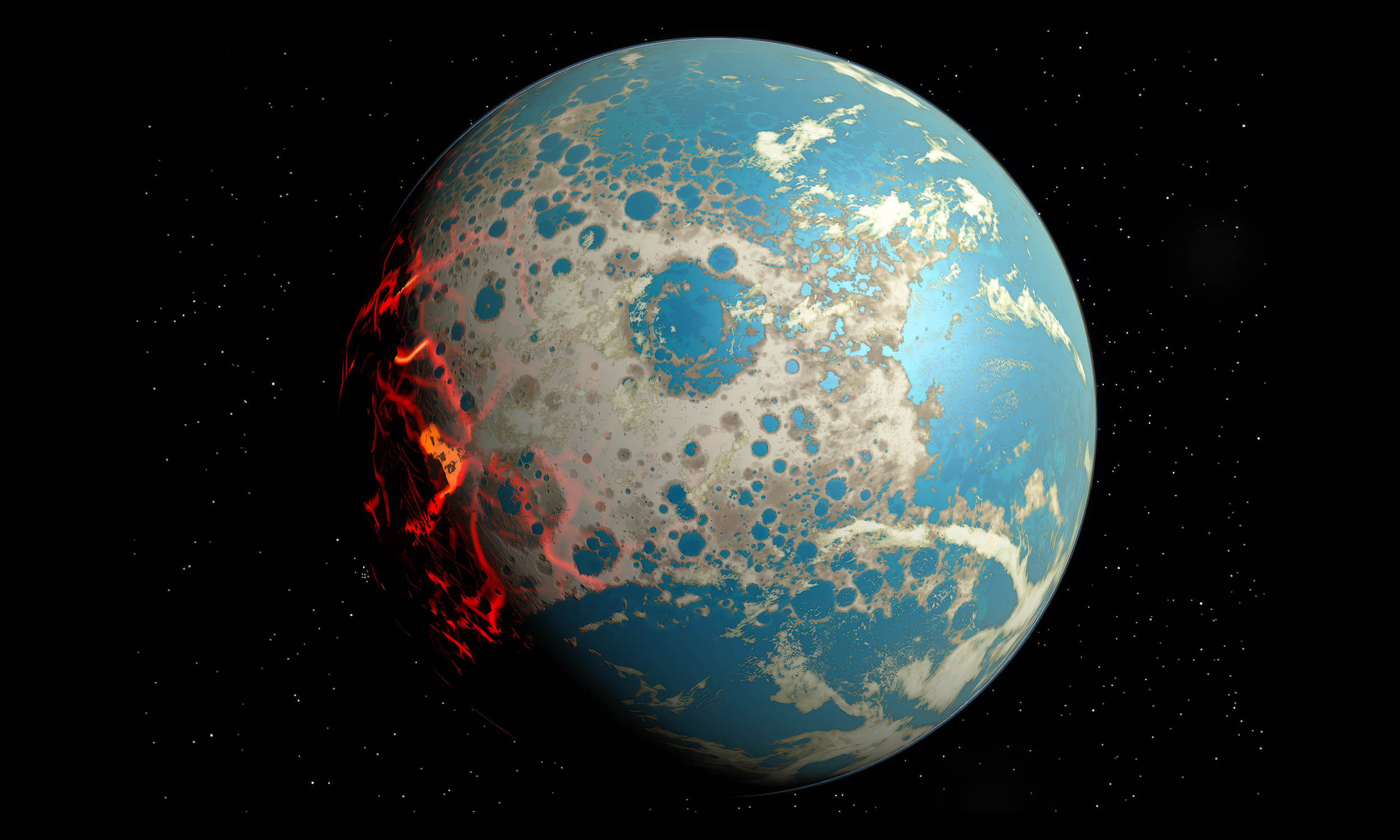 SwRI Institute Scientist Dr. Simone Marchi created this artistic rendering of early Earth, which shows a surface pummeled by large impacts, creating hydrothermal conditions that could support the evolution of life. Credit: SwRI. Click image to enlarge.Expanding the search for life
Before this work, the link between hot water and life’s origins rested mostly on studies of individual craters and broader theoretical arguments.
This study puts hard numbers on the idea for the first time, estimating how much of the early crust impacts made permeable and how long that permeability lasted.
That gives origin-of-life scientists a much firmer target. They can now treat the early crust as a planet-wide network of hydrothermal habitats and ask which of them contained the right ingredients, rather than focusing on one crater at a time.
There is a broader implication as well. The same bombardment that scarred Mars and the Moon also hammered the early Earth.
If these models are correct, the conditions they describe may have appeared on other young worlds as well. That possibility broadens the search for places where life may have begun.
The study is published in the journal AGU Advances.
—–
Like what you read? Subscribe to our newsletter for engaging articles, exclusive content, and the latest updates.
Check us out on EarthSnap, a free app brought to you by Eric Ralls and Earth.com.
—–