
The expansion of the Universe is not slowing down. An international team of astrophysicists has refuted last year’s “sensational” study, which claimed the opposite. Two Nobel laureates have confirmed that dark energy continues to accelerate the expansion of the Universe.
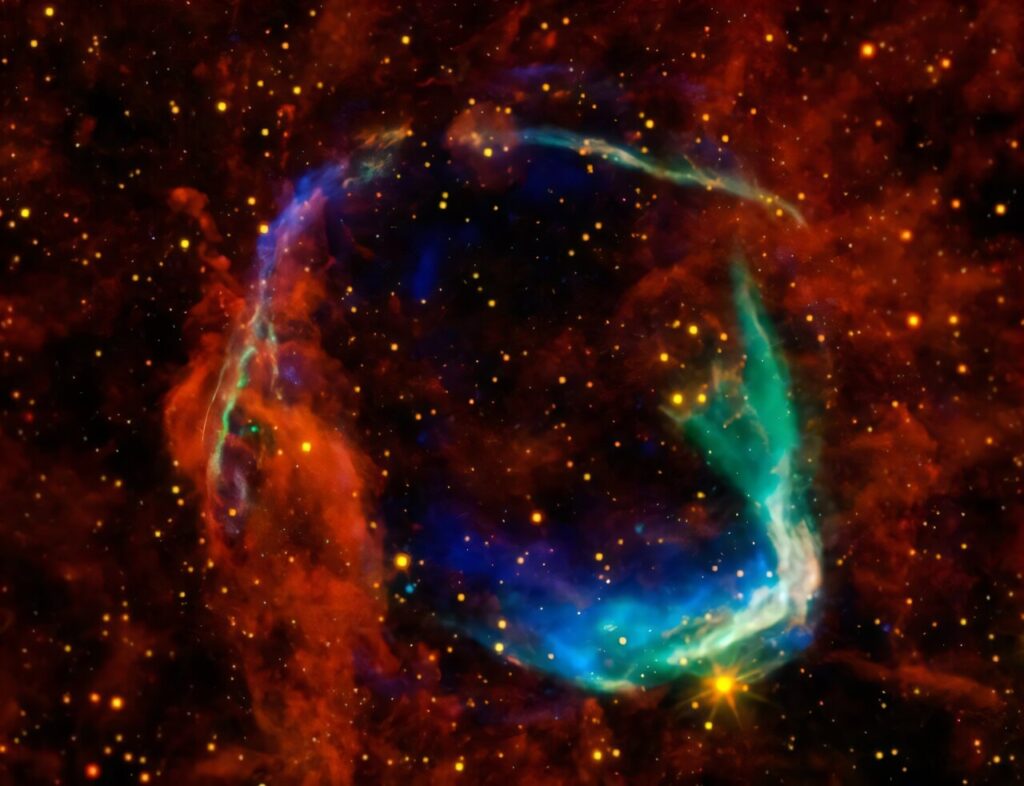
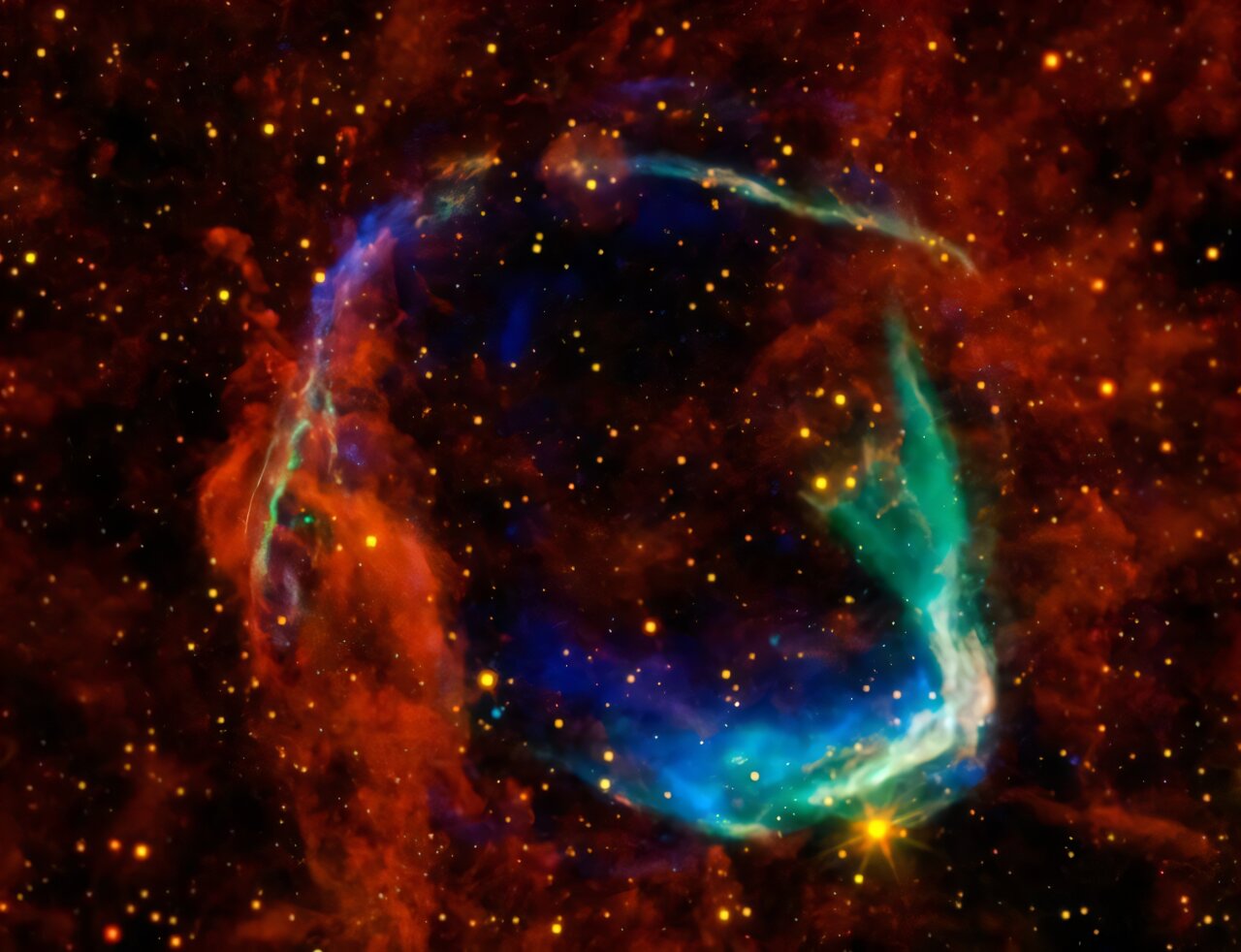 A multi-wavelength image of the remnants of supernova RCW 86, the oldest documented example of a supernova. The image combines data from four space telescopes. Credit: X-ray: NASA/CXC/SAO & ESA; Infrared: NASA/JPL-Caltech/B. Williams (NCSU)
What the previous study found
Last year, a group of South Korean researchers published a paper in which they claimed that the expansion of the universe may be entering a phase of deceleration. In their view, dark energy is a mysterious force that acts as an anti-gravity and weakens over time.
To reach this conclusion, the researchers analyzed Type Ia supernovae. These are powerful explosions of white dwarfs that astronomers use as standard candles to measure distances in the universe. The South Korean team claimed that these supernovae change their peak brightness with age, and this allegedly misled astronomers.
Where was the mistake?
A team led by Phil Wiseman, a researcher at the University of Southampton, identified a specific error in that study. The South Korean authors mistakenly equated the age of the galaxy with the age of the exploding star, even though these are entirely different quantities.
Furthermore, that study did not account for the mass of the galaxy in which the explosion occurred, a standard correction that modern cosmology uses to improve the accuracy of measurements. When the new team took both of these factors into account, the evidence supporting the acceleration of the universe remained unchanged.
Nobel laureates
Professors Adam Riess and Brian Schmidt, who shared the 2011 Nobel Prize in Physics with Saul Perlmutter, have joined the new study. This trio was responsible for studying Type Ia supernovae and determining that distant objects are moving faster than closer ones. This became the basis for the conclusion that the expansion of the universe is accelerating.
Adam Riess noted that extraordinary claims require particularly careful scrutiny. According to him, when supernovae are calibrated to account for different environments and stellar populations, the evidence supporting cosmic acceleration remains robust.
What does this mean for science?
Phil Wiseman concluded that the previous measurements were accurate and that our current understanding of the fate of the universe remains sound. The results were published in the journal Monthly Notices of the Royal Astronomical Society.
The mystery of dark energy hasn’t gone away. Now scientists can focus not on whether it exists at all, but on the much deeper question of its nature.
According to phys.org