
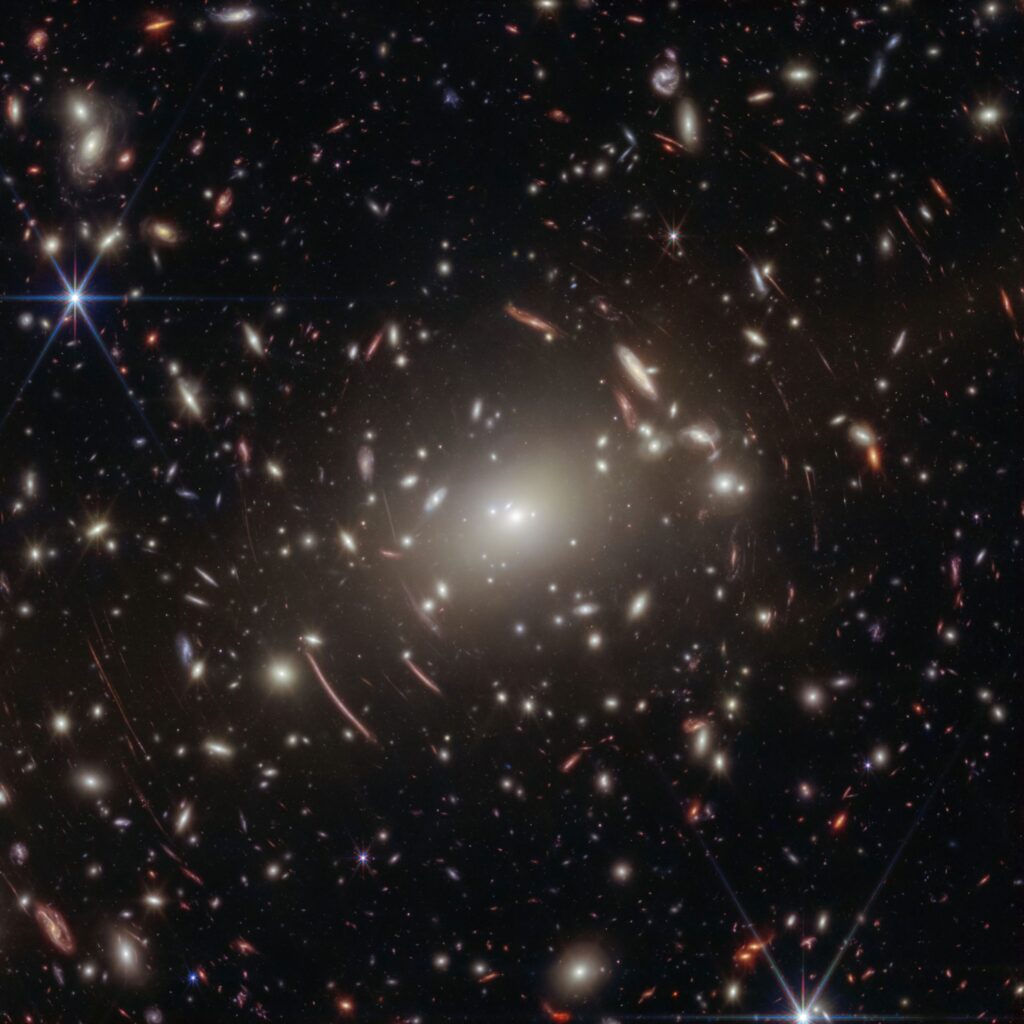
Since its launch, the James Webb Space Telescope has continued to challenge our understanding of the cosmos. In 2022, shortly after beginning its scientific observations, it detected a mysterious anomaly in the early universe—numerous objects that have been tentatively named “little red dots.” They appeared approximately 600 million years after the Big Bang. For a long time, astronomers puzzled over their nature, and only now is this complex cosmic puzzle beginning to take shape.
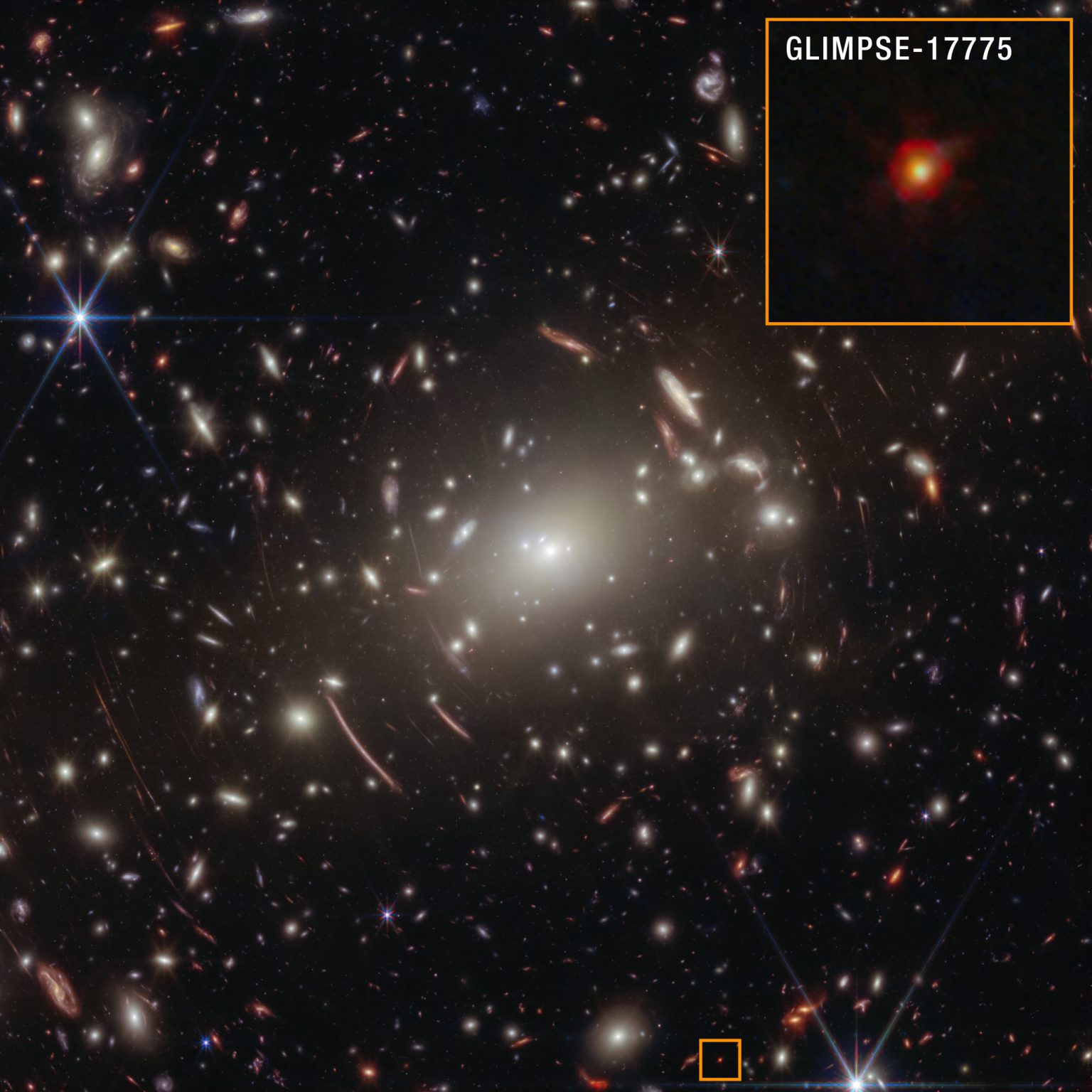 Although the primary goal of the James Webb Space Telescope’s observations of the Abell S1063 galaxy cluster was to search for a specific group of stars, scientists obtained a detailed spectrum of the object GLIMPSE-17775 from the dataset. This little red dot is located behind the Abell S1063 cluster. Image: NASA, ESA, CSA
A team of astronomers from the University of Texas at Austin has identified a unique “dot” known as GLIMPSE-17775. Thanks to the James Webb Space Telescope’s unprecedented infrared sensitivity, the scientists obtained the deepest and most detailed spectrum of a source of this kind. An article presenting the results of this work was recently published in the prestigious journal The Astrophysical Journal.
The object GLIMPSE-17775 has a cosmological redshift of z ≈ 3.5, meaning it existed 1.8 billion years after the Big Bang. Its study was made possible by an incredible coincidence: the object is located far behind the massive galaxy cluster Abell S1063. This cluster acted as a giant gravitational lens.
Iron forest in a gas cocoon
More than 40 distinct emission lines were detected in the spectral data. All of them strongly point to the so-called BH* (black hole star) scenario: GLIMPSE-17775 is a rapidly growing supermassive black hole that is actively accreting surrounding matter. Its central accretion disk is tightly enveloped by a thick layer of partially ionized gas. It is this gaseous cocoon that processes the radiation from the black hole, creating the features that scientists have observed.
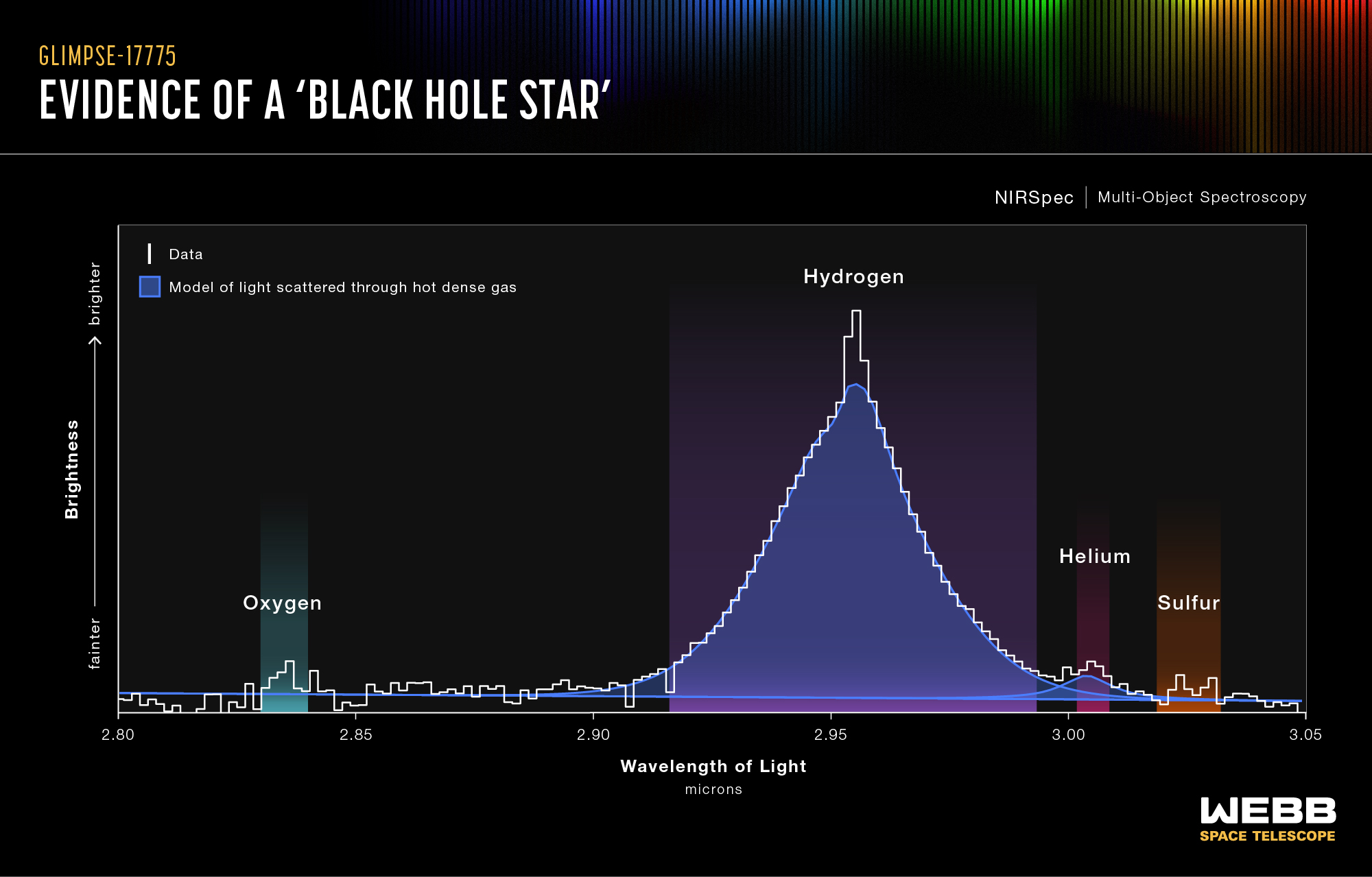 The James Webb Space Telescope has captured the deepest spectrum to date of a little red dot. The data revealed more than 40 spectral lines, many of which independently support the theory that GLIMPSE-17775 is a black hole shrouded in a cocoon of hot, dense gas. Image credit: NASA, ESA, CSA
Several indisputable facts support this model. First, the hydrogen, oxygen, and helium lines exhibit the electron scattering effect—a sure sign of a gaseous medium expanding around a dense source. Second, scientists observed the “iron forest”—an intense set of 16 iron lines. Their formation requires a source of immense energy, a characteristic unique to active black holes. Furthermore, this model perfectly explains why the red dots emit almost no X-rays: the dense cocoon simply blocks and absorbs these rays.
Hubble comes to the rescue
However, one piece of the puzzle required closer examination, as not all the pieces fit together. The fact is that the GLIMPSE-17775 spectrum showed a very faint “Balmer break”—a specific dip in the emitted light that is a hallmark of most red dots. The team brought in additional archival data from the Hubble Space Telescope (from the Frontier Fields and BUFFALO programs) to investigate this.
Data from both telescopes showed that this particular black hole is located within a massive host galaxy. The excess blue light from the stars in this giant galaxy effectively masks the Balmer break, which is in excellent agreement with the general gas model.
This discovery is of fundamental importance to modern astrophysics. When the James Webb Space Telescope first detected these bright objects, some in the scientific community panicked, claiming that they “violate cosmology.” After all, galaxies in the early universe could not physically have formed quickly enough to generate that much starlight. However, a new study sets the record straight: the source of this incredible glow is not stars, but black holes, and their masses are entirely consistent with the established history of the universe’s evolution.
Researchers hope that in the coming years, new data will finally settle the question of the nature of these remarkable cosmic beacons.
We previously discussed how primordial black holes might have replaced stars.
According to NASA