
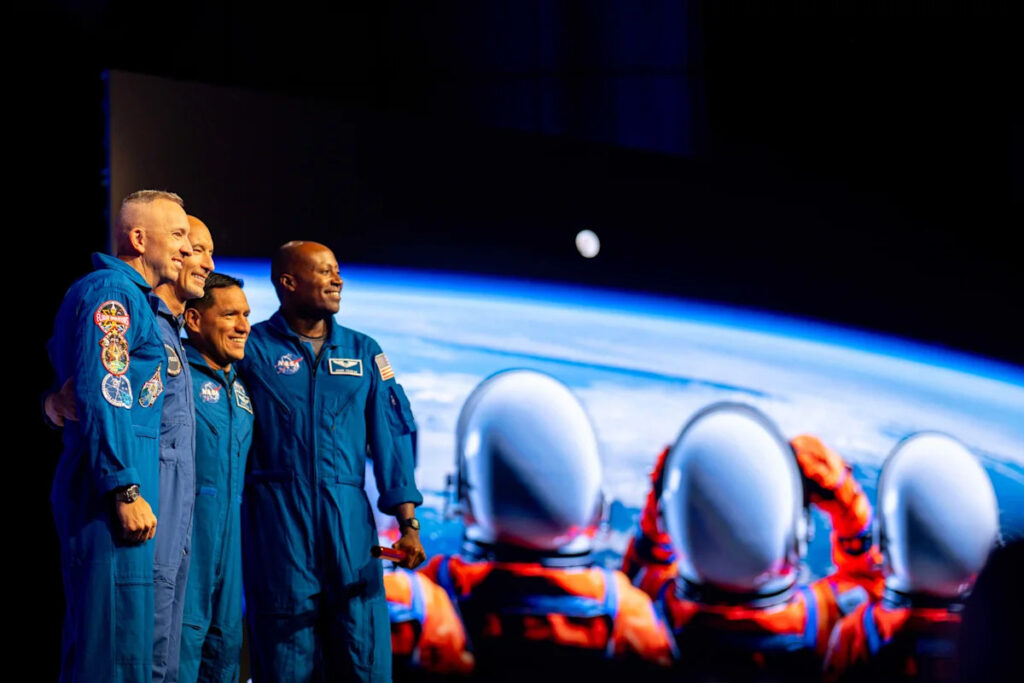
When NASA announced the crew for its Artemis III mission this week, one detail stood out beyond the astronauts’ impressive resumes—all three Americans on board have ties to the South.
Joining the entirely male crew are NASA astronauts Randy Bresnik, Frank Rubio, and Andre Douglas, alongside European Space Agency astronaut Luca Parmitano. While Parmitano brings international representation to the mission, the three Americans all call the South home.
The four-person crew will help carry out one of the most ambitious spaceflight tests in recent history. Scheduled for 2027, Artemis III will launch aboard NASA’s Orion spacecraft and perform a series of complex rendezvous and docking demonstrations in Earth orbit with lunar landers being developed by Blue Origin and SpaceX, per a release from NASA.
Mission Commander Randy “Komrade” Bresnik was born in Kentucky and attended the The Citadel, in Charleston, South Carolina, commissioning as a Second Lieutenant in the U.S. Marine Corps in May 1989. A veteran of Space Shuttle mission STS-129 and former commander of the International Space Station, Bresnik has logged more than 32 hours of spacewalk time across five EVAs, over 7,000 flight hours in 95 aircraft types, and 3,600 hours in spacecraft.
Mission Specialist Dr. Frank Rubio is a Florida native who graduated from the U.S. Military Academy before serving more than 28 years in the U.S. Army as both an aviator and physician, including completing his medical residency at Fort Benning, Georgia. Selected by NASA in 2017, Rubio later set the U.S. record for the longest single spaceflight after spending 371 consecutive days aboard the International Space Station.
Mission Specialist Andre Douglas is a Virginia native who earned a bachelor’s degree from the U.S. Coast Guard Academy and later obtained a doctorate in systems engineering from George Washington University in Washington, D.C. Before joining NASA’s 2021 astronaut class, Douglas served in the U.S. Coast Guard and worked on cutting-edge robotics and space exploration projects at Johns Hopkins University’s Applied Physics Laboratory.
The mission is designed to pave the way for Artemis IV, NASA’s planned return of astronauts to the lunar surface in 2028.
“Today we take another bold step in humanity’s return to the Moon, building on the extraordinary foundation laid by the Artemis II astronauts,” NASA Administrator Jared Isaacman stated in a written release. “Their achievements reignited global excitement for exploration, and now they pass the torch to the Artemis III team, Randy, Luca, Frank, and Andre.”
Read the original article on Southern Living