
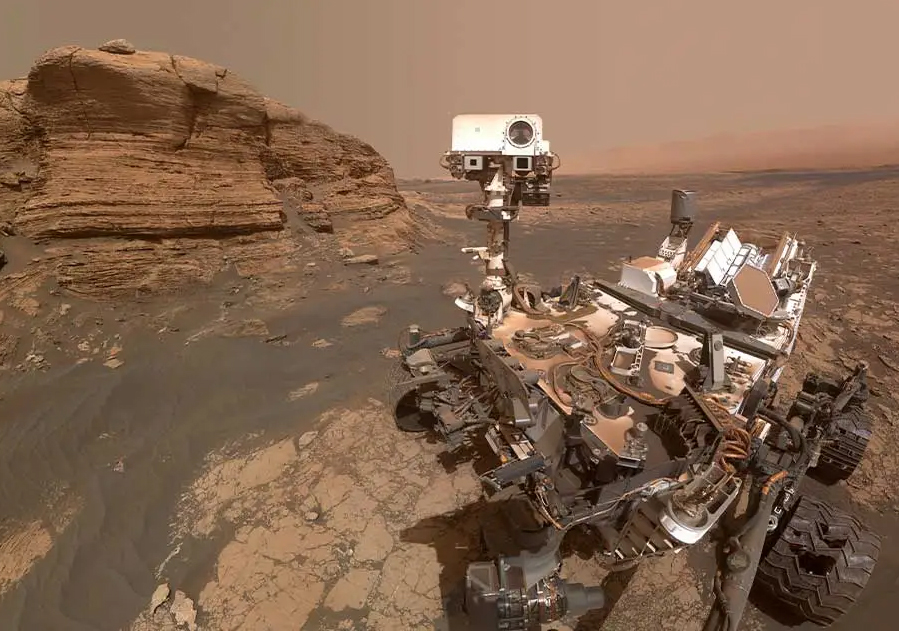
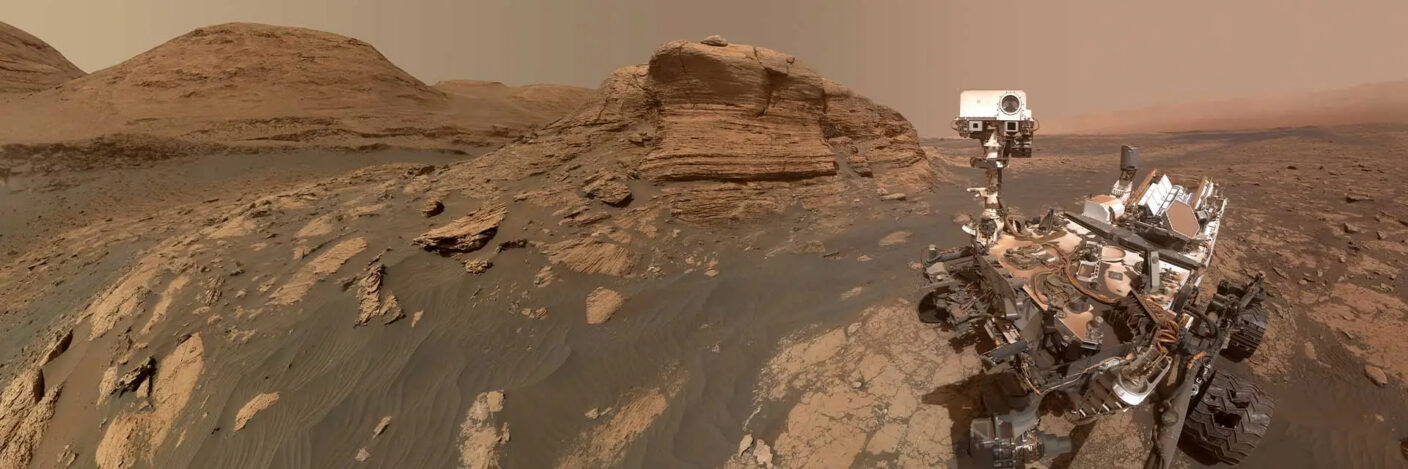
NASA’s Curiosity rover explores layered rock formations on the slopes of Mount Sharp in Gale Crater, where ancient environments are preserved in stone. Recent research shows similar rocks can retain organic molecules for billions of years.
Credit: NASA/JPL-Caltech/MSSS
NASA’s Curiosity rover has uncovered the most diverse set of organic molecules ever detected on Mars, including several compounds never before identified on the planet, a finding that adds to growing evidence that ancient Mars had the chemistry needed to support life.
The discovery comes from a rock sample collected in 2020 from Gale Crater, an area shaped by lakes and streams billions of years ago. Using an advanced chemical technique, scientists identified 21 carbon-based molecules preserved in clay-rich sedimentary rocks, including seven that had not previously been seen on Mars.
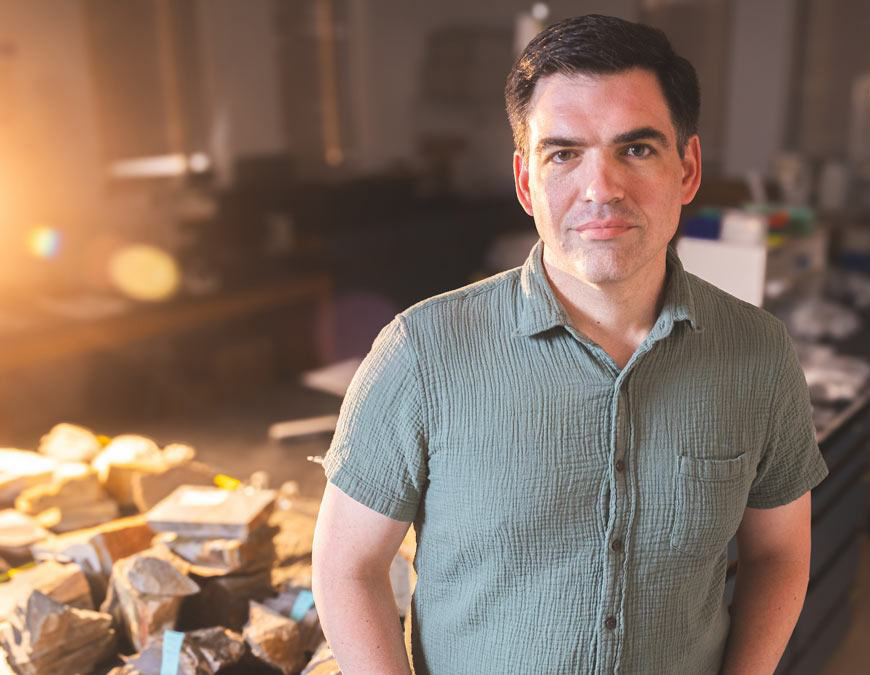
The preservation itself is what stands out to researchers like Texas A&M University astrobiologist and geobiologist Dr. Michael Tice, who studies the chemical record of ancient environments on Earth and Mars. His findings using data collected by the Perseverance rover were shared by NASA in September. He was not involved in the new study.
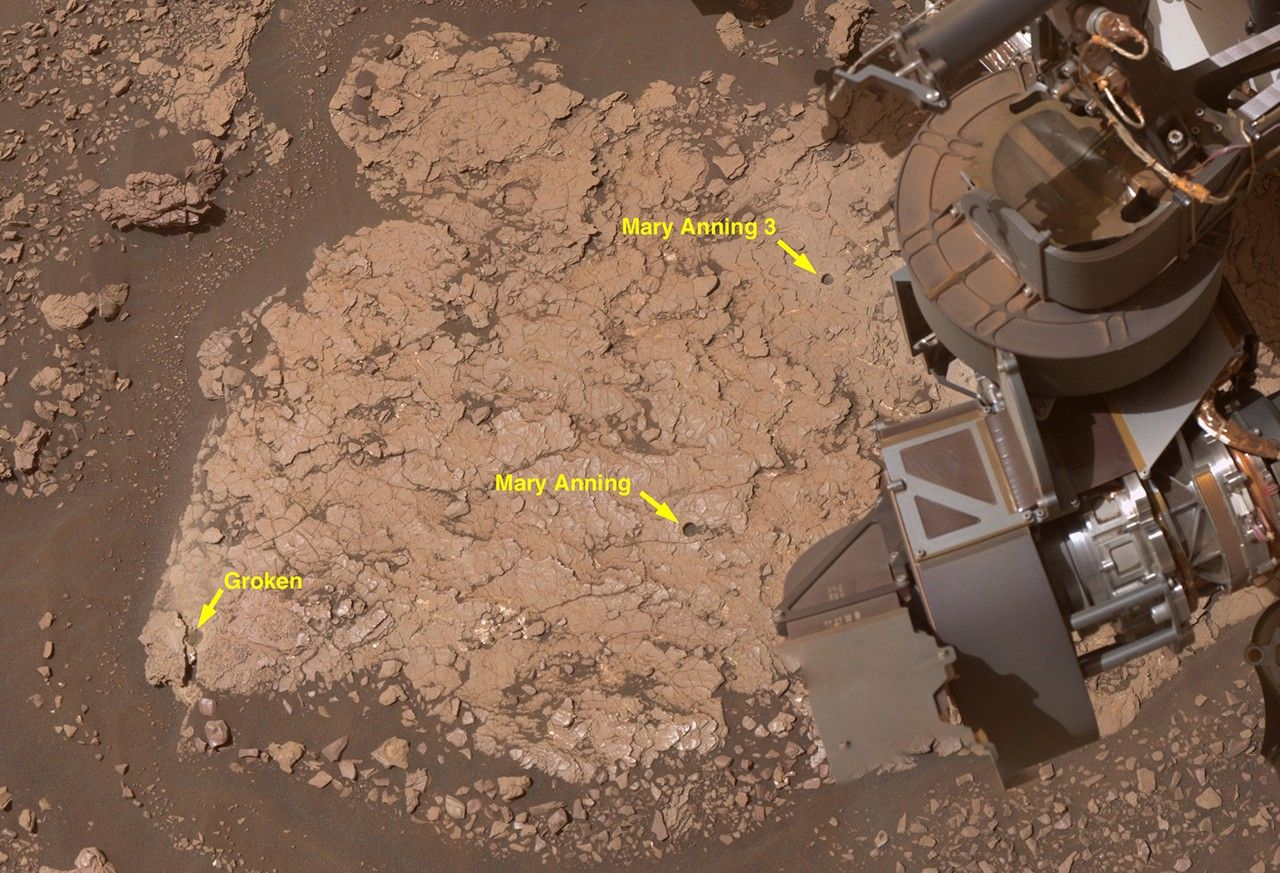
Close-up of three drill holes created by NASA’s Curiosity rover at the “Mary Anning” site in Gale Crater, where rock samples were collected for analysis.
Credit: NASA/JPL-Caltech/MSSS
“The actual organic components they found are not strong evidence for life,” Tice said, noting that similar compounds can form in meteorites or through non-biological processes.
What matters, he said, is where and how those molecules are stored.
“These organics were likely preserved in the rocks for a very long time, possibly billions of years, despite radiation and other harsh conditions on Mars,” he said. “It blows my mind.”
Organic molecules are considered the building blocks of life, but they can also form through non-biological processes such as geologic reactions or delivery by meteorites. Scientists say the finding does not prove that life existed on Mars, but it confirms that complex carbon chemistry, a key ingredient for life, can survive in the planet’s harsh environment over billions of years.
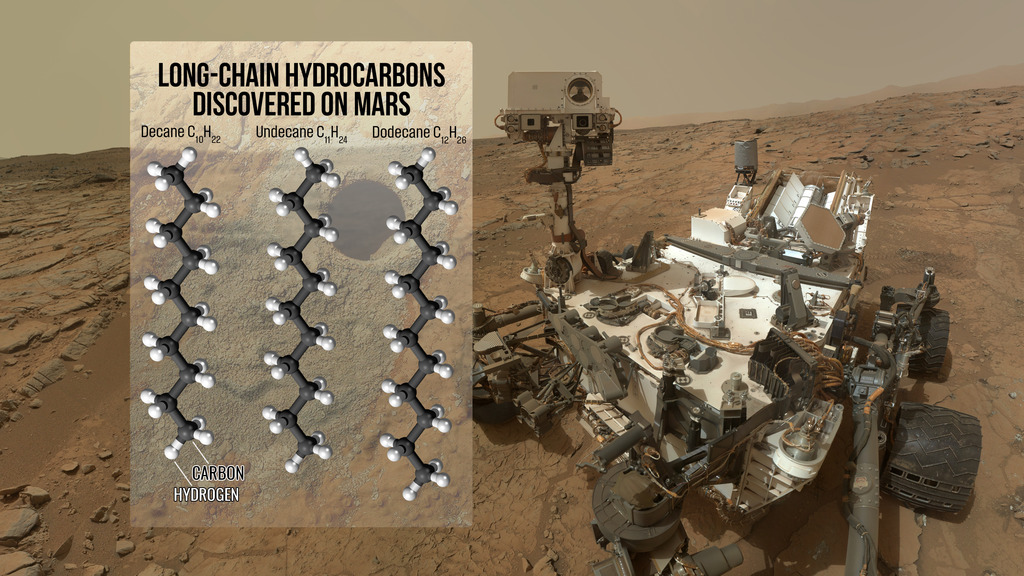
Curiosity’s Sample Analysis at Mars Instrument (SAM) discovered three long-chain hydrocarbons in a Martian mudstone. Decane, undecane, and dodecane are the largest organic molecules yet discovered on Mars, and may be the byproducts of fatty acids that disintegrated during heating by SAM.
Credit: NASA/Goddard/JPL-Caltech/MSSS
On Earth, comparable organic compounds preserved in sedimentary rocks allow scientists to reconstruct how life and environments changed over deep time. Finding similar preservation on Mars opens the door to asking the same kinds of questions about the Red Planet.
“Studying how those compounds vary between different rocks can tell a story of how life and environments changed,” Tice said. “Finding organics stored in similar ways on Mars tells us that there could be similar stories preserved there as well.”
The results also raise the possibility that Martian rocks may record a time before life began, something Earth’s active geology has largely erased.
“It is even possible that some Mars rocks will tell us about times when there was no life there,” he said, with organics formed instead through prebiotic chemistry or delivered from space. “We do not have an equivalent record of such a time preserved on Earth.”
Building on earlier discoveries
The new findings align with and extend earlier research co-led by Tice that identified what scientists described as potential biosignatures, chemical patterns that may point to ancient microbial life on Mars.
Credit: Texas A&M University
That study, published in Nature, based on data from NASA’s Perseverance rover, focused on fine-grained mudstones in Jezero Crater’s Bright Angel formation. The rocks were rich in organic carbon along with iron, sulfur and phosphorus, a combination that can provide energy for microorganisms.
Researchers also observed chemical patterns consistent with redox reactions, processes in which electrons are transferred between elements. On Earth, those reactions are commonly driven by microorganisms.
“When we looked even closer, we saw things that are easy to explain with early Martian life but very difficult to explain with only geological processes,” Tice said at the time.
Still, he emphasizes that confirming whether life existed on Mars will require more detailed laboratory analysis than current rover instruments can provide. “We need to bring these samples back to Earth, where we can analyze them with far more sensitive instruments,” he said.
“With the right collection, we could find the next step in evidence for past life on Mars or learn about the kinds of processes that eventually led to life on our planet.”
Continuing the search
Tice’s work remains focused on understanding how early Mars evolved and what its rocks can reveal.
“I’m continuing to study the record of early Martian evolution as part of the PIXL instrument team on the Perseverance rover,” he said. “In addition, I’m comparing how organisms affected some of the oldest sediments on Earth — now preserved in rocks in South Africa — with the potential biosignatures we discovered on Mars.”
His work is also aimed at improving how scientists search for those signals on future missions.
“I’m working on a couple of new instruments for field geology on the moon and Mars,” he said.
Taken together, the latest Curiosity results and ongoing work by Tice and team continue to refine a central question in planetary science: whether Mars once hosted life or merely preserved the chemical ingredients that made it possible.
More information: Diverse organic molecules on Mars revealed by the first SAM TMAH experiment, Nature Communications (2026)
DOI 10.1038/s41467-026-70656-0
https://www.nature.com/articles/s41467-026-70656-0
Redox-driven mineral and organic associations in Jezero Crater, Mars, Nature (2025).
DOI 10.1038/s41586-025-09413-0
www.nature.com/articles/s41586-025-09413-0
Journal information:
Nature Communications and Nature