
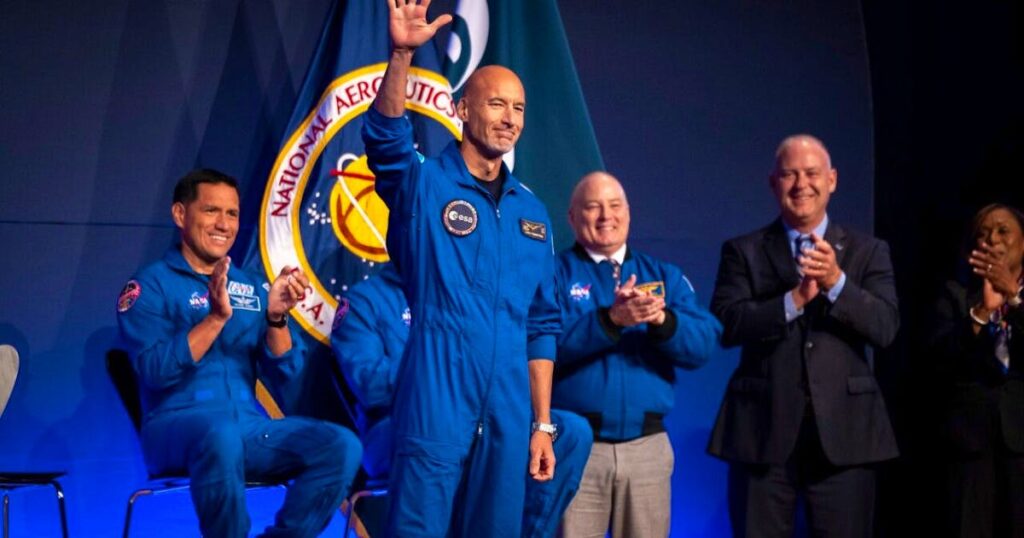
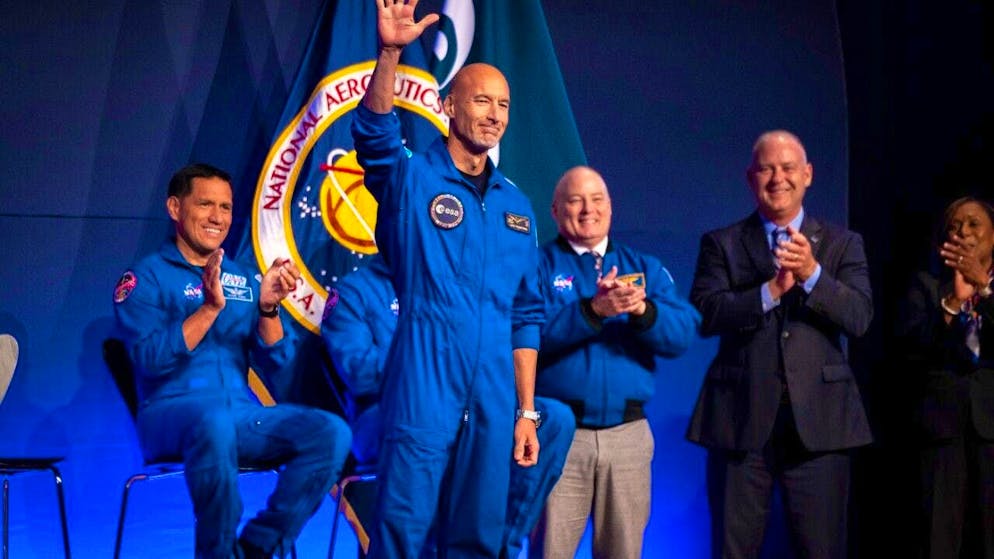
dpatopbilder – Artemis III crew member Luca Parmitano greets the leadership team during a press conference at the Johnson Space Center. Photo: Annie Mulligan/FR172050 AP/AP/dpa
Keystone
The first European to fly on a NASA “Artemis” moon mission is not a German, as previously announced, but surprisingly an Italian. Luca Parmitano has been selected as one of four astronauts for the “Artemis 3” mission, the US space agency Nasa announced.
It also came as a surprise that a European should be on board for “Artemis 3” and not just for later missions. According to Josef Aschbacher, head of the European Space Agency Esa, there are currently no commitments from Nasa for further launch slots, possibly for a German astronaut. However, this is to be negotiated.
The launch of “Artemis 3” is scheduled for 2027, and the crew will also include US astronauts Andre Douglas, Frank Rubio and Randy Bresnik. According to NASA, Bresnik is the official commander of the mission, while Parmitano is the pilot and the other two are “mission specialists”.
Unlike originally planned, the two-week mission does not include a moon landing. Instead, the coupling of the “Orion” spacecraft with lunar landing systems is to be tested. The mission is intended to test the technology for a planned moon landing in advance, as close to Earth as possible. In the event of problems, the crew should be able to be brought to safety within hours.
What exactly was originally announced?
Esa boss Aschbacher said at the end of 2025: “I have decided that the first Europeans to fly on a moon mission will be Esa astronauts of German, French and Italian nationality.” Germany will be first in line, he said at the Esa Ministerial Council Conference in Bremen. The two German Esa astronauts Alexander Gerst and Matthias Maurer subsequently emphasized several times that they would very much like to take up this opportunity.
So was Aschbacher’s announcement wrong?
That is a question of interpretation – but Aschbacher himself says no. “The statement still stands,” the Esa boss told the German Press Agency after the announcement of the “Artemis 3” crew. Because “Artemis 3” will remain in Earth orbit, it is “of course not a flight to the moon as we would traditionally see it”.
In addition, the statement was made on the basis of the “Lunar Gateway” project – a planned outpost on the moon, in which Esa was significantly involved, but which NASA has now scrapped, at least for the time being. That is why we now have to “discuss it again and start afresh”. Esa is in a “good starting position”, said Aschbacher, but there are still no commitments and “a flight to the lunar surface is not yet guaranteed”.
Parmitano is now the first Esa astronaut on an “Artemis” mission – but he is not going to the moon. Nasa boss Jared Isaacman surprisingly announced a complete change of strategy at the end of February: “Artemis 3” will be launched in 2027, but will not land on the moon as planned.
Instead, the “Orion” spacecraft will only fly in a Low Earth Orbit (LEO) and the crew will test coupling with one or two lunar landers.
Isaacman explained that the intervals between the individual missions had been too long up to now. “With ever-increasing credible competition from our biggest geopolitical adversary, we need to move faster, eliminate delays and achieve our goals.”
Why aren’t Gerst or Maurer starting with “Artemis 3”?
Parmitano (49), Gerst (50) and Maurer (56) all have experience with space flights. Parmitano flew to the ISS space station in 2013 and 2019, Gerst in 2014 and 2018, Maurer in 2021.
The decisive factor for Parmitano was the requirements profile specified by NASA, said Aschbacher. “They were specifically looking for a test pilot and there is only one test pilot in our astronaut corps and that is Luca Parmitano.”
The Italian is married and has two children. He trained at the Italian Air Force Academy and has a degree in experimental flight test engineering. Parmitano was a test pilot in the Italian Air Force. He was selected as an Esa astronaut in 2009 and was involved in docking maneuvers with the ISS on several occasions.
Parmitano is also associated with a very special piece of space history: In 2013, he almost became the first person to drown in space. During an external mission, his helmet filled with water and he narrowly made it back on board.
How does Esa decide who gets to fly?
Money plays a major role here: Germany, France and Italy are the largest contributors to Esa, which is why it is not surprising that these countries should be given a go on the moon flights. Germany – the most important supporter of the space agency – increased its contribution to a peak of 5.4 billion euros in November. In the previous three-year period, the figure was 3.5 billion euros.
Wasn’t there a moon mission recently?
Yes, for the first time in more than half a century, people flew near the moon again at the beginning of April. They did not land. The “Artemis 2” crew included three Americans and one Canadian.
At the announcement of the “Artemis 3” crew in Houston, the “Artemis 2” Americans also appeared on stage and officially handed over the baton to their successors. “Artemis 2 was about moon joy, Artemis 3 will be about earth joy,” said Nasa manager Nicky Fox.
What kind of spacecraft are part of “Artemis”?
The missions will each be launched on a Space Launch System (SLS) rocket, the most powerful rocket Nasa has ever built. The astronauts travel on board the “Orion” capsule, whose service module for the supply of oxygen, water and electricity (European Service Module, ESM) is manufactured at the Airbus plant in Bremen. “Orion” flies largely fully automatically.
Unlike previous NASA projects, private space companies such as Blue Origin, owned by Amazon founder Jeff Bezos, and SpaceX, owned by tech billionaire Elon Musk, are involved in Artemis: they are to build lunar landers (“Human Landing System”, HLS).
However, Blue Origin had just suffered a major setback at the end of May when the powerful heavy-duty rocket “New Glenn” exploded during a routine test at the Cape Canaveral spaceport in the US state of Florida. The company is making “excellent progress” in investigating the incident and has stepped up its efforts once again to stay on schedule, Blue Origin manager John Couluris said at the event in Houston.
Originally, the project also envisaged an outpost on the moon called “Lunar Gateway”, which was to serve as a stopover for manned missions to the moon and later possibly also to Mars. Esa is significantly involved in the project, providing three core elements, among others. Preparation and implementation have been underway for years.
However, Isaacman said in March that the plans would be scrapped, at least for the time being. A final statement on whether the “Lunar Gateway” will be used at all has yet to be made.
Is it certain that the USA will be the first to put people back on the moon?
No. “The clock is ticking in this competition between the superpowers and success or defeat will be measured in months, not years,” Isaacman explained in March.
According to experts, it cannot be ruled out that the Chinese will quietly pass by. China has set itself the goal of putting humans on the moon by 2030. NASA’s current plan is to possibly undertake two moon landings as early as 2028 with “Artemis 4” and “Artemis 5”. However, there have been repeated delays in the past. Now, however, NASA is “extremely confident”, said Isaacman. “We will return to the moon before the end of 2028.”
The “Artemis” program – named after the goddess of the moon and twin sister of the god Apollo from Greek mythology – was announced by Nasa in 2017. It originally envisaged a manned moon landing – with “Artemis 3” – by 2024.
The first man on the moon, some 400,000 kilometers away, was Neil Armstrong on 20 July 1969, and the last to leave it so far was Eugene Cernan on 14 December 1972. In total, the USA is the only country to have put twelve men on the moon with the “Apollo” missions.
Why is the moon so important?
For countries like the USA and China, returning to the moon symbolizes technological and geopolitical leadership. A permanent presence there is seen as a way of securing national interests in space travel and shaping international cooperation. Russia, for example, also wants to take people to the moon, but is struggling with delays due to economic difficulties.