
NASA has announced details of the next phase of its Moon program that includes one of the most complex human spaceflights ever undertaken.
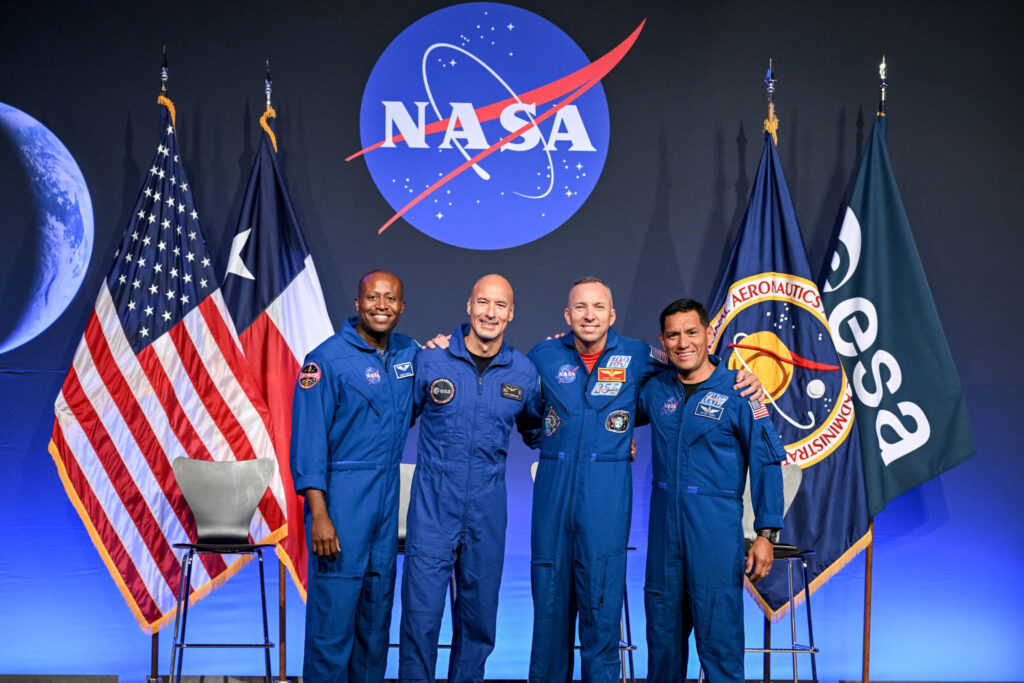
It has also announced the four crew members for the Artemis III mission, which will undertake a series of challenging tests in Earth’s orbit in 2027.
This is part of the preparations for a human moon landing in 2028.
“During Artemis III, the agency’s SLS (Space Launch System) rocket will launch the Orion spacecraft and its crew from NASA’s Kennedy Space Center in Florida to low Earth orbit,” NASA said in statement today.
“After Orion systems checkouts, the spacecraft will, for the first time, demonstrate rendezvous and docking capabilities with test versions from one, or both, American commercial human landing systems in development by Blue Origin and SpaceX.
“This highly choreographed mission includes a dramatic multi-launch campaign of the world’s most powerful rockets, testing integrated hardware between Orion and the landers, including system interfaces, software, propulsion, and communications.”
The crew for the mission are NASA astronaut Randy Bresnik (commander), ESA (European Space Agency) astronaut Luca Parmitano (pilot), NASA astronaut Andre Douglas (mission specialist) and NASA astronaut Frank Rubio (mission specialist).
NASA Administrator Jared Isaacman said the next mission would build on the recent “extraordinary foundation” laid by the Artemis II astronauts who travelled to the far side of the moon in the longest-ever human space flight.
He said Artemis II had reignited global interest in space flight.
“This (new) mission will require the most awe-inspiring coordination of heavy-lift rocket launches in history, drawing on the talent and capability of teams across government and the spaceflight community,” he said.
“The Artemis III astronauts, alongside ESA and our international partners, and the tens of thousands of the best and brightest across the agency and industry, are ushering in a new Golden Age of exploration carrying forward the hopes and dreams of the next generation just as the Apollo astronauts did for so many of us.”
More information is available here.