
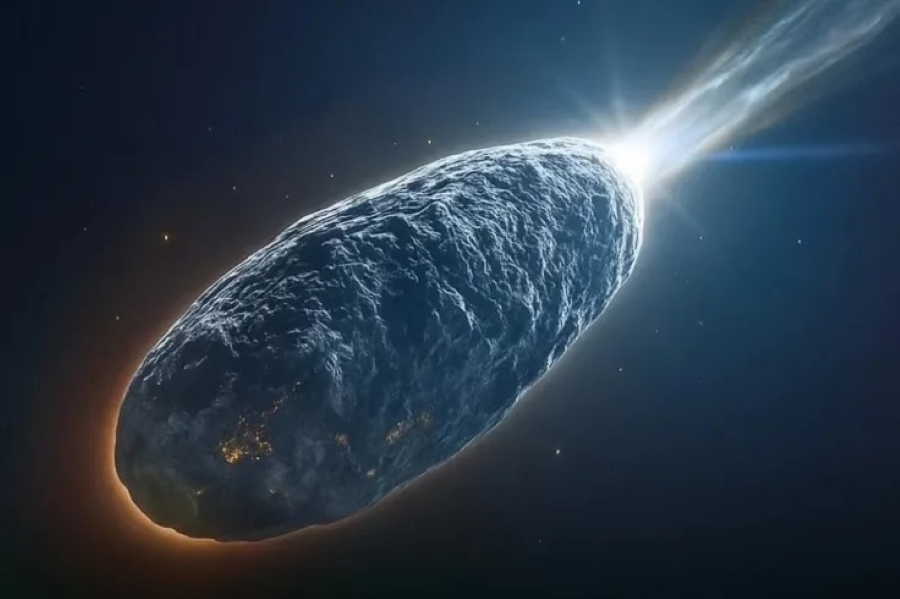
Last year, the mysterious interstellar object 3I/ATLAS made a fascinating journey through the inner reaches of our Solar System. After passing by several planets, it vanished forever into the depths of space, leaving no chance of a second encounter. However, it left behind a vast amount of data collected by ground-based and space-based observatories. For scientists, this is an invaluable and extremely rare opportunity to study a “visitor” that originated far beyond the boundaries of our star system.
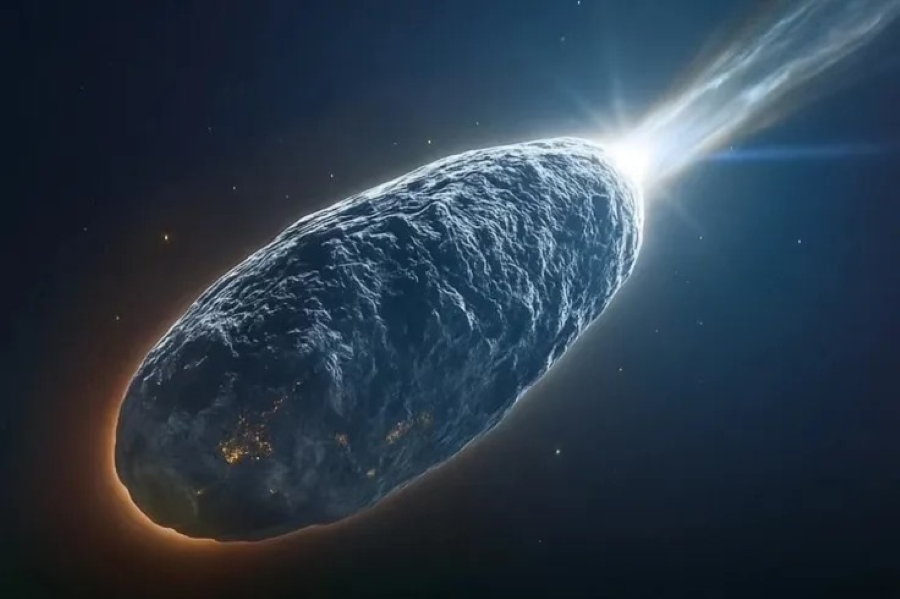 Illustration of the interstellar object 3I/ATLAS. Source: ibtimes.com
Researchers recently made a stunning discovery by analyzing data from the MIRI instrument aboard NASA’s advanced James Webb Space Telescope.
According to the European Space Agency, in December the telescope detected traces of methane emanating from 3I/ATLAS. This occurred approximately two months after the interstellar comet passed its perihelion—the point of closest approach to the Sun. Jokingly, one could say that the comet “let off some gas” as it flew through our cosmic neighborhood.
Secrets beneath the ice
The significance of this discovery cannot be overstated. This is the first time in history that astronomers have managed to obtain a chemical fingerprint of an interstellar object and detect methane in it. According to a study published in The Astrophysical Journal Letters, the MIRI instrument revealed not only the presence of methane but also the distribution of water and carbon dioxide.
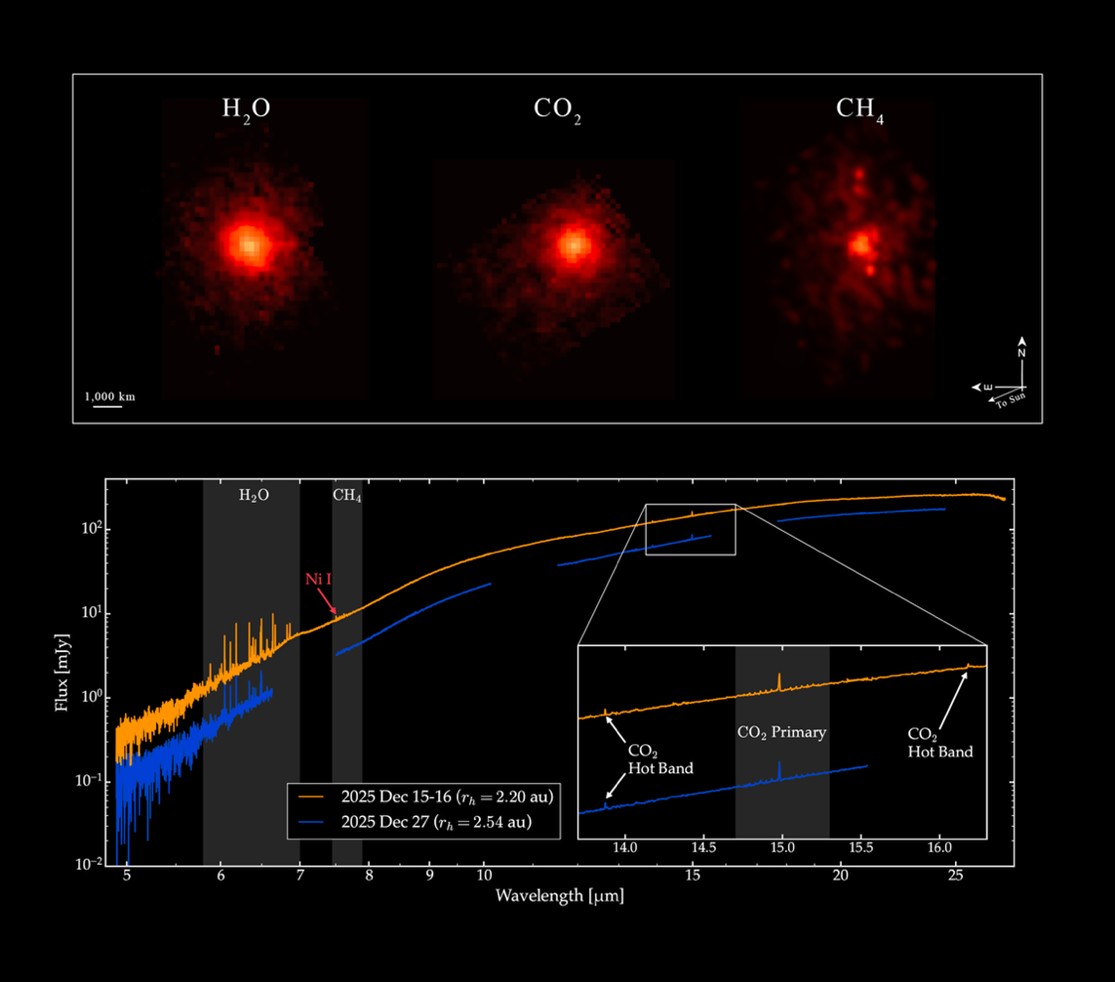 The image above shows the interstellar comet 3I/ATLAS, photographed using the MIRI instrument on NASA’s James Webb Space Telescope, along with outlines illustrating the distribution of various gases at the time the comet was observed. Water vapor extends far beyond the nucleus, as much of it is released from ice grains in the coma, while carbon dioxide and methane are most concentrated near the comet’s nucleus. The image below shows a spectrum, and the markers indicate the signatures of various gases that the telescope has detected escaping from the comet. Source: NASA, ESA, CSA, STScI
Since the intense gas outburst occurred after perihelion—when comets typically heat up the most and lose the most material—scientists have reached an interesting conclusion. They speculate that the methane was hidden very deep beneath the comet’s thick icy shell. According to NASA, methane is an extremely volatile substance that sublimates very easily—that is, it transforms from ice into gas.
A completely different chemistry
The chemical composition of 3I/ATLAS has greatly surprised astronomers. The ratio of methane to water detected was found to be abnormally high compared to the typical comets we are used to seeing. In addition, the latest observations have confirmed that the object is exceptionally rich in carbon dioxide, making it even more unique.
Representatives of the European Space Agency emphasize that these findings unequivocally point to one thing: the chemical composition and formation environment of 3I/ATLAS differ significantly from the conditions under which the vast majority of comets in our solar system formed.
We previously reported on how the interstellar object 3I/ATLAS contained traces of extraterrestrial fuel.
According to NASA