
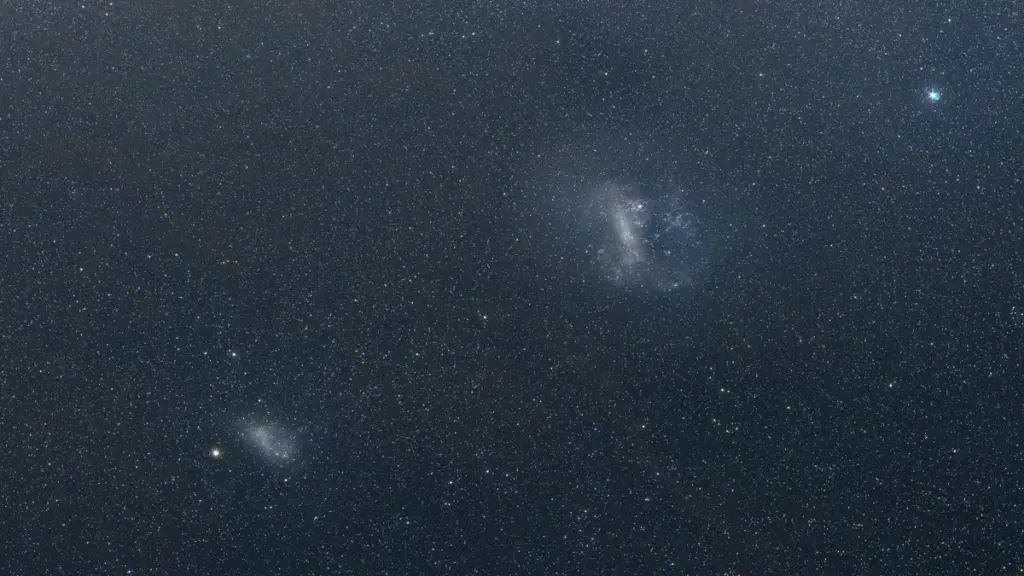
Two dwarf galaxies near the Milky Way are locked in an uneven struggle. The Small Magellanic Cloud is being distorted by the gravitational pull of the Large Magellanic Cloud. New observations have shown that the stars in the smaller galaxy are moving outward rather than orbiting the center, as was previously thought.
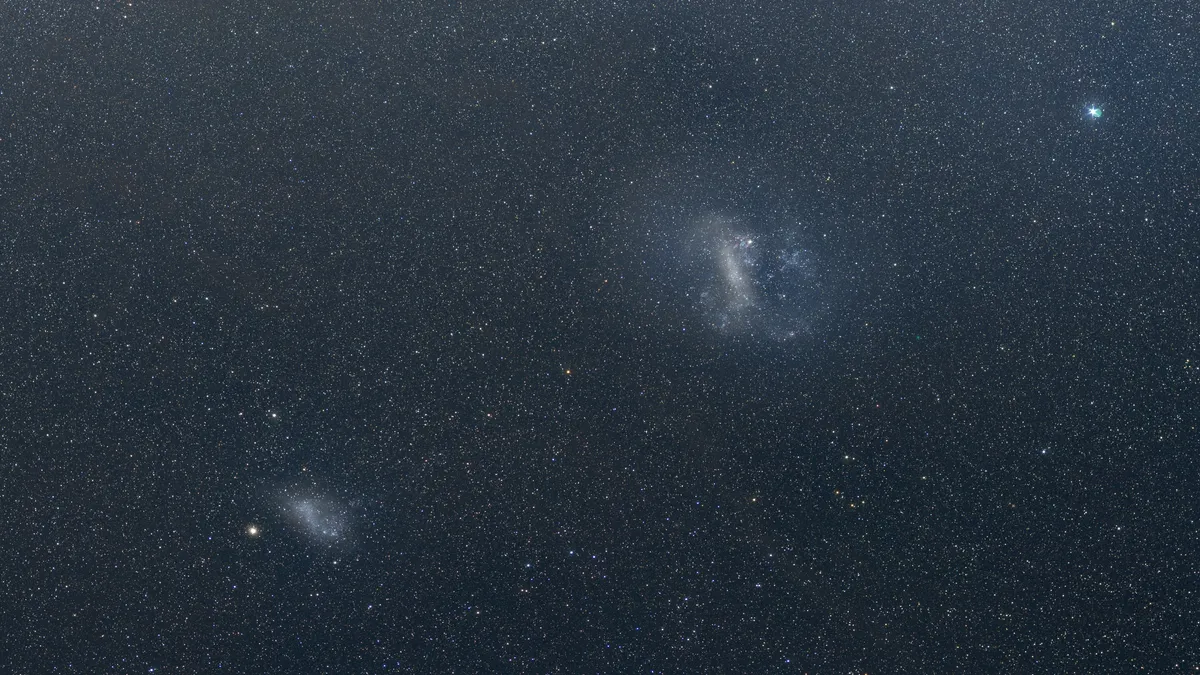 The Large and Small Magellanic Clouds are visible from the Southern Hemisphere as faint patches in the night sky. Credit: Axel Mellinger, Central Michigan University / NASA Visualization Studio
Magellanic Clouds
The Large and Small Magellanic Clouds are two irregularly shaped dwarf galaxies located near the Milky Way. The Large Magellanic Cloud is approximately 163,000 light-years away, while the Small Magellanic Cloud is farther away, at a distance of 200,000 light-years.
Both are subject to the gravitational pull of our galaxy, which triggers bursts of star formation within them. In addition, this gravitational pull draws a shared stream of gas away from both galaxies, known as the Magellanic Stream.
What did the researchers find out?
The new results were obtained using the Visible and Infrared Survey Telescope for Astronomy (VISTA) during observations of the Magellanic Clouds from the summit of Mount Paranal in Chile. Over the course of 11 years, scientists used this 4-meter telescope to map the movements of millions of individual stars in both galaxies. Working in the infrared range allows the telescope to penetrate through some of the dust and obtain clearer images of the objects.
Previous measurements suggested that the motions of stars in the Small Magellanic Cloud corresponded to the galaxy’s rotation. It turned out that this was a misinterpretation. The stars are actually moving outward from the central regions of the galaxy, and the direction of this motion points directly toward the Large Magellanic Cloud. This is a typical sign that the gravitational tidal forces of the larger galaxy are pulling the smaller one apart.
Speed and scale of change
The average speed at which stars move is about 17 kilometers per second. Over the course of several hundred million years, they can travel thousands of light-years.
This gives an idea of just how much the Small Magellanic Cloud has been distorted over billions of years. In the past, its structure must have been more compact and clearly defined, unlike the irregular shape it has today.
Mysterious movement of ancient stars
In addition to the general outflow, the telescope revealed another unusual detail. Ancient red giants in the Small Magellanic Cloud are moving northward as a group, although the reason for this movement remains unclear.
These stars formed about two billion years ago, and their current motion reflects some ancient influence from that very time. Since astronomers believe that the Magellanic Clouds are approaching our galaxy for the first time, those events may have taken place in a completely different part of the universe.
What will happen next?
The Magellanic Clouds are gradually slowing down due to their interaction with the Milky Way’s halo. Recent computer simulations have shown that both galaxies will be absorbed by our own in billions of years.
Until then, the two galaxies will remain close together. However, the Large Magellanic Cloud will continue to distort its smaller companion, gradually altering its structure. The findings have been published in the journal Astronomy & Astrophysics.
According to space.com