
A new study of binary star systems has identified a factor that significantly influences their evolution and had previously been overlooked. Computer simulations have shown that magnetic fields form in these systems very early on and push the future stars toward one another.
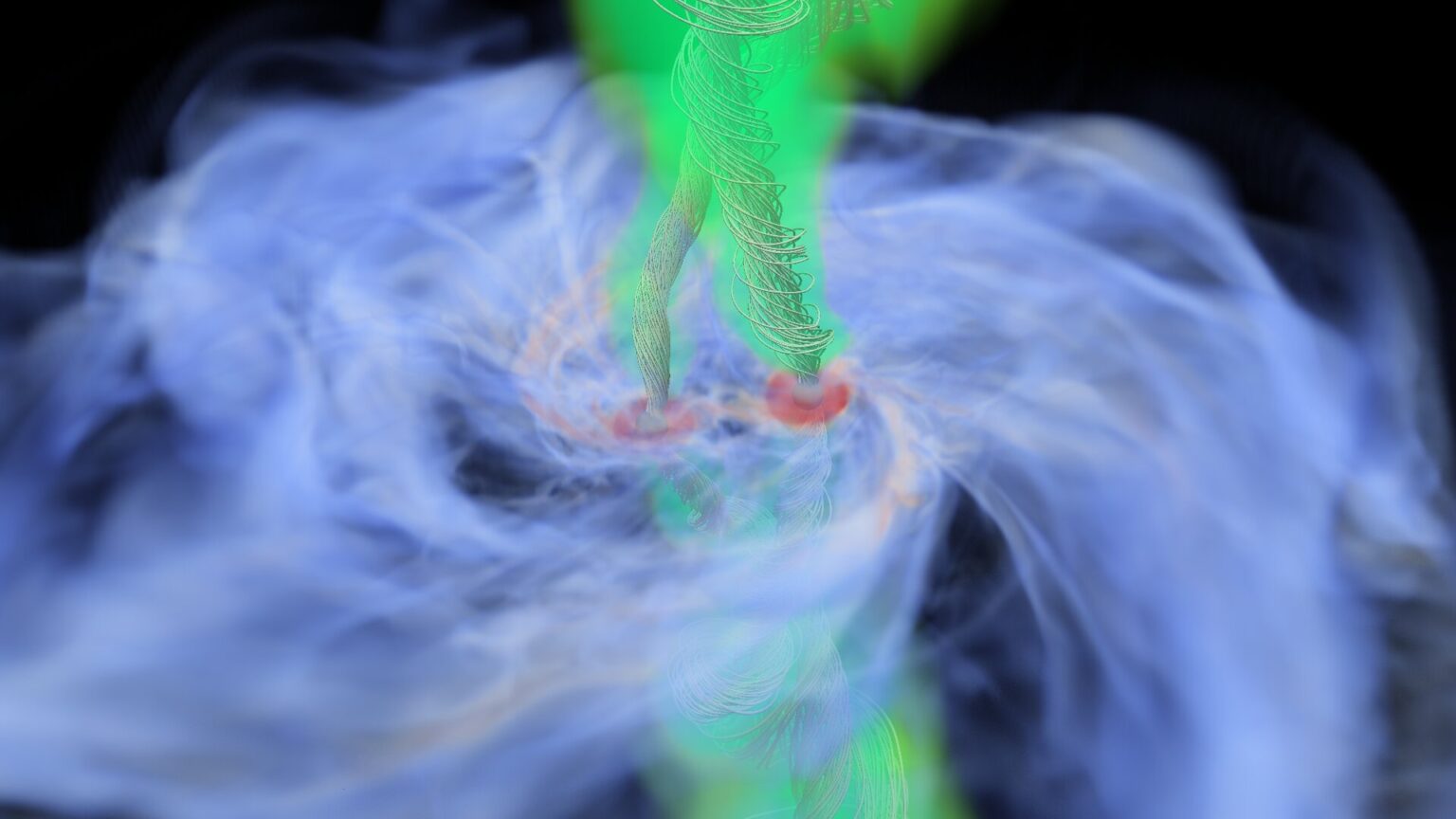 Magnetic fields of newborn stars. Source: Matsumoto, Hotokezaka, Inayoshi 2026
Magnetic fields of stars
Every star is not only a powerful source of thermal energy but also a generator of a magnetic field. Recently, a group of Japanese researchers published an article in the journal Monthly Notices of the Royal Astronomical Society examining this phenomenon in stars that form binary systems.
Every star is not only a powerful source of thermal energy but also a generator of a magnetic field. Recently, a group of Japanese researchers published an article in the journal Monthly Notices of the Royal Astronomical Society examining this phenomenon in stars that form binary systems.
Both single and binary stars are born from cold molecular gas clouds that stretch across space for many light-years. Over time, these clouds break up into separate globules, within which dense regions form; their mass and density increase, and eventually they evolve into protostars.
What the simulation showed
Scientists have decided to investigate exactly what happens when two condensates form within a single globule and whether magnetic fields have time to develop in the process. More specifically, they had two different models: in one, they set the magnetic field to zero, and in the other, they set it to be significantly stronger.
And it turned out that something as seemingly insignificant as a magnetic field has a significant impact on the early evolution of the system. It turns out that, thanks to it, the two stars come much closer together even in the early stages of their existence. In other words, they form a tighter system, and this affects how planets form within it.
The researchers also found that a similar effect appears to occur not only in young stars but also in black holes. In pairs of black holes, the magnetic field is also thought to accelerate their approach to one another. This means that mergers in such systems are likely to occur faster than scientists typically predict.
According to phys.org