
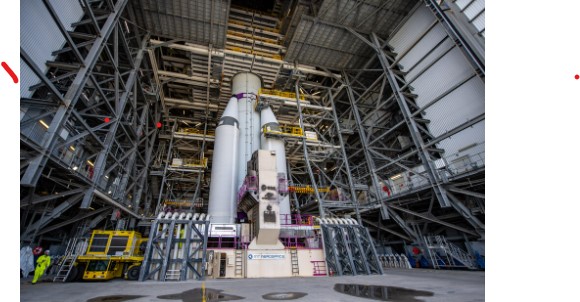
ESA has announced that it is preparing for a 17th June Ariane 6 launch from its spaceport in French Guiana. The launch window runs from 08:53 to 09:22 local time, which corresponds to 12:53–13:22 BST and 13:53–14:22 CEST. This mission will feature upgraded boosters that use the P160C solid-propellant motor, making the rocket more powerful than previous configurations.
The upcoming flight, designated VA269, will carry 36 satellites for the Amazon Leo constellation. This marks the third time the Amazon Leo system is being deployed by Ariane 6. The four boosters on this mission are based on the P160C motor, and each booster carries more solid propellant than the earlier P120C version. In total, the solid-propellant load increases by about 14 tonnes per booster.
Ariane 6 is designed to be adaptable for different missions and to accommodate future upgrades. The vehicle began with two P120C-based boosters on its first flight in 2024. For the February 2026 flight, the rocket flew with four boosters for the first time. The present launch will introduce the four P160C boosters, setting a new power benchmark for the launcher.
Each P160C motor utilizes 14 tonnes more propellant than the P120C, and the overall height of the engine assembly rises by roughly one metre. This added height does not disrupt the connection to the central core of Ariane 6. The P160C was developed by Europropulsion under a contract from ArianeGroup and Avio, with the engine’s structure built in Italy, the nozzle manufactured in France, and the igniter produced in Norway. Fuel loading and final assembly occur in French Guiana.
The project illustrates European collaboration across multiple countries. The European Space Agency coordinates with a broad industrial network across 13 European nations, led by ArianeGroup as prime contractor and design authority. CNES oversees range operations at Europe’s Spaceport in French Guiana. Arianespace serves as the launch service provider for this Amazon mission.
 Published by James Hydzik
James Hydzik is a technology geek focused on the junction of engineering, writing, and coffee. He joined Orbital Today in 2020 to help make sense of the Johnson government’s decision to buy OneWeb. Since then, he has taken on interviewing and editor-in-chief roles. James learned the ropes of editing and writing with Financial Times magazines, The World Bank, PwC, and Ericsson. Thus far, interviewing New Space movers has put the biggest smile on his workaday face. The son of an Electrical Engineer, James understands the value of putting complex topics into clear language for those with a lay person’s understanding of the subject. James is a European transplant from the United States, and as ex-KA3LLL, he now holds European amateur radio licenses. His next radio project is a portable 10GHz EME (moonbounce) station, as it combines his childhood interests in antennas and space.