
What experts say about the eclipse
“A total solar eclipse is one of those rare moments when millions of people can look up together and feel both wonder and curiosity,” said Carole Mundell, director of science at the European Space Agency (ESA). “It connects us to the Universe and reminds us that the desire to explore and understand is one of humanity’s greatest strengths.”
Where the eclipse will be visible
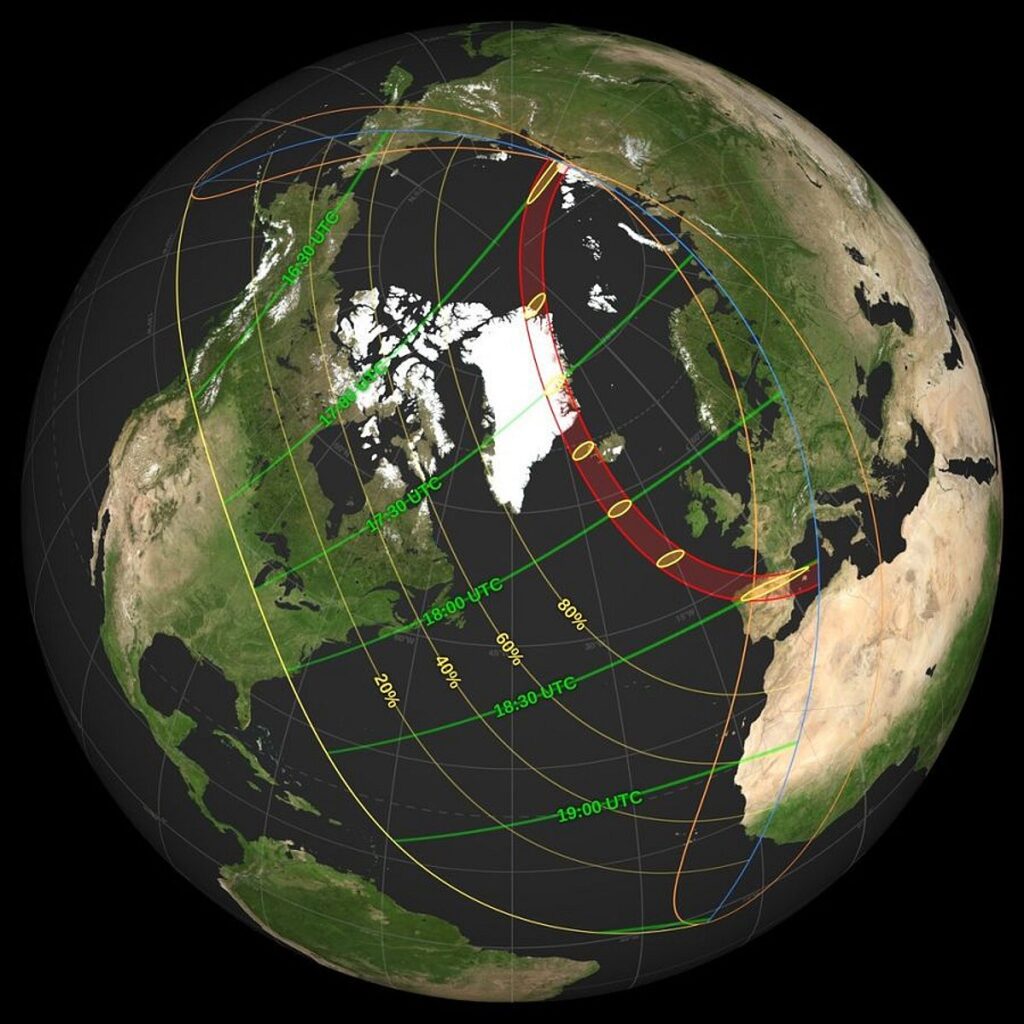
The narrow path of totality will stretch across Arctic regions before crossing Greenland, Iceland, Portugal and northern Spain.
Greenland: just over 2 minutes of totality
Northern Spain: as little as 20 seconds, depending on conditions
Weather conditions remain the biggest factor affecting visibility
The eclipse will move over Galicia and the Balearic Islands as sunset approaches, accelerating the transition from day to night.
For those outside the path, the European Space Agency will stream the event live from the Astrophysical Observatory of Javalambre in Spain.
August 2027: Longest solar eclipse of the century
Just one year later, on August 2, 2027, the world will witness the longest total solar eclipse of the 21st century visible from land, lasting up to 6 minutes and 23 seconds.
During this rare event, the Moon will completely cover the Sun, plunging daytime into near darkness.
Where the 2027 eclipse will be seen
The path of totality will stretch across 11 countries, including:
Spain, Gibraltar, Morocco, Algeria, Tunisia, Libya, Egypt, Sudan, Saudi Arabia, Yemen and Somalia
Egypt is expected to offer some of the longest viewing durations, particularly near Luxor and the New Valley Governorate.
Why the 2027 eclipse will last so long
The unusually long duration is due to a rare alignment:
The Moon will be at perigee (closest to Earth)
The Earth will be near aphelion (farthest from the Sun)
This makes the Moon appear larger and the Sun slightly smaller
This alignment allows the Moon to fully cover the Sun for an extended period—making it the longest land-visible eclipse of the century.
What happens during totality
During totality, observers may experience:
Day turning into twilight darkness
A noticeable drop in temperature
Visibility of planets and bright stars
The Sun’s outer atmosphere, or solar corona
Rare effects like Bailey’s Beads and the Diamond Ring effect
How to view safely
Experts warn that looking directly at the Sun without protection is dangerous.
Only certified solar eclipse glasses or properly filtered equipment should be used. Regular sunglasses are not safe for viewing any phase except totality.
Looking ahead
2027 (Aug 2): Longest total solar eclipse of the century
2033 (Mar 30): Total eclipse visible in Alaska
2044 (Aug 22): First total eclipse over contiguous US since 2027
2045 (Aug 12): Coast-to-coast eclipse across the US
When is the next eclipse in your city?
The next total solar eclipse visible from your location depends on where you are in the visibility path. For example:
Middle East (including UAE): Likely visibility in 2027 (2 Aug) and 2035 (partial/total depending on location)
North America: 2026 and 2031 events offer strong visibility in many regions
Europe: 2026, 2027, and 2033 offer multiple viewing opportunities
Asia: 2026, 2027, 2028, and 2035 events provide coverage depending on region
Total solar eclipses worldwide (2026–2035)
A once-in-a-century sky spectacle
Astronomers say the 2027 eclipse will be one of the most significant celestial events of the century, drawing global attention from scientists, tourists and skywatchers alike, as daylight briefly turns into darkness across multiple continents.