
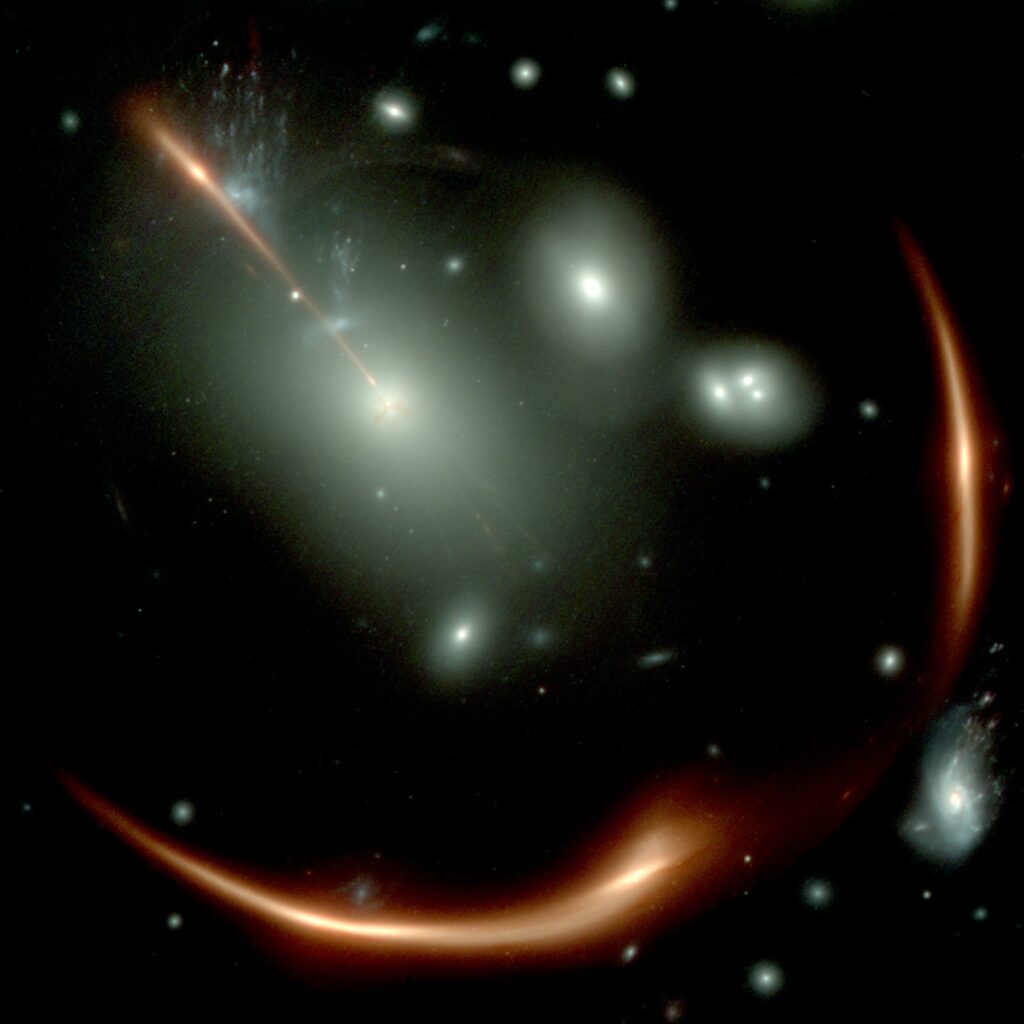
For the first time, astronomers have measured the mass of an inactive supermassive black hole in a galaxy located at a record distance from Earth. To do this, they tracked the motion of stars at its very center. This will help us understand how these objects evolved in the early universe.
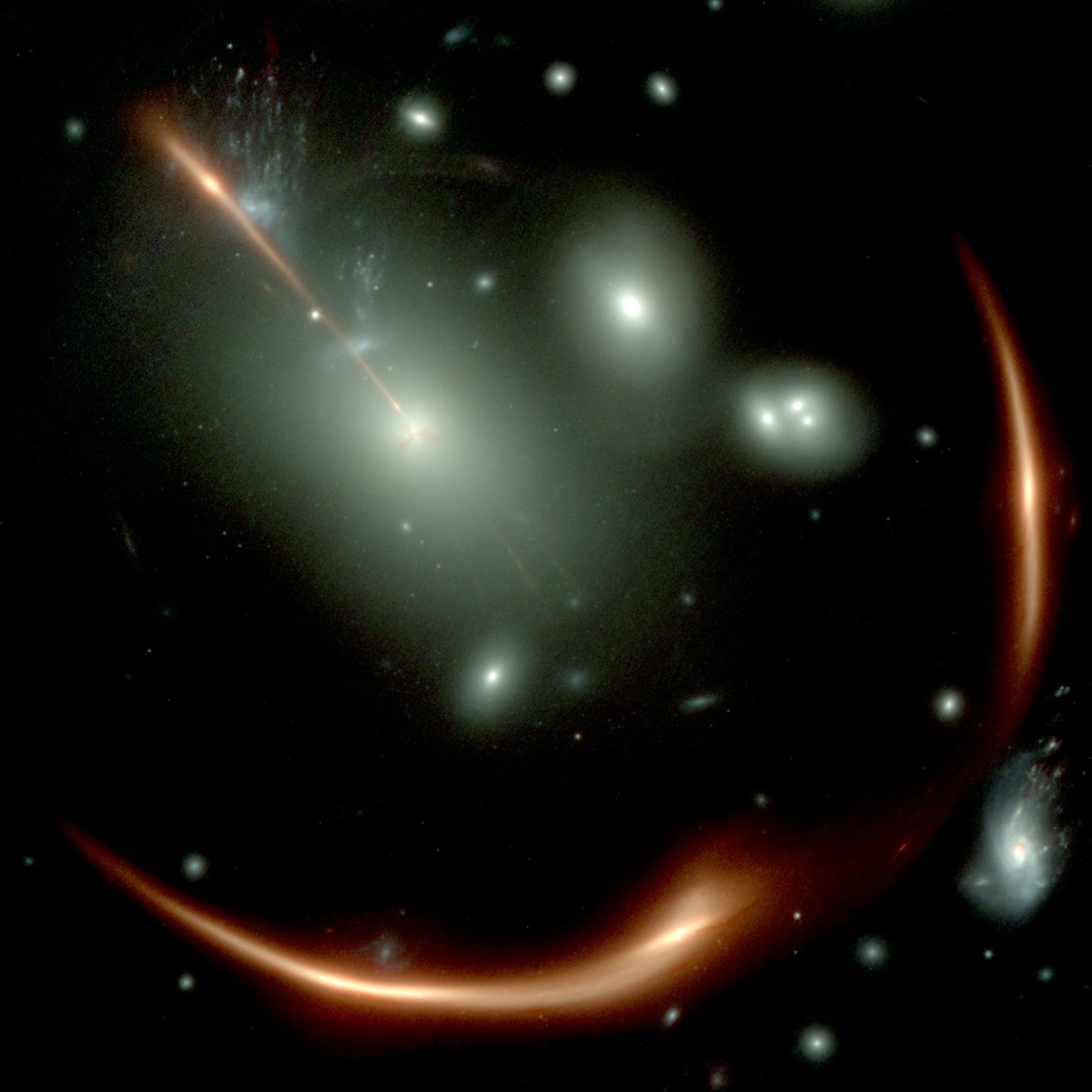 The MRG-M0138 galaxy, as captured by the James Webb Space Telescope. Photo: NASA / JWST
How to weigh the invisible
Unlike active black holes, which give themselves away through powerful emissions, this one remains completely dark. It does not absorb matter, so it is impossible to observe it directly.
However, the gravity of such an object causes the surrounding stars to move differently. By tracking these velocities using the James Webb Space Telescope, researchers were able to calculate the mass of this black hole. This approach is known as stellar dynamics, and until now it had only been applied to neighboring galaxies.
Lensing effect
The galaxy MRG-M0138 is so far away that it would be impossible to discern the motion of individual stars within it without a natural aid. That aid turned out to be a massive galaxy cluster in the foreground.
Its gravity bent the light from a distant galaxy, acting as a giant lens. This magnified the image by about 30 times and made it possible to reconstruct the object’s internal structure.
“By combining data from the James Webb Space Telescope with gravitational lensing, we were able to peer inside the black hole’s influence sphere, where its gravity is accelerating the stars,” explained lead author Andrew Newman of the Carnegie Institution for Science’s Observatory.
Why has star formation stopped?
The black hole turned out to be colossal, with a mass estimated at approximately 6 million solar masses. At the same time, it is completely inactive, just like the galaxy surrounding it.
No new stars are forming in MRG-M0138. Scientists believe that in the past, this black hole grew rapidly and expelled nearly all the gas needed for star formation. Without it, star formation simply came to a halt.
A look into the past
The study demonstrates that the stellar dynamics method works even at cosmological distances. Previously, it had been applied only to galaxies no more than 700 million light-years away. Now, that limit has been pushed back more than tenfold.
Astronomers hope to find more dormant black holes from the early universe. This will help determine how they halt star formation and whether they can become active again when new masses of matter enter their surroundings.
According to phys.org