
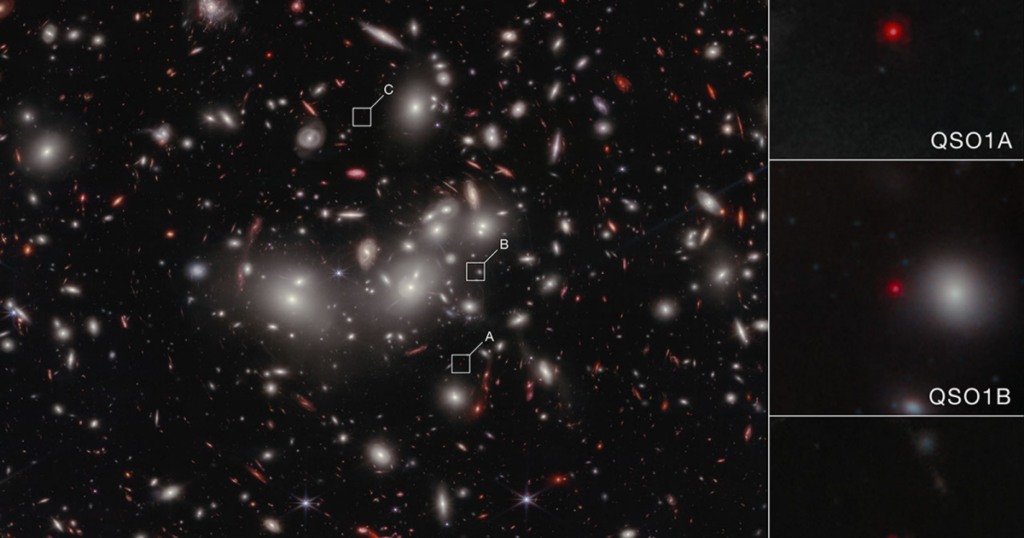
The vast majority of galaxies have a black hole at the center, keeping everything in orbit.
A new study details the discovery of a black hole that was older and heavier than its host galaxy.
The black hole is 13 billion light years from Earth.
That means the images researchers are looking at now with the James Webb Space Telescope are actually from the early universe.
“It’s as if we were putting this galaxy under a strong microscope,” said Eiichi Egami, an astronomer with the Steward Observatory and study author.
He says the black hole has the mass of about 50 million suns, which means previous explanations for how black holes form don’t apply, because it would take too much time for this black hole to get that large.
“This discovery would put new light on these sort of non-traditional black hole formation scenarios and make astronomers and physicists rethink how black holes might have formed in the early universe,” Egami said.