
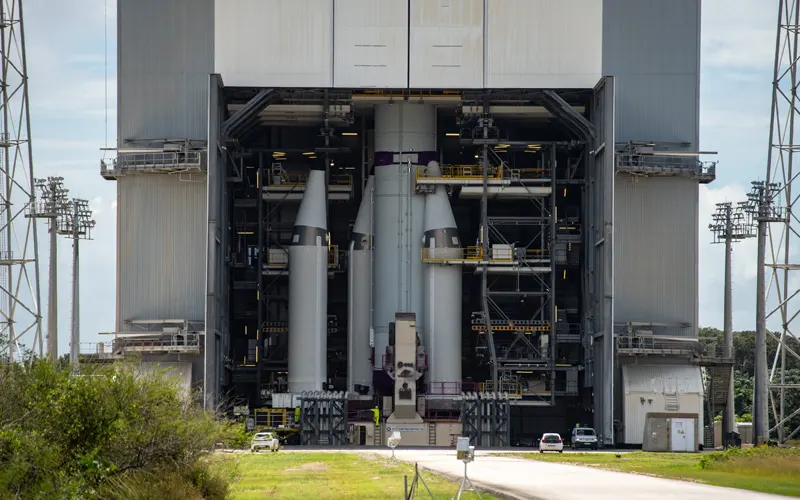
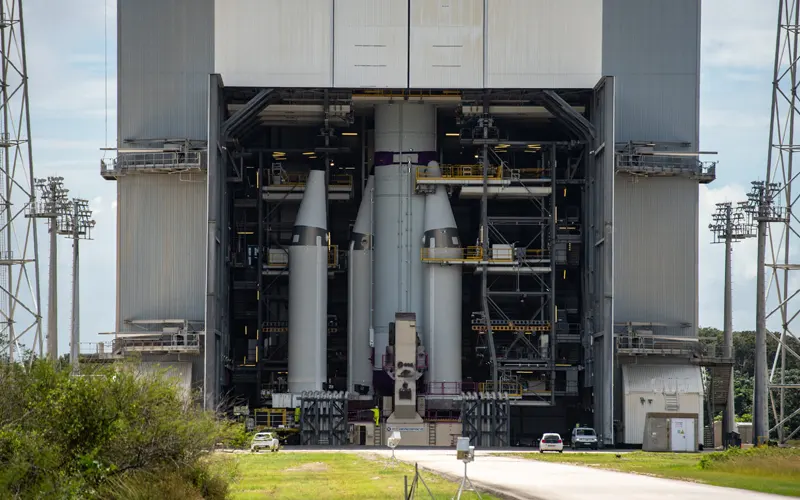
 Credit: Arianespace / CNES / ESA
Arianespace has announced that the first Ariane 64 rocket equipped with its upgraded P160C solid-fuel boosters will be launched on 17 June. The rocket will carry 36 satellites to low Earth orbit for Amazon.
Since its introduction in July 2024, a total of seven Ariane 6 flights have been launched from the Guiana Space Centre’s ELA-4 launch site. The first five used the rocket’s two-booster configuration, while the two most recent flights used the more powerful four-booster configuration. All seven, however, used the P120C, the current generation of the rocket’s solid-fuel strap-on booster.
In December 2025, the European Space Agency announced that it had fully qualified the upgraded P160C booster, which includes an additional 14 tonnes of solid propellant, bringing its total propellant load to approximately 160 tonnes. In late April 2026, Arianespace confirmed that the first Ariane 6 flight to include the upgraded boosters would be VA269, the company’s third launch for Amazon.
Powered by four P120C boosters, the previous two Ariane 64 rockets each carried 32 Amazon satellites to orbit. With the upgraded P160C boosters, the rocket will now carry 36 of the same satellites, an increase of around 12%.
“Every additional satellite we can safely deploy on a single launch accelerates the pace at which we scale our constellation and bring reliable connectivity to customers around the world,” said Melissa Wuerl, director of Launch Systems, Amazon Leo. “The upgraded P160C boosters give us the performance margin to do that confidently.”
The launch of the VA269 mission is scheduled for liftoff between 12:53 and 14:22 CET on 17 June. The last of the 36 satellites is expected to be deployed into orbit approximately one hour and 50 minutes into the flight. The mission will mark Arianespace’s third completed launch for Amazon in less than five months.
Following the launch of the 36 satellites, the next Ariane 6 rocket launch is expected to occur on 28 August with the rocket in its two-booster configuration. While the CNES “mark your calendars” announcement did not mention the expected passenger for the flight, it is likely to be the Meteosat-14 weather satellite for the European Organisation for the Exploitation of Meteorological Satellites (EUMETSAT).
Keep European Spaceflight Independent
Your donation will help European Spaceflight to continue digging into the stories others miss. Every euro keeps our reporting alive.