
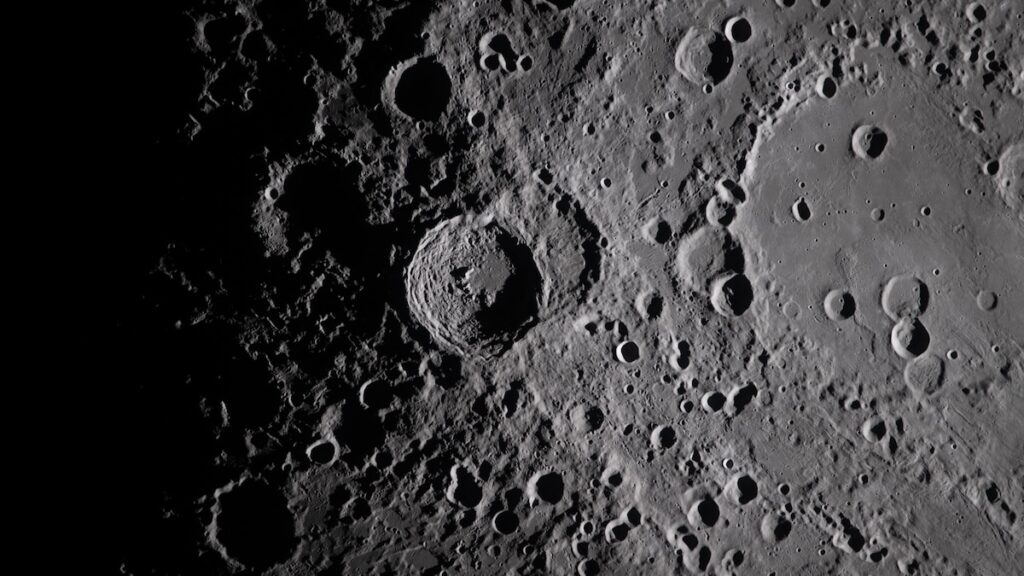
Thankfully, there’s a great hiding spot just 240,000 miles away. “For radio astronomy, the moon is one of the best places,” says Garrett. If you’re on the lunar far side, you’re facing away from Earth, and the moon acts as a giant geologic barrier to the planet’s cacophony. And if you take measurements at night, it also filters out the sun’s own radio interference.
Without all that noise, a lunar telescope could pick up a variety of signals that are harder for radio telescopes to pick up on Earth. “It’s also important for the search for extraterrestrial intelligence,” says Garrett. One of the biggest obstacles to identifying a radio signal coming from alien technology is trying to pick it out of Earth’s own radio commotion. This would be far easier to do on the tranquil lunar far side.
Any radio astronomy conducted on the moon would be welcome. But detecting a signal from “the cosmic dark ages is the long-term goal,” says Slosar. Around 380,000 years after the Big Bang, the universe was a soup of neutral hydrogen gas. That hydrogen would eventually clump together and ignite as the first stars, but back then, there was nothing but darkness.
But raw hydrogen emanates radio waves of a very specific wavelength. This distant signal would be extremely weak, but if scientists could tune into it, they could find out how ordinary matter interacted with enigmatic dark matter—an as-yet undetected ‘glue’ that binds the universe together—to shape the cosmos we live in today.
There’s no guarantee that a telescope on the lunar far side will be able to hear anything: Even with Earth and the sun blocked out, the hum of the Milky Way galaxy itself is still far louder than those hydrogen whispers. But if it does detect those murmurs, our understanding of the universe will change forever. “It’s totally uncharted territory,” says Garrett.