
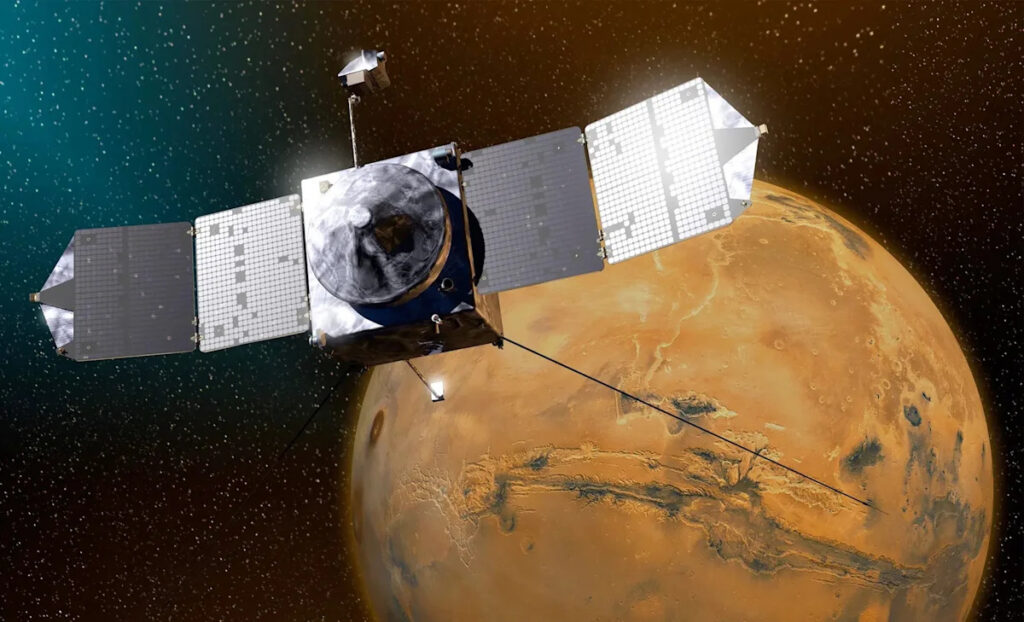
On Wednesday, NASA officially confirmed what we’d been hoping wasn’t true: The MAVEN Mars mission is officially dead. It’s not a surprising announcement, since the probe (fully named the Mars Atmosphere and Volatile Evolution Mission) had been out of contact since December, but many had hoped for a miracle to bring the satellite back to life.
Instead, we now know that the 11 years of data MAVEN produced is the only data we’ll ever get from it.
MAVEN was technically supposed to last a mere two years, with its initial operations planned to end in 2015. But it ended up orbiting for more than a decade. This is typical, as NASA usually picks relatively short proposed lifetimes and then massively exceeds them.
It’s a good public relations strategy, and proof that the mission basically justified itself early on. After that, everything it delivered was extra value.
Here’s the official NASA announcement livestream (audio only), featuring a lengthy perspective from the mission’s leaders.
The fact that MAVEN and many other NASA projects technically exceed expectations could be helpful in the quest to consistently demonstrate value going forward. In the live stream above, the mission’s chief scientists use the phrase “on time and under budget” multiple times in reference to the MAVEN mission.
That’s too similar to NASA’s new overall catchphrase, “under budget and ahead of schedule.” It would seem that even decade-old projects remain subject to scrutiny under the agency’s new austerity regime and must be framed around efficiency and return on investment.
So, just what did MAVEN send back over its 11 years of service? Well, lots. MAVEN wasn’t a single-instrument spacecraft but was packed with instruments for collecting ultraviolet light, measuring magnetic fields, and directly analyzing atmospheric samples.
First, it showed the Sun’s impact on Mars. It revealed that the Martian atmosphere is severely eroded by solar radiation and that solar storms can have a big impact on the planet. MAVEN’s ability to simultaneously measure the Sun and Mars made it the only NASA spacecraft capable of producing this insight.

mars maven ultraviolet images
While it was orbiting Mars, MAVEN snapped and some amazing ultraviolet images of the Red Planet.Credit: NASA
There are also MAVEN’s readings of Martian auroras, showing that, unlike terrestrial auroras, those on Mars can actually occur across the entire planet. It also captured the first-ever readings of so-called “atmospheric sputtering,” in which particles collide with the atmosphere, causing perturbations that eject pockets of gas. This also occurs on Earth, but has a lesser impact due to the higher gravity pulling these pockets back in.
Then there are the events that MAVEN just so happened to be around to witness. It was able to see the impact of a 2018 global dust storm on the upper atmosphere, proving that dust storms actually eject water into space. MAVEN was even around to help collect data about comet 3I/ATLAS, imaging it in the ultraviolet range.
Don’t worry, though: MAVEN is sure to be in the news for years to come. The nature of the data it provided is such that astronomers and all manner of other scientists still have some time before they can be sure they’ve fully mined it for insights. The spacecraft itself should also continue orbiting for another 50-100 years before deorbiting into Mars.
Here’s hoping that future NASA budgets allow for the launch of a successor probe that can fill its unique role.