
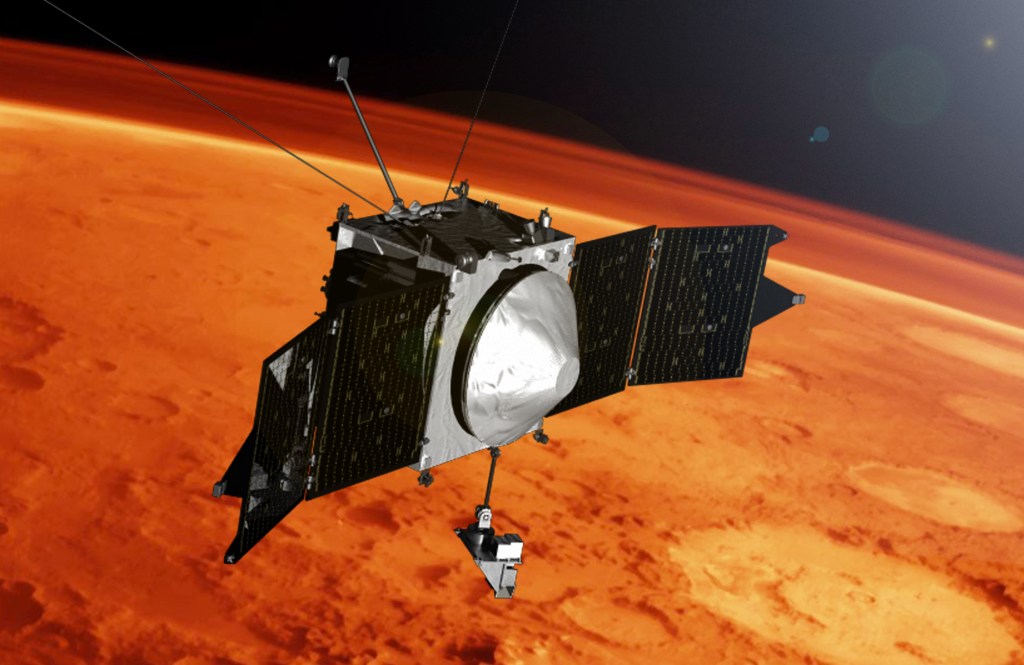
NASA officially declared its Mars MAVEN spacecraft dead on Wednesday, marking the end of a mission that was led by the University of Colorado Boulder for more than a decade.
The MAVEN spacecraft, or the Mars Atmospheric and Volatile EvolutioN, was launched in 2013 as the first NASA mission devoted to observing the Martian atmosphere and its evolution. The spacecraft was last heard from Dec. 6, when it experienced an unexpected loss of signal after it passed behind Mars. NASA conducted an investigation, and after six months of no communication with the orbiter, declared the MAVEN spacecraft officially dead.
The end of the MAVEN mission marks an emotional loss for many of the scientists who worked on it, including the more than 200 students, professors and researchers in Colorado and at CU Boulder’s Laboratory for Atmospheric and Space Physics who have worked on the MAVEN mission in the past 15 years. CU Boulder’s Shannon Curry, principal investigator for MAVEN, said the team is broken up about the loss but is “incredibly proud of the science we’ve accomplished over the past decade.”
“MAVEN’s science has had incredible implications for not just atmospheric evolution at Mars, but planetary science, heliophysics and even astrophysics,” Curry said. “We have so much to learn from the data set that we’re about to get ready to archive, and not just for science, but to understand some of the biggest factors and threats for future exploration of Mars.”
MAVEN reached Mars in September of 2014 to study the planet’s upper atmosphere and determine how its climate evolved from warm and wet to the current cold and dry conditions. Initially designed as a one-year mission, MAVEN continued orbiting Mars and collecting data for more than 11 years. NASA planned to use the spacecraft for as long as possible, and its fuel was expected to last through 2030. Up until its death, the spacecraft continued to collect data to determine whether Mars was once habitable for life.
In December, all systems on board MAVEN were working normally before the spacecraft passed behind Mars. After the spacecraft emerged, NASA could not get a signal. A brief fragment of data from radio signals analysis indicated the spacecraft was rotating at a high rate when it emerged from behind Mars, indicating a disruption in MAVEN’s orbit trajectory. A NASA review board concluded that due to this rotation, the batteries on the spacecraft had drained, causing the communications system to lose power and rendering MAVEN in an unrecoverable state.
Those preliminary findings do not address a potential root cause for the failure, which is still being investigated. The NASA review board is expected to provide its final report later this year.
“I’m very proud to have been part of the MAVEN mission and to build this legacy of successful missions out of the Goddard Center,” said Mike Moreau, the MAVEN project manager at NASA’s Goddard Space Flight Center. “… The team really experienced the loss of a loved one with the end of the mission here, and I want to extend my recognition to the amazing team that has labored to operate this spacecraft.”
Since its launch, MAVEN has completed more than 22,000 orbits of Mars. It is one of the largest NASA contracts CU Boulder has received, worth “millions of dollars,” according to Curry. The spacecraft helped discover a new atmospheric process called sputtering, where charged particles crash into the upper Martian atmosphere and splash out into space. MAVEN also discovered that the erosion of the Martian atmosphere increases dramatically during space weather events, when solar storms erupt from the surface of the sun. The spacecraft discovered several types of aurora, or light displays in the atmosphere, and imaged them, giving a glimpse of what an astronaut would see from Mars’ surface.
In 2024, MAVEN helped observe the biggest space weather event in 20 years, a severe geomagnetic storm on May 10 of that year that disturbed the Earth’s magnetic field. In 2018, it helped scientists study a dust storm so large it enveloped the entire planet. It also observed the unexpected, including collecting data on X-ray radiation from a black hole binary system 9,000 light-years away and images of the rare interstellar comet 3I/ATLAS that was discovered to be traveling through Earth’s solar system in July 2025.
Despite the disruption to its orbit, the MAVEN spacecraft is still orbiting Mars, where it will remain for the next 50 to 100 years before it will crash down through the Martian atmosphere.
“MAVEN’s decades of operations help us understand Mars’ path, both its atmosphere and how to operate in this challenging environment,” said Greg Heckler, the deputy program manager for capability development within NASA’s Space Communications and Navigation Program. “(NASA) will take those hard-won operational lessons and build the foundation for what comes next.”
Subscribe to our new newsletter to get CU Boulder’s latest news sent straight to your inbox.