
The James Webb Space Telescope recently found something that changes how scientists think about the beginning of everything. For years, scientists have believed that galaxies came first and black holes grew within them over time. However, Webb has discovered a black hole in a distant, tiny galaxy that existed before its galaxy had finished forming.
The Chicken or the Egg
Stars were thought to be the first objects to form in the universe. These stars would eventually die, leaving behind small black holes. Over billions of years, those small black holes would continue to merge and consume vast amounts of gas, eventually forming supermassive black holes.
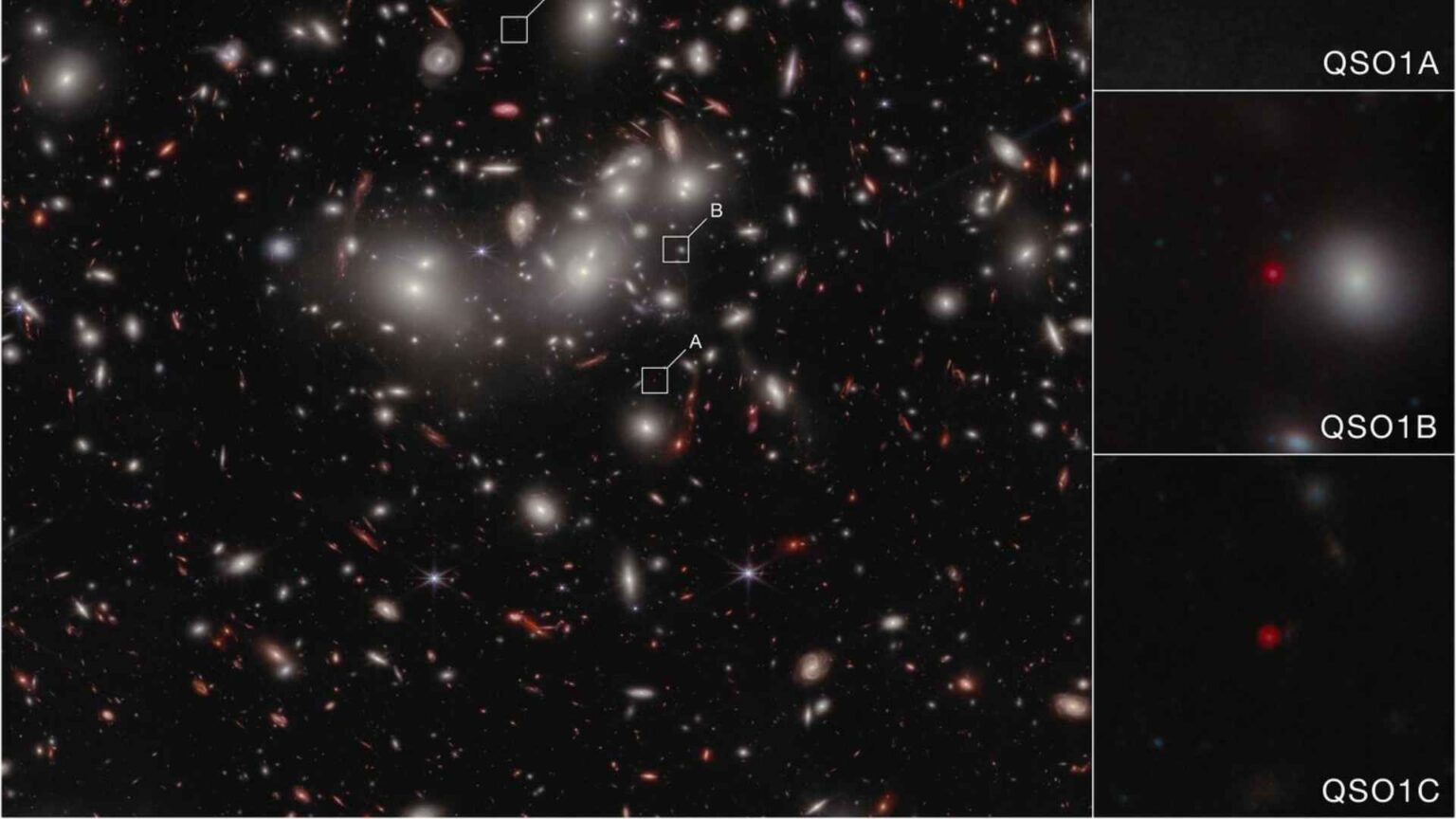
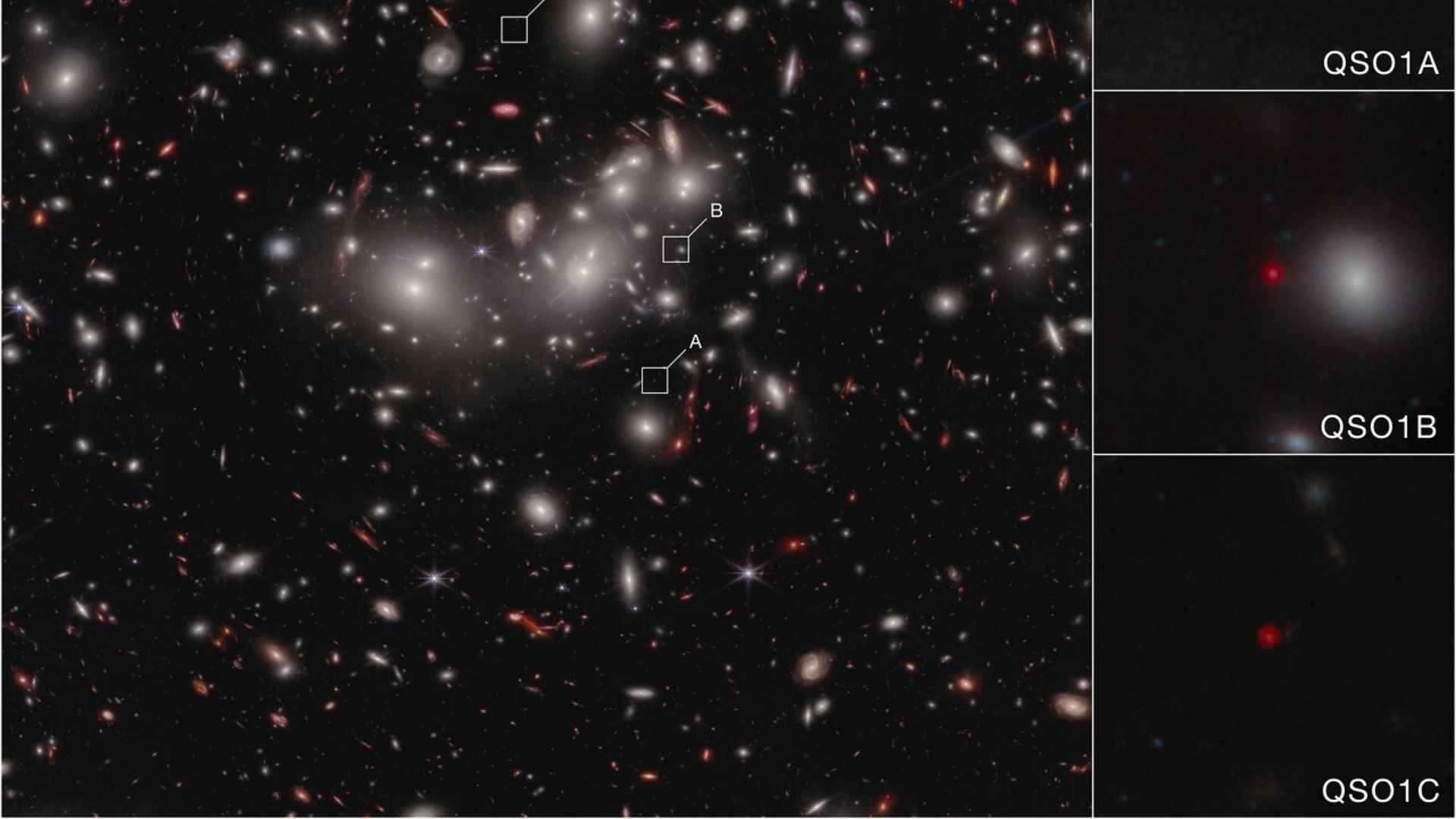 Photo: NASA, ESA, CSA, L. Furtak (Ben-Gurion University), R. Maiolino (Cambridge), F. D’Eugenio (Cambridge), I. Juodžbalis (Cambridge), H. Übler (MPE), C. Marconcini (University of Florence). Image processing: A. Pagan
However, the discovery of massive black holes existing in the early universe contradicts these theories. Webb observed a “Little Red Dot” named QSO1, whose massive black hole contained 50 million times the mass of our sun. Furthermore, the black hole’s mass accounts for two-thirds of the mass of its entire galaxy. Normally, the black hole in the center of a galaxy contains only a small fraction of the galaxy’s total mass.
Direct Evidence From Gas
Scientists were able to prove the black hole’s massive mass through the study of the gas that orbits the black hole. The motion of the gas around the black hole is similar to how planets orbit the sun, which allows us to calculate the black hole’s mass. The composition of the gas surrounding the black hole was also studied.
Most galaxies contain “heavy” elements, such as oxygen, that are formed by the stars within the galaxy. However, the gas around this massive black hole was almost entirely composed of hydrogen and helium – elements formed before the creation of stars. Thus, the black hole certainly existed well before there were many stars to contribute to its massive size.
Born big
The leading theory for the formation of the black hole is that it was “born big” – it did not originate as a much smaller black hole that grew over time. The massive amount of gas that collapsed into the black hole may have formed after the Big Bang.
While this discovery of a massive black hole that predates the formation of the galaxy in which it exists overturns current theories, the James Webb Space Telescope is continuing to observe other “Little Red Dots” to determine if this phenomenon is the exception to the rule, or if it is actually the typical existence of such massive black holes within their galaxies.