
In 2012, a NASA research probe confirmed a fact that had seemed like science fiction: on Mercury—a planet that is literally baking in the sun’s rays—there are vast deposits of water ice. They are hidden in deep polar craters where sunlight never reaches. However, the mechanism by which water reached this inhospitable planet remained a cosmological mystery for a long time.
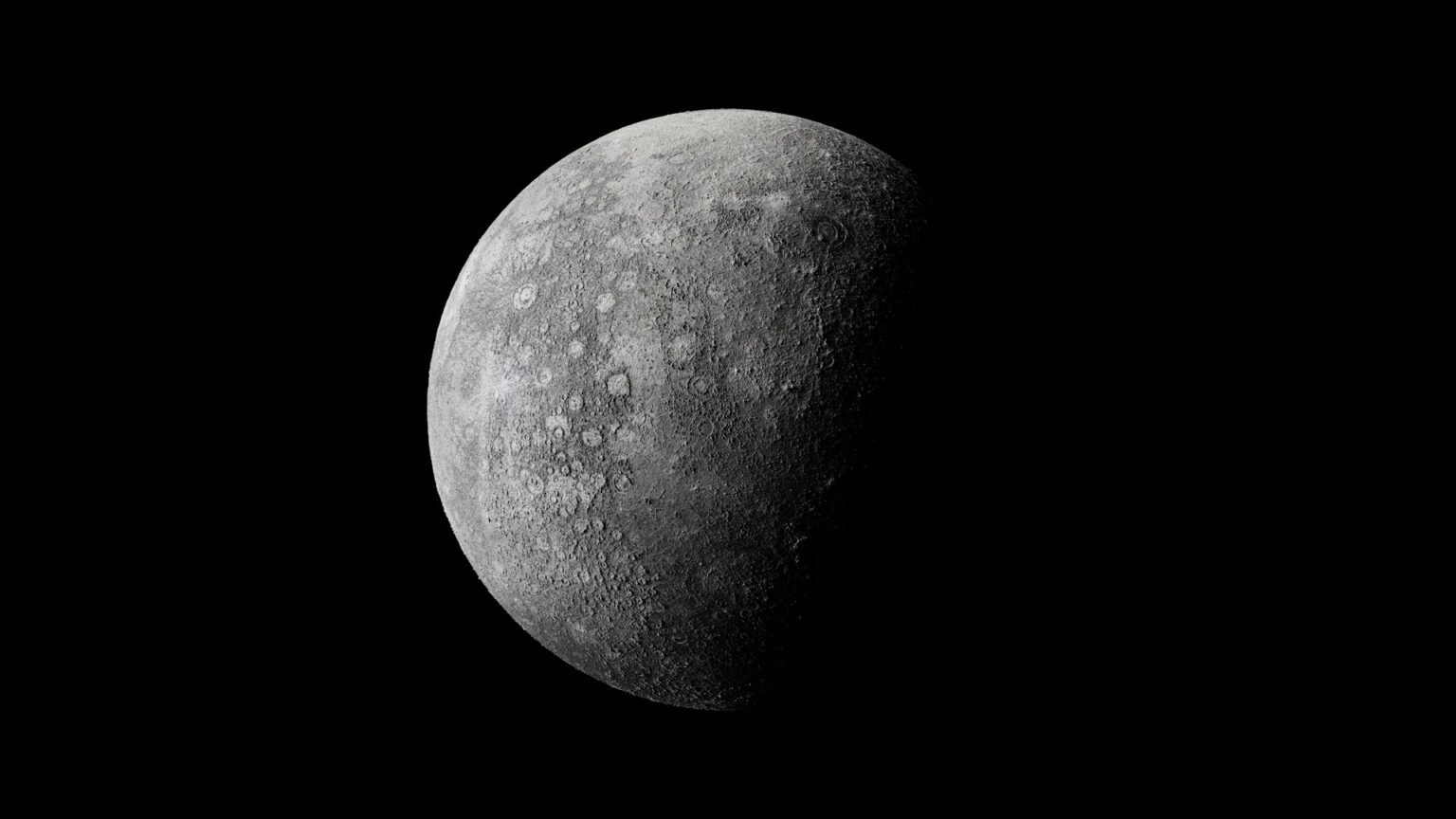 Mercury. Illustration: Unsplash
Today, the veil of mystery has been lifted. A new study, published in the Journal of Geophysical Research: Planets, demonstrates that all of Mercury’s water appeared almost instantly by cosmic standards. A massive collision with a water-rich object—a comet or an asteroid—delivered these reserves to the planet in just one Mercurian day, which lasts about 157 Earth days.
A planet of extreme contrasts
Mercury is our sun’s closest neighbor. To a hypothetical observer on its surface, the sun would appear three times larger than it does in the Earth’s sky, and its blinding rays would be seven times brighter. Due to this extreme proximity to the sun, daytime temperatures there reach a scorching 430 °C.
Interestingly, Mercury isn’t the hottest planet in our Solar System—that title belongs to Venus, thanks to its extremely dense atmosphere, which creates a greenhouse effect. Mercury, on the other hand, has virtually no atmosphere of its own. That is why the planet cools rapidly at night, with temperatures dropping to an incredible -180 °C.
Despite such freezing temperatures on the night side, the presence of water on the surface seemed unlikely. But as early as the 1990s, radar observations from Earth detected areas of abnormally high signal reflection at Mercury’s poles. These bright “spots” were the first hint of the existence of ice. The world received definitive confirmation in 2011, when the Messenger spacecraft made history as the first artificial satellite of Mercury, mapping these ice deposits in detail.
The day that changed everything
To determine the origin of this water, a team of scientists led by Parvathy Prem of the Johns Hopkins Applied Physics Laboratory developed complex computer models. These models took into account the detailed topography of the perpetually shadowed regions and the extreme temperature fluctuations on the surface.
The simulation results painted a striking picture: the “culprit” behind the formation of ice was a space object about 17 km in diameter that struck Mercury at a colossal speed—nearly 30 km/s. This apocalyptic impact released so much energy and water vapor that within an hour of the collision, the planet was enveloped in a dense, albeit temporary, atmosphere.
Salvation in eternal shadow
If it weren’t for this sudden atmosphere, the water would have been doomed. Most of the water vapor formed during the impact would inevitably have been destroyed by the devastating effects of solar photons (a process known as photolysis). However, the dense cloud of vapor acted as a kind of shield: it effectively blocked the Sun’s ultraviolet radiation, slowing the breakdown of water molecules.
This protective barrier gave the water enough time to migrate to the coldest places on the planet—its poles. There, water molecules settled in deep craters, where temperatures remain consistently low, and turned into ice, safely shielded from the sun’s destructive rays.
The scientific community eagerly awaits new data that will help confirm this theory. Hopes are pinned on the large-scale BepiColombo mission—a joint project of the European Space Agency (ESA) and the Japan Aerospace Exploration Agency (JAXA). Launched back in 2018, the spacecraft is set to become the second probe in history to enter the orbit of the enigmatic Mercury to continue studying its icy secrets.
Earlier, we shared 12 interesting facts about Mercury.
According to gizmodo.com