
— On April 29, Wadena-Deer Creek junior, Enoch Horton joined students from across the country at the NASA Johnson Space Center in Houston, Texas, to participate in the NASA HUNCH (High school students United with NASA to Create Hardware) Final Design Reviews — where students presented their completed projects for formal evaluation after months of design, development and iteration.
Over 550 schools from 34 states and 3,800 students participate in the program annually, with the top three students from 11 regions advancing to the final design review. Mike Shrode, WDC middle/high school technology and engineering teacher leads the NASA HUNCH program and said WDC is the only rural school in Minnesota to participate in the program with Horton being the first student to be selected as a finalist.
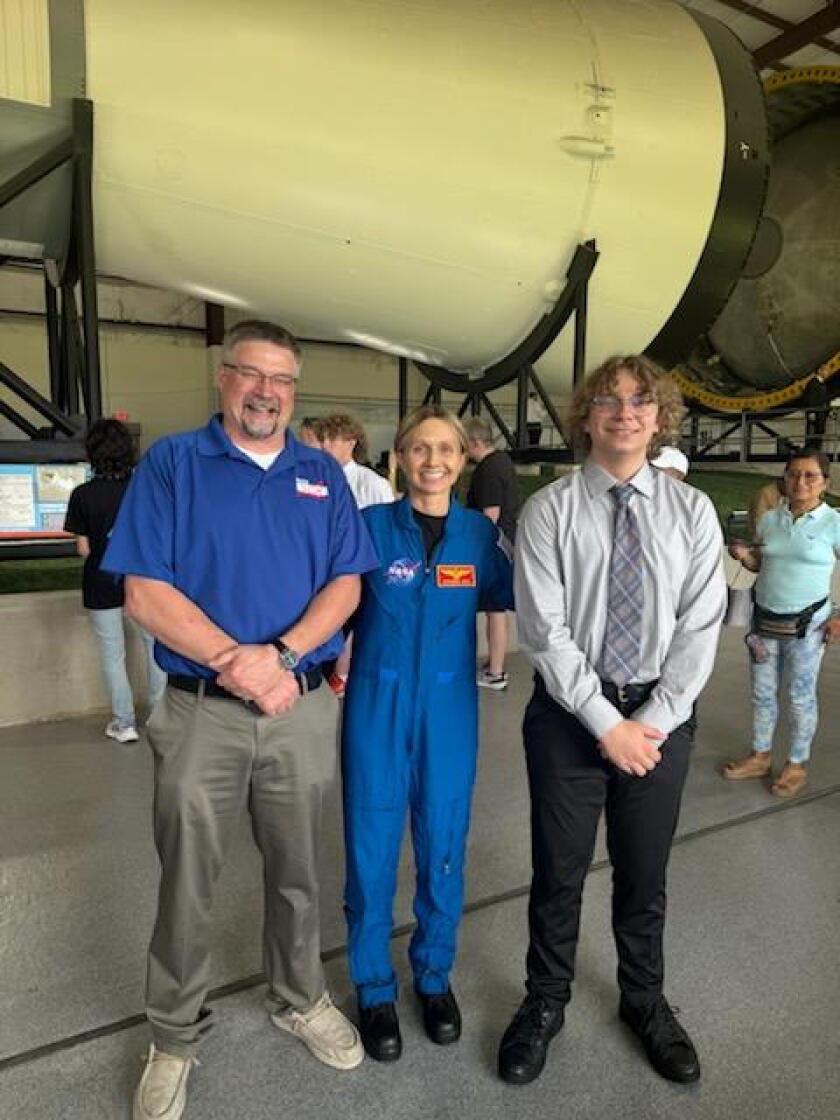
Wadena-Deer Creek junior Enoch Horton (right) stands with teacher Mike Shrode (left) and a NASA astronaut (center) during the NASA HUNCH Final Design Review at Johnson Space Center in Houston. Horton presented an AI-powered satellite project aimed at improving orbital sustainability and expanding access to space research.
Contributed / Mike Shrode
Set against the backdrop of Rocket Park and its towering full-scale Saturn V rocket, student teams presented projects they had spent months developing to mentors, engineers, NASA scientists and astronauts. Designed to address real challenges encountered in space exploration, the projects created by students aim to provide creative solutions to advance human spaceflight and support future missions.
“The program follows engineering protocols and begins during the first week of school,” said Shrode, adding the program, now in its fourth year at WDC, is an instructional partnership that challenges students to design and manufacture real-world products for NASA.
The program offers eight categories to choose from, including hardware manufacturing, design and prototyping, biomedical, soft goods, culinary challenge, software and artificial intelligence, video and media and flight configuration.
“The students do some brainstorming, get some ideas how they want to solve the problem and then they go on to the preliminary design review,” said Shrode, who added the preliminary design review takes place in the Twin Cities. “NASA engineers come in person for that and give kids constructive criticism on their projects, help them with some insight and improvements they can make. Then they get the next six to eight weeks to build a prototype and presentation.”
Horton’s software design project — a docking of a SlimSat, part of a CubeSat — uses AI and a realistic physics engine that simulates how satellites move in space. Through trial and error, Horton said the AI learned how to navigate and perform maneuvers in low Earth orbit.
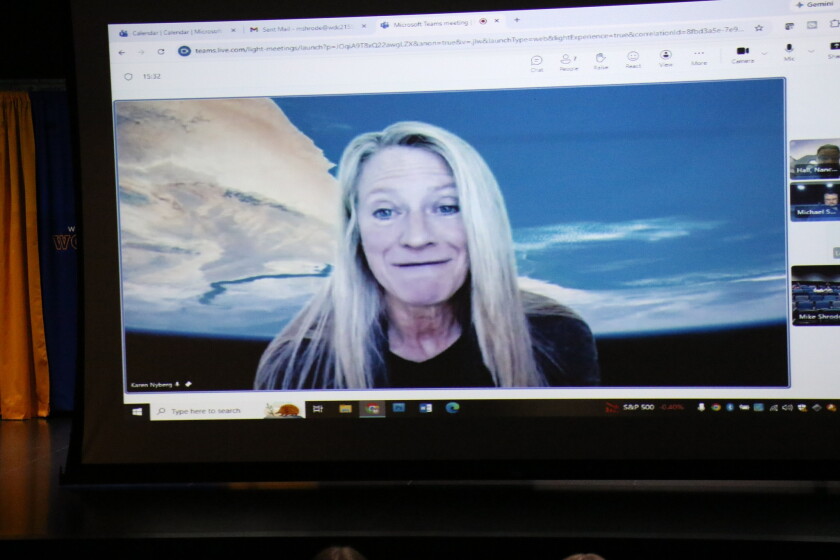
Vining native and retired NASA astronaut Karen Nyberg surprised Enoch Horton via Zoom on March 19, to announce Horton was a national finalist in the NASA HUNCH software design competition.
Photo / Norm Gallant
“The project, my side of it, is a software engine that has physics that are fairly realistic, which we do in high fidelity and a neural network backing, which basically learns from itself and its past mistakes and its past motions,” said Horton, who added the project was a collaboration with the University of Lafayette, alumni from the University of North Dakota and Sanford University.
“So what happened is it learned orbital dynamics in low earth orbit, which is a little bit shy of the ISS (International Space Station),” said Horton, who added that Earth is 25 kilometers below the International Space Station.
Horton said the bigger goal is making space research more accessible and sustainable.
“The whole mantra of this project is accessibility,” Horton said. “A larger school with more resources could purchase a CubeSat that carries several smaller SlimSats. Then, through an API or other access system, they could share that platform with smaller schools so students can conduct research in space without the financial burden of launching their own satellite.”
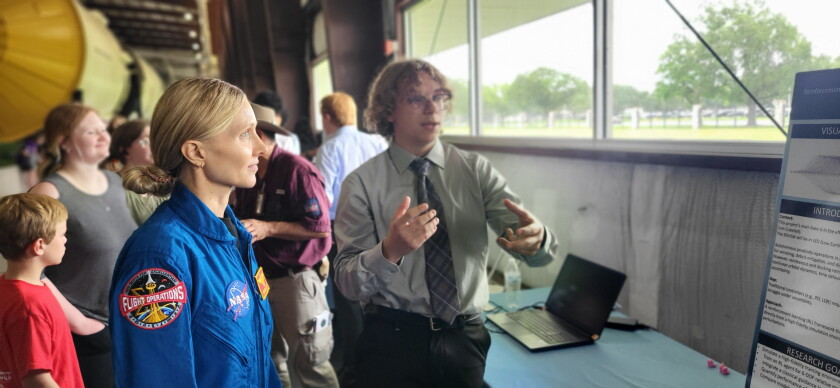
WDC junior Enoch Horton explains the design and goals of his satellite sustainability project to a NASA astronaut during the NASA HUNCH Final Design Review at Johnson Space Center in Houston. Horton was among the students selected to present their work to NASA engineers, scientists and astronauts.
Contributed / Mike Shrode
He explained that satellites in low Earth orbit slowly lose altitude because of atmospheric drag.
“The main thing, why this is important, is satellites need to be refilled to keep them operational, because of the low Earth orbit, they’re constantly getting slight decay from the atmosphere and causing their apogee to be lower,” said Horton.
Apogee, Horton explained, commonly refers to the highest or most successful point of something. For satellites in space, it is the point in the orbit that is at the greatest distance from the center of the Earth. He said the International Space Station needs to be refilled constantly for it to stay in orbit.
“Some satellites, if it’s too costly to refill, they just let it crash down and burn in the atmosphere,” said Horton, whose project helps combat the ongoing issue of defunct satellites which are contributing to the growing problem of space debris.

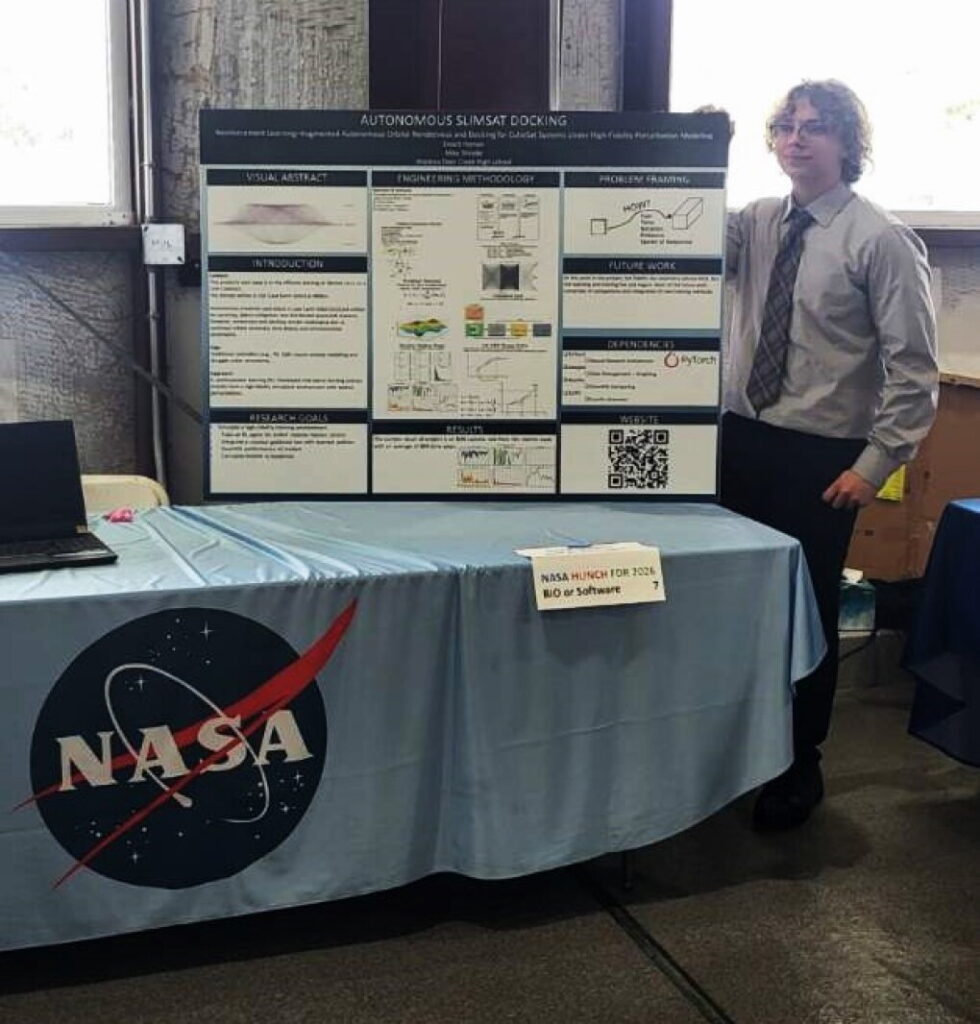
After returning from Houston, WDC junior Enoch Horton (right) and teacher Mike Shrode pose with the display board Horton used to present his AI-powered satellite project at NASA’s HUNCH Final Design Review.
Nicole Stracek / Wadena Pioneer Journal
“This entire maneuvering in low Earth orbit is kind of an essential to the future in long orbital sustainability,” said Horton, adding that AI could potentially help plan efficient orbital maneuvers, extend satellite lifespans, assist with refueling and reposition satellites and improve long-term sustainability of low Earth orbit.
“Some people say AI is taking over the programming sphere, which is multifaceted and kind of nuanced,” he said. “But I feel like it won’t be completely replaced. It will be a tool that people who know how to use it will flourish.”
While at the Johnson Space Center to present his final design review, Horton said he felt a mix of excitement and pride. Horton said he was challenged to clearly communicate his project and ideas, defend his design decisions and demonstrate a technical understanding — meant to mirror the rigorous review process used in real NASA missions.
Now in his fourth year of the NASA HUNCH program, Horton said the program is a self-focused independent or group research project, and although it may sound intimidating, it’s really not.
“You get to choose your partners, but the big thing for me is the connections you make along the way. Without this project, I probably wouldn’t have had as many opportunities as I have been given,” said Horton. “Because of my project this year, I was a NASA intern, 2025 through 2026, for my project and without the things I’ve done and kind of given the room to grow and change, I wouldn’t probably have become the person I am right now.”
But in the meantime, Horton said he has plans to spend his summer learning calculus, linear algebra and discrete mathematics. “Besides that, working and applying for scholarships.”