
Enabling & Support
02/06/2026
4 views
0 likes
Behind a heavy, white door inside an ESA ESTEC laboratory sits an unassuming metal and glass cabinet. Tucked between the metal storage shelves it overflows with plastic and foil wrapped objects, far from the outer space vacuum where they once operated.
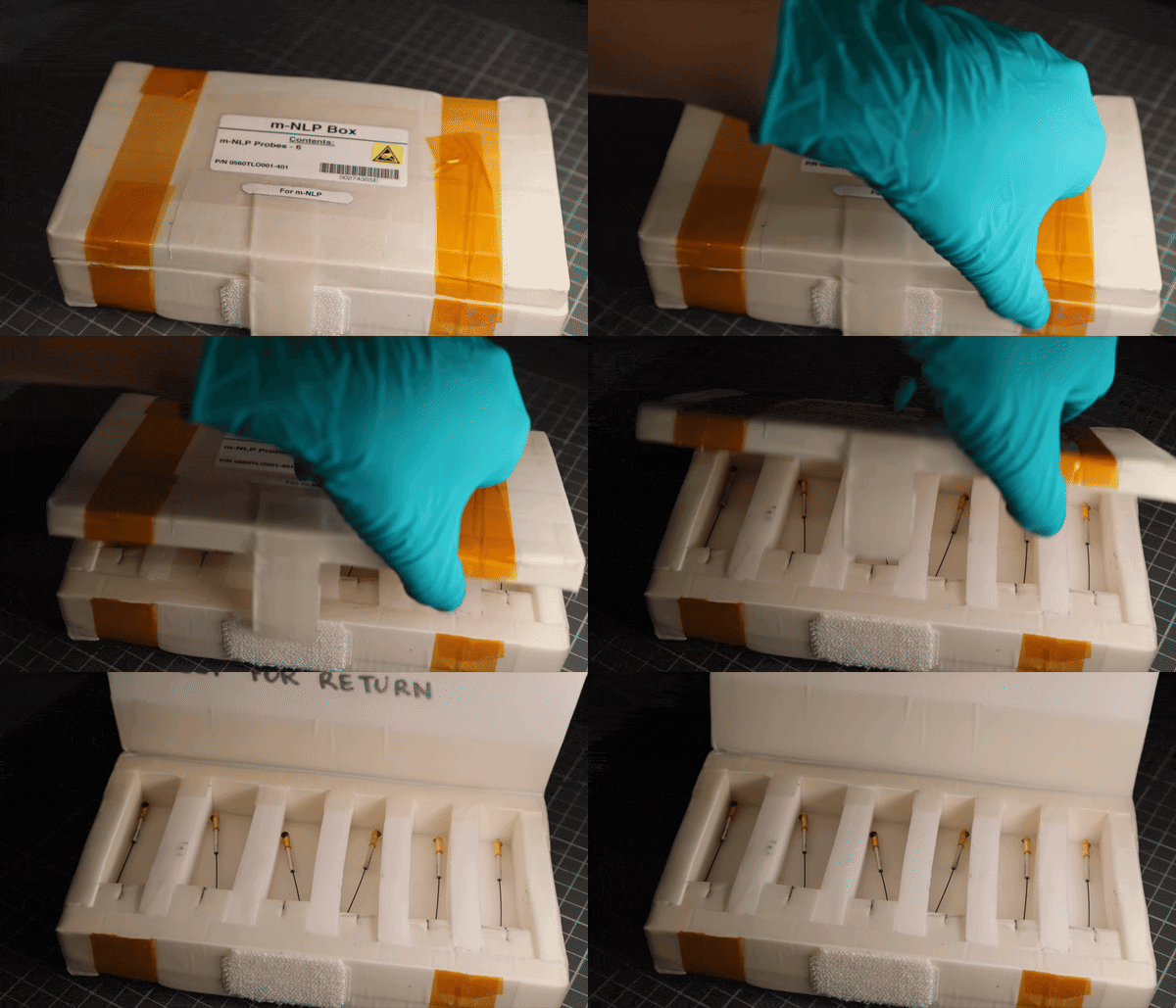
Inside, continuously flushed with nitrogen, six credit-card length pieces of wire lie in a cream box, with no evidence to show that they are integral to a mission quietly pushing the boundaries of how we observe space.
These are the needles from the Multi‑Needle Langmuir Probe (m‑NLP), a Norwegian-built instrument developed with ESA’s General Support Technology Programme (GSTP), ESA’s PROgramme de Développement d’Expériences scientifiques (Prodex) office, the University of Oslo and industrial partners including EIDEL. They recently returned from an inaugural flight onboard the International Space Station (ISS), where they were able to sample and map the charged particle environment around the ISS, taking almost 5000 measurements per second to reveal fine-scale structures that were previously invisible.
One of six needles from the Multi‑Needle Langmuir Probe (m‑NLP)
The returned probes, weighing around 10 g each, have been carefully removed from the instrument itself to save bringing back the entire 26 kg payload. They are being examined using optical and electron microscopy, before being reintroduced into controlled plasma environments for comparison testing.
For Manuela Marcos, the ESA technician tasked with analysing them, the moment is both technical and disconnected. Handling protocols are strict as the probes must be stored in inert atmospheres, manipulated only with gloves and never touched at their most sensitive points.
“You cannot touch them without gloves,” Manuela says. “And you try to avoid touching the needle — that’s the part we care about.”
Examining m-NLP needles in ESA storage room
She works precisely and methodically, using optical microscopy and scanning electron microscopy (SEM) to conduct chemical composition analysis and surface imagery to see how the probes might have degraded during their time in space.
“We want mainly pictures,” she explains. “Very good pictures, like with the SEM where you see the surface in really, really fine detail.”
Slowly the story of the needle’s space flight begins to appear. “In the optical microscope, you can see different colours,” notes Manuela. “Some parts look like they had a coating before and it went away or eroded.”
Optical microscopy image of th m-NLP needle
These variations may point to the effects of radiation hazards in low Earth orbit. Or the paint might have flaked off during transport.
“With the SEM, you bombard the sample with electrons,” she explains. “Then with Energy-dispersive X-ray spectroscopy (EDX), you can actually identify the chemical elements in different areas of the surface.”
Even simple steps like laying the probes out for imaging becomes an exercise in precision and patience.
“There are six of them,” she explains. “But only three are being tested right now. The others couldn’t be safely separated, so they’re still packaged.”
Human interactions
The mNLP’s performance depends on the electrical behaviour of its probes, which is directly influenced by its surface properties. “The evolution of the surface material is very important,” explains Espen Trondsen, one of the lead engineers from EIDEL. “It influences the current–voltage characteristics we measure.”
“There are limitations,” he explains. “The probes have been stored and handled since return. Even on the ISS the environment isn’t perfectly controlled so we need to take that into account.”
“It’s the first time these probes have been brought back to Earth after a flight. We expected the surface to be altered by atomic oxygen, as we know these oxide layers form and performance can be affected, but it’s the first time that such an effect might be characterised.”
Early results
m-nLP successfully transferred to Bartolomeo platform
Early mission analysis confirms that, despite the loss of one measurement channel, the instrument performed strongly.
“The instrument worked nominally except for one channel,” the EIDEL operations team notes. “We still had more than the minimum configuration.”
The data itself is currently undergoing extensive analysis but already seems to show a marked improvement on any earlier data. “The difference in sampling rate is about a factor of 300,” says Tore André Bekkeng, an engineer on the team at EIDEL. “That changes what you can actually observe.”
“These kinds of measurement are interesting, they are very relevant for the monitoring of the Earth’s ionospheric environment, which is expected to vary with, for example, solar activity and events triggering for instance geomagnetic storms,” says Fabrice Cipriani, the ESA Technical Officer monitoring the instrument’s progress. “We met the goals for instrument performance but now we have access to the high-frequency data that allows us to connect instrument performance with real geophysical phenomena.”
“The outcome is positive”
The experience gained working as one of the first payloads on Airbus’ Bartolomeo platform has also strengthened collaboration across teams. “We were effectively the pilot payload,” Cipriani reflects. “That meant solving challenges in real time, and the collaboration between ESA, Bartolomeo, the University of Oslo and EIDEL was extremely strong.”
So strong that improved versions of the m-NLP are already being prepared for multiple upcoming missions, including CubeSat platforms and larger ESA M-class missions.
“The outcome is positive,” Cipriani concludes.
Like