

ⓘ NASA – Unsplash
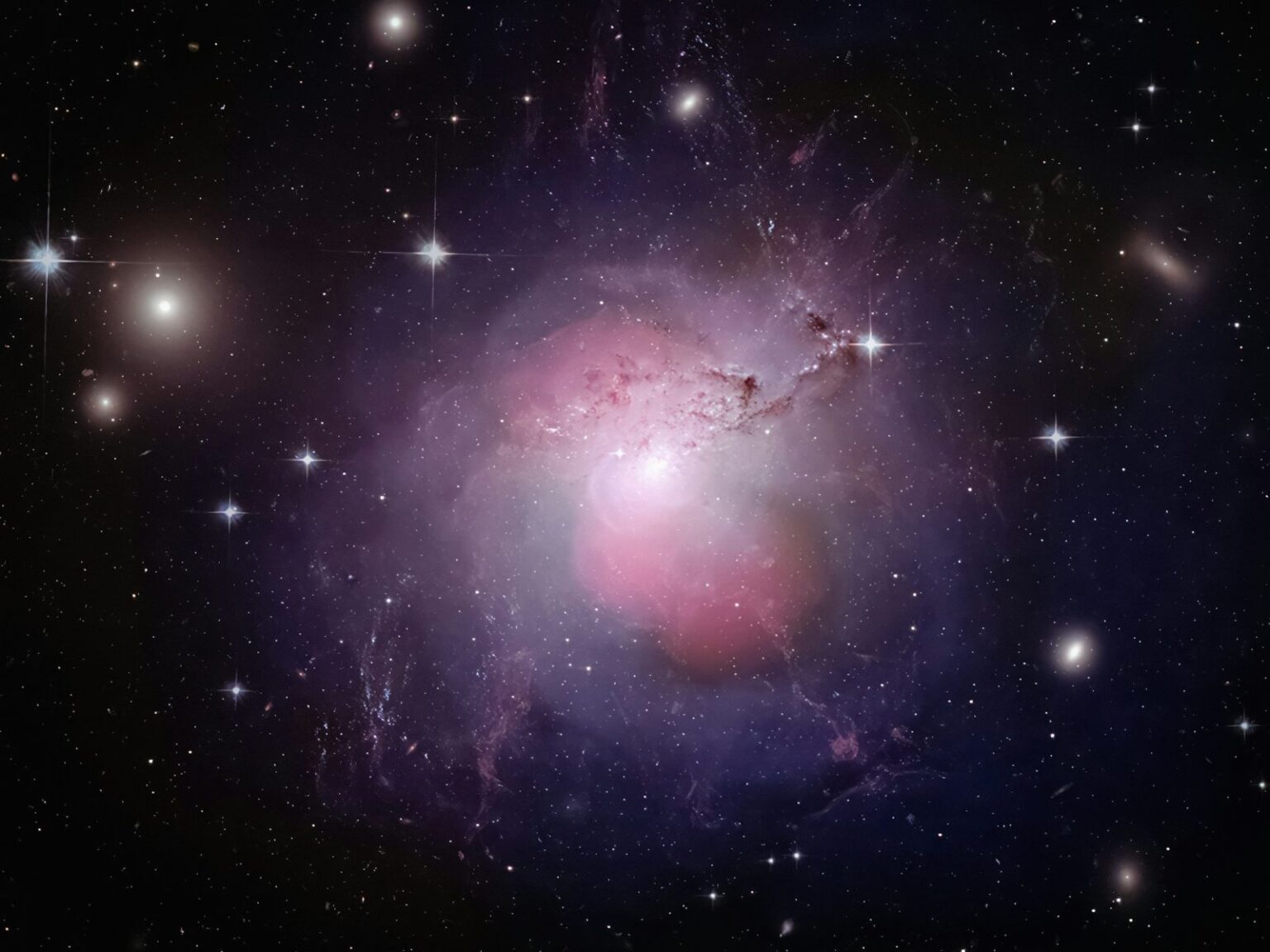
An image showing the galaxy NGC 1275.
Recently, the Hubble Space Telescope has unveiled a striking image of a dwarf galaxy located 23 million light-years from Earth. And this image may help researchers to better understand the early stages of the universe.
The Hubble Space Telescope has been observing the universe since 1990, allowing astronomers to study numerous celestial objects. Recently, this telescope captured a striking image of a dwarf galaxy located about 23 million light-years from Earth.
Known as ESO 490-017, this dwarf irregular galaxy has a very interesting composition and structure. Indeed, it measures only 12,000 light-years in diameter, while that of the Milky Way is about 100,000 light-years, and it is also very faint.
In addition, its structure is not clearly defined, as can be seen in this image. As a result, its weak gravity allows stars to move freely within the galaxy. Finally, its low luminosity is also linked to its gravity, as the stars are not concentrated in one place but are dispersed.

ⓘ NASA
The image taken by the Hubble Space Telescope showing the dwarf galaxy ESO 490-017.
However, although this galaxy may seem unremarkable, it is actually very interesting. These structures contain fewer heavy elements than spiral galaxies, and their environment is similar to that of the early universe. Thus, by discovering and studying these celestial objects, researchers will be able to better understand this mysterious period of the universe. This will also allow them to better study celestial phenomena that are still poorly understood.
Image source: NASA, ESA, R. Tully (University of Hawaii); Image Processing: G. Kober (NASA/Catholic University of America) / NASA Hubble Space Telescope – Unsplash
 Alexis Stegmann – Tech Writer – 647 articles published on Notebookcheck since 2025
I’ve been working in the field of web writing for several years, and I’m passionate about keeping readers up to date with the latest news on astronomy, technology, the world of video games and other exciting subjects. In particular, I’ve had the opportunity to work on a number of websites, which has enabled me to cover a wide range of subjects. In my personal life, I’m passionate about a wide range of subjects, including astronomy, video games, history and science. I’m also drawn to psychology, which is a subject that deserves greater documentation and recognition.