
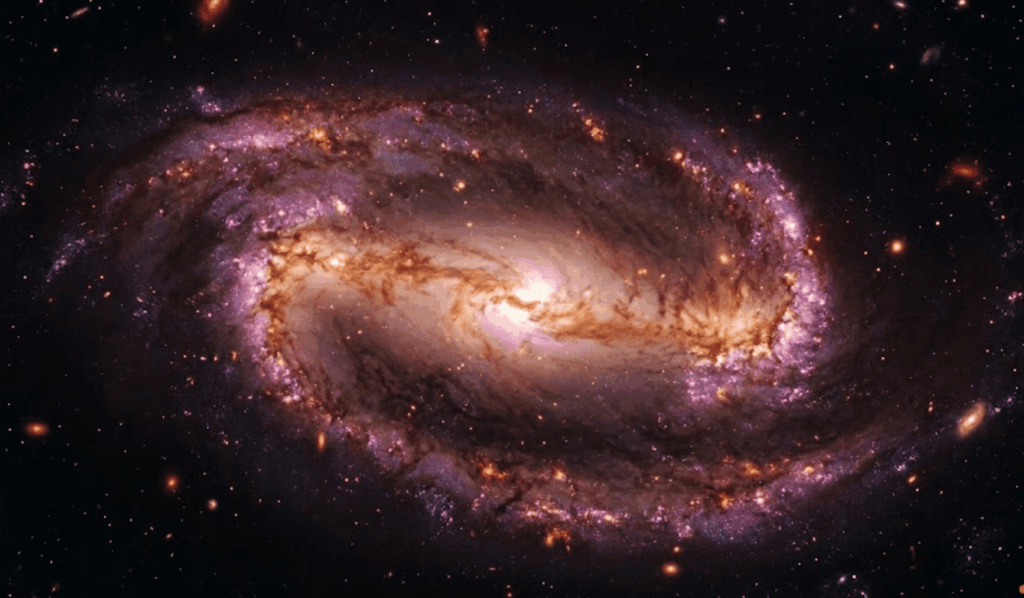
Astronomers have discovered a bar in the GN20 galaxy, which existed just 1.5 billion years after the Big Bang. According to established theories, such a structure should not have been there. But it is.
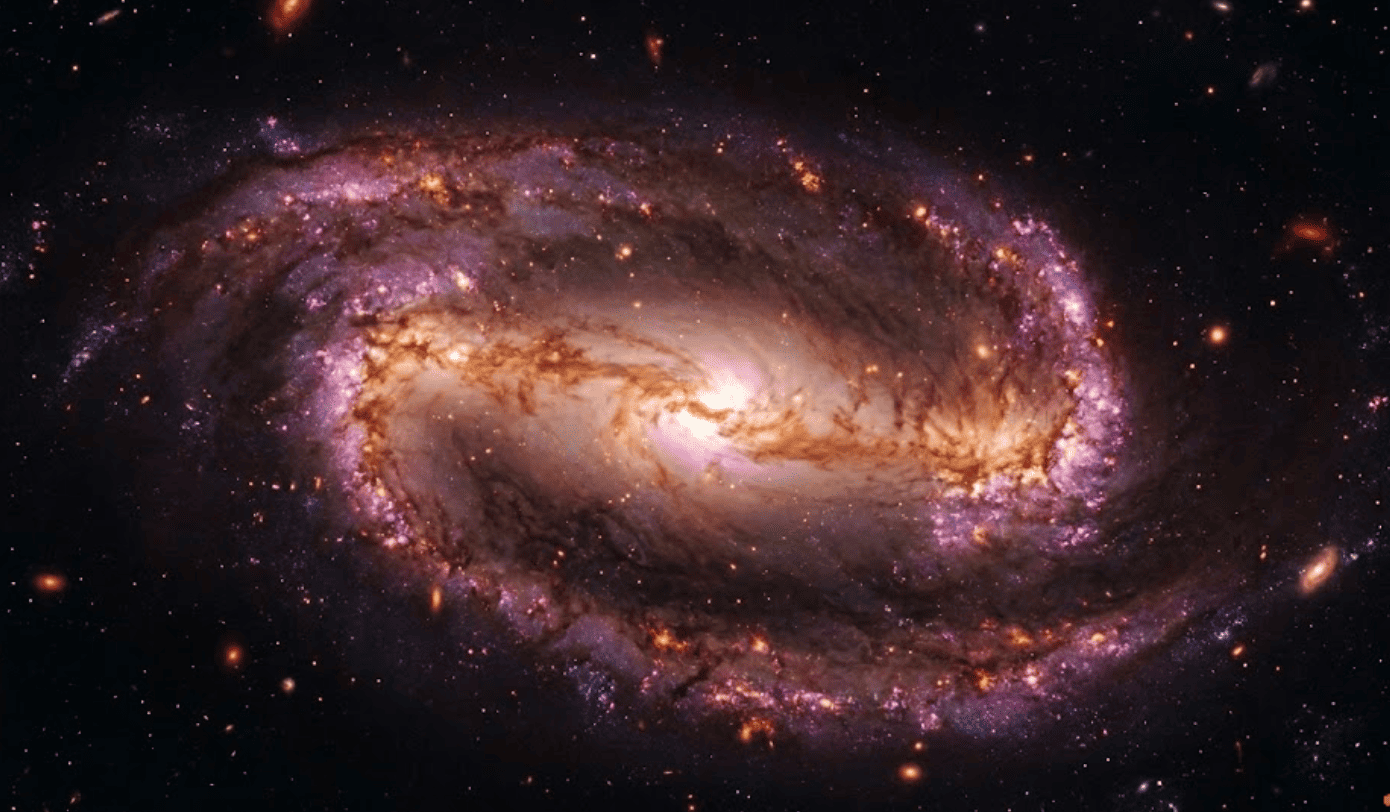 Artistic visualization of a massive galaxy from the early universe with a stellar bar at its center.
What is a galactic bar?
A galactic bar is an elongated cluster of stars that runs through the center of a galaxy and rotates as a single unit. As it rotates, it acts like a funnel, drawing gas toward the galaxy’s core, where it triggers active star formation, feeds the central black hole, and forms a dense core.
In the modern universe, bars are common. This structure is found in about two-thirds of spiral galaxies, and the Milky Way is no exception.
Why does this contradict the theory?
It is believed that the formation of a stellar bar is a slow process that takes billions of years. Furthermore, early galaxies were gas-rich, and according to current models, the gas suppressed or delayed the formation of the bar.
When astronomers began using the James Webb Space Telescope to detect stellar bars in galaxies from the first two billion years after the Big Bang, this already called standard models into question. GN20 further challenges these models.
What was hidden beneath the dust?
The GN20 galaxy has a redshift of z=4, meaning we see it as it was 12 billion years ago. The dense dust surrounding it made observations difficult. Researchers led by Leindert A. Boogaard of Leiden University used the James Webb Space Telescope’s infrared instruments, which allowed them to peer through the dust clouds.
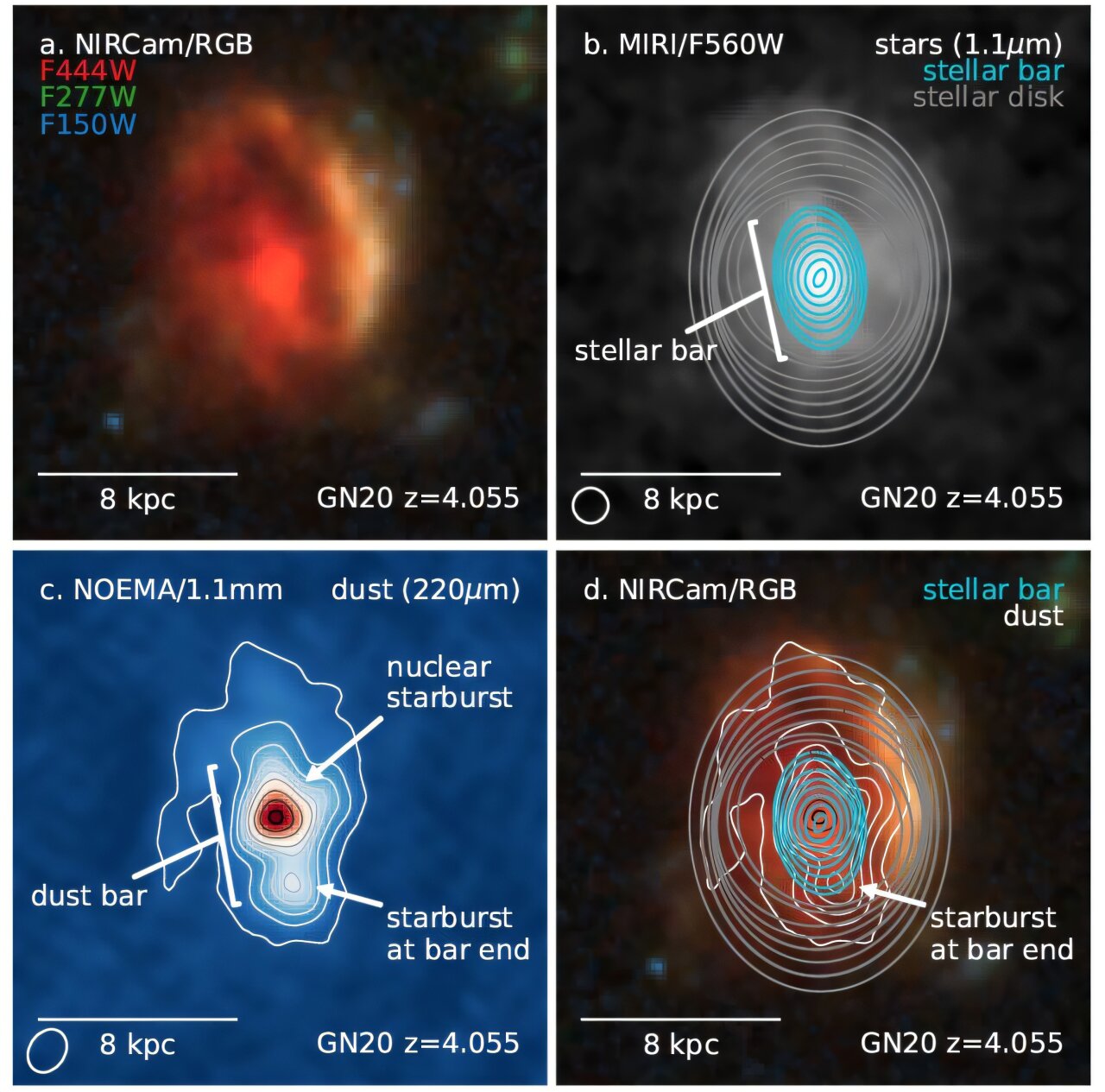 The four panels illustrate the structure of the GN20 galaxy: an image from the James Webb Space Telescope’s Near-Infrared Camera (NIRCam), an image from the Mid-Infrared Instrument (MIRI) showing a 7-kiloparsec-long stellar bar, submillimeter observations from the Northern Extended Millimeter Array (NOEMA) showing the distribution of dust across the stellar disk, and a comparison of the stellar and dust bars. Credit: Leindert A. Boogaard et al. (2026). Source: arxiv.org
An analysis of the distribution of light brightness from the center of the galaxy outward revealed a bar seven kiloparsecs long. An independent mathematical analysis confirmed this separately. Further confirmation came from the Northern Extended Millimeter Array (NOEMA), which detected a similar elongated shape in the dust distribution.
Turbulence as the key
According to classical theories, a galactic bar could not have formed under such conditions for three reasons. Typical bars are so massive that they collapse under their own weight. Even if such a bar were to form, it would take billions of years to grow to seven kiloparsecs. Furthermore, the excess gas in early disks should have slowed or halted this process.
“Our results show that all three obstacles are overcome by a single factor, which is directly indicated by the observations: the presence of highly turbulent gas in the galaxy’s inner disk, combined with a high gas fraction,” the study’s authors write.
The driving force
Observations also reveal where the most intense activity is concentrated. Where the bar connects with the outer disk in the south, gas accumulates and a region of intense star formation flares up. At the center, the bar feeds material inward, fueling the nuclear outburst and, likely, a supermassive black hole.
This may explain the star formation rate in GN20, which exceeds 1,000 solar masses per year. Once the star-forming gas is depleted, the galaxy will cease to form new stars. Scientists suggest that this mechanism explains why massive elliptical galaxies, which ceased forming new stars in the early universe, exist in the present-day universe.
According to phys.org