
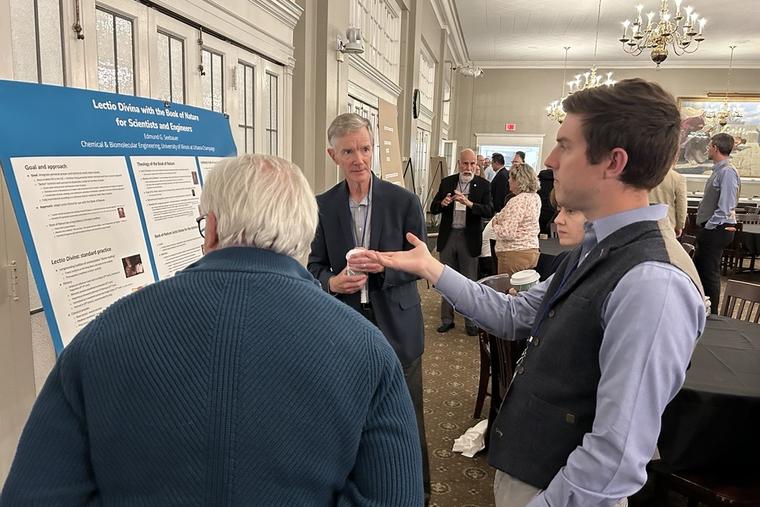
The 2026 Conference of the Society of Catholic Scientists will take place June 5–7 at Mundelein Seminary near Chicago.
The Society of Catholic Scientists (SCS) is preparing to gather for its ninth annual conference June 5–7 at Mundelein Seminary northwest of Chicago, with plans to discuss some of the major issues facing the scientific community.
The society exists as an answer to the call of St. John Paul II that “members of the Church who are active scientists” be of service to those who are attempting to “integrate the worlds of science and religion in their own intellectual and spiritual lives.” SCS does this through annual and regional conferences, college chapters, lectures, and other activities, as well as by a large archive of educational material and articles on its website.
Founded in 2016, SCS has quickly grown to over 2,700 members from 65 countries (75% are from the U.S. and Canada, followed by Spain, Poland, and the UK). Many hundreds of scientists have attended its conferences — along with theologians, philosophers, and historians — while thousands, from professors to high school students, regularly attend its local events.
Stephen Barr, a physicist at the University of Delaware and founder of the group, told EWTN News that SCS gains about 250 new members each year. He expects this year’s convention to attract approximately 130 attendees, including a significant number of young participants.
Barr explained his impetus for founding SCS. “Thereʼs this big perception in society that science and religion are at odds — this has become the conventional wisdom. It’s going to take a lot of work to overcome that,” he said.
“We are there to proclaim that they are not at odds. The mere fact that we exist shows people that there are not just a handful of scientists who are religious, but a large number of scientists who are religious — and not only that, but a large number who are believing, practicing, faithful Catholics.”
Historically, many prominent scientists were Catholic, and several of this year’s talks will highlight that joint history.
Nuno Castel-Branco, a historian of science and Research Fellow at All Souls College, Oxford, will speak about “The Anatomy of a Conversion: Nicolaus Steno and the Search for Certainty in the Scientific Revolution.”
Steno was a Danish scientist in the 1600s. A pioneer in both anatomy and geology, he became a Catholic bishop in his later years and has been beatified by the Catholic Church.
Ignasi Rosell of the Universidad CEU Cardenal Herrera will share a presentation called “John Henry Newman, New Doctor of the Church: His Vision of the University and the Place of the Sciences,” and Berta Moritz of “Science Meets Faith” will present “Gregor Mendel in Brno and Vienna: An On-Site Perspective.”
Part of SCS’ mission is being a public witness to the compatibility of faith and science and a first-of-its-kind event at this yearʼs conference will address that issue directly: an event designed to prepare Catholic scientists to deliver effective talks on science and faith. Science and Faith Speaker Training is a one-and-a-half-day workshop that will take place before the main conference begins. A grant from The Templeton Religious Trust supports this event.
Another top-of-mind topic for science-curious Catholics is human biology and sexuality, and two talks from prominent scientists will clarify aspects of these issues.
James J. Lee, a professor in the Department of Psychology at the University of Minnesota, will discuss “The Evolution of Sexual Reproduction and Differentiation” and Maureen L. Condic, a professor at The Catholic University of America whose research focuses on the role of stem cells in development and regeneration, will present a lecture on “The Biology of Human Nature and Human Individuation.”
“A lot of social issues nowadays touch upon the meaning of sex and what it means to be human,” Barr told EWTN News. “What is sex? What is a human being? We donʼt necessarily aim to have talks that address hot-button issues — actually, we try to steer clear of highly contentious social issues — but clearly a lot of theological questions revolve around the nature of sex and the nature of human beings.”
Another conference presentation will illuminate the latest research about the future of the universe. Robert J. Scherrer, a professor in the Department of Physics and Astronomy at Vanderbilt University, where he also served as department chair for 13 years, will present “How the Universe Will End.”
“The universe is accelerating, but it seems that will end at some point,“ Barr said. ”Itʼs not so clear anymore whether the universe is going to expand forever or collapse, and that is a very interesting question. It also has some theological interest if weʼre thinking about the end of the world and the next world and how theyʼre connected.”
Computer scientist Gregory F. Johnson, principal software engineer at Zap Surgical Systems, a spin-off of the Stanford Medical School, will discuss Gödelʼs Incompleteness Theorem and how it launched “a mathematical and philosophical revolution.”
“That talk is personally interesting to me, as Gödelʼs Theorem is regarded as having great philosophical implications,” Barr said. “But I think all the talks this year Iʼm going to learn something from, and thatʼs exciting. I like it when I go to a talk and come out knowing more than I did when I went in.”
The 2026 conference is open to SCS members and associates and will be livestreamed for free. The conference schedule and speaker biographies can be found here.