
Blue Origin CEO Dave Limp said Saturday that the company has regained some access to Launch Complex 36 at Cape Canaveral Space Force Station, where a New Glenn rocket exploded in a “hotfire anomaly” that’s now under investigation. “We will start clearing the pad soon and have a good rebuild plan in place,” Limp said on social media. “The booster and GS2s in the integration facility appear healthy from quick looks.” No injuries were reported after the fireball lit up the night sky on Florida’s Space Coast. The U.S. Space Force confirmed the New Glenn rocket exploded at 9 p.m. Thursday. >>Video below: Dozens call 911 after rocket explosion rocks Space Coast Footage captured by Chopper 2 the morning after the blast showed the extent of the damage, left behind by an explosion so large that one of at least 40 calls to 911 that night described it as looking like “the atom bomb.” NASA Administrator Jared Isaacman said the space agency is still analyzing what the New Glenn explosion could mean for the Artemis program and America’s moon-base ambitions. Blue Origin’s New Glenn rockets are a key part of the Artemis program, meant to serve as launch vehicles for the company’s lunar landers. Eric Berger, senior space editor at Ars Technica, told WESH 2 News on Friday that while he doesn’t think it’s an unrecoverable situation for Artemis, it’s still going to be a significant setback. “I’m thinking 12 to 18 months, probably, before they have another launchpad ready to go for the rocket,” Berger said. NASA’s target date for the Artemis III launch is late 2027, when astronauts are expected to conduct docking and rendezvous tests in low-Earth orbit as a key rehearsal for future lunar landings. Blue Origin founder Jeff Bezos said the night of the explosion that it was too early to know its root cause and work was already underway to determine what happened. SpaceX and United Launch Alliance, meanwhile, launched their Falcon 9 and Atlas V rockets from elsewhere at Cape Canaveral Space Force Station the next day, pulling off a doubleheader in spite of the New Glenn explosion less than 24 hours before. Beachgoers in Brevard County are being warned by Blue Origin that debris from the explosion could begin washing ashore in the coming days and weeks. The company said debris could appear anywhere from Playalinda Beach south to Cocoa Beach and urged the public not to touch any suspicious material that may be found along the shoreline or in the water. Reports of such debris, if any is found, can be made to 1-321-222-4355 or missionrecovery@blueorigin.com.
CAPE CANAVERAL, Fla. —
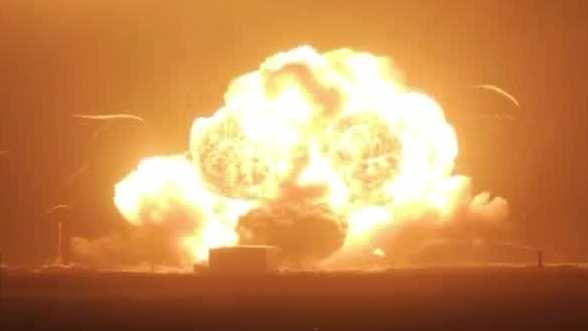
Blue Origin CEO Dave Limp said Saturday that the company has regained some access to Launch Complex 36 at Cape Canaveral Space Force Station, where a New Glenn rocket exploded in a “hotfire anomaly” that’s now under investigation.
“We will start clearing the pad soon and have a good rebuild plan in place,” Limp said on social media. “The booster and GS2s in the integration facility appear healthy from quick looks.”
No injuries were reported after the fireball lit up the night sky on Florida’s Space Coast. The U.S. Space Force confirmed the New Glenn rocket exploded at 9 p.m. Thursday.
>>Video below: Dozens call 911 after rocket explosion rocks Space Coast
Footage captured by Chopper 2 the morning after the blast showed the extent of the damage, left behind by an explosion so large that one of at least 40 calls to 911 that night described it as looking like “the atom bomb.”
NASA Administrator Jared Isaacman said the space agency is still analyzing what the New Glenn explosion could mean for the Artemis program and America’s moon-base ambitions.
Blue Origin’s New Glenn rockets are a key part of the Artemis program, meant to serve as launch vehicles for the company’s lunar landers.
Eric Berger, senior space editor at Ars Technica, told WESH 2 News on Friday that while he doesn’t think it’s an unrecoverable situation for Artemis, it’s still going to be a significant setback.
“I’m thinking 12 to 18 months, probably, before they have another launchpad ready to go for the rocket,” Berger said.
NASA’s target date for the Artemis III launch is late 2027, when astronauts are expected to conduct docking and rendezvous tests in low-Earth orbit as a key rehearsal for future lunar landings.
Blue Origin founder Jeff Bezos said the night of the explosion that it was too early to know its root cause and work was already underway to determine what happened.
SpaceX and United Launch Alliance, meanwhile, launched their Falcon 9 and Atlas V rockets from elsewhere at Cape Canaveral Space Force Station the next day, pulling off a doubleheader in spite of the New Glenn explosion less than 24 hours before.
Beachgoers in Brevard County are being warned by Blue Origin that debris from the explosion could begin washing ashore in the coming days and weeks.
The company said debris could appear anywhere from Playalinda Beach south to Cocoa Beach and urged the public not to touch any suspicious material that may be found along the shoreline or in the water.
Reports of such debris, if any is found, can be made to 1-321-222-4355 or missionrecovery@blueorigin.com.