
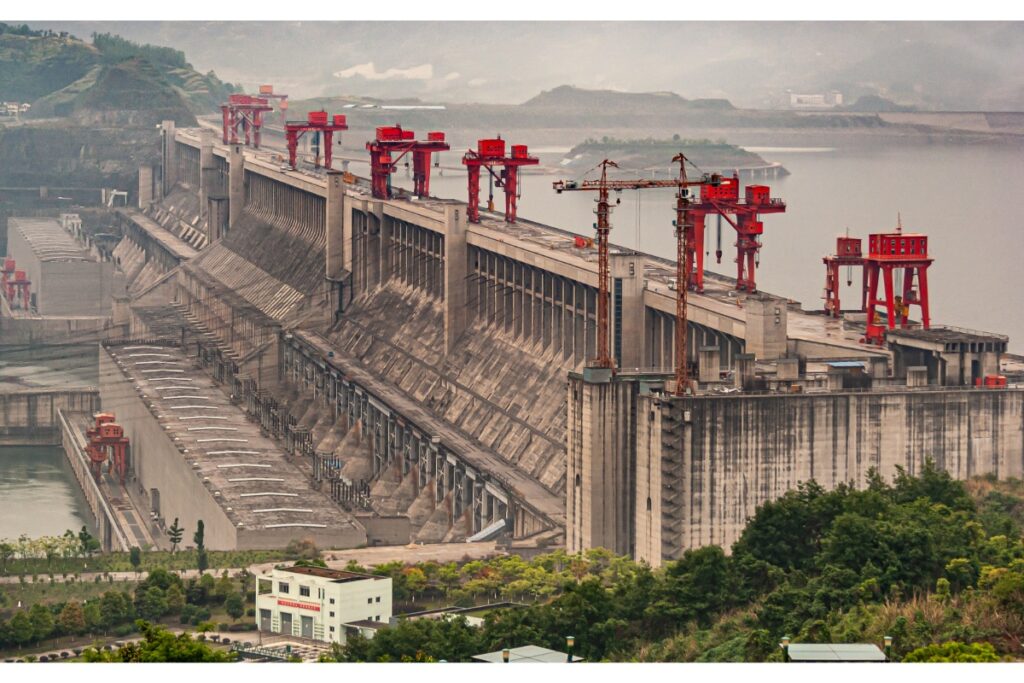
Built on China’s Yangtze River, the Three Gorges Dam is the world’s largest hydroelectric power station, eclipsing Itaipu’s output. NASA calculations led by geophysicist Benjamin Fong Chao say the reservoir’s roughly 40 billion liters of retained water slightly redistributes Earth’s mass, nudging the axis and lengthening a day by about 0.06 microseconds.
On the Yangtze, an engineering leviathan that lights up cities also nudges the planet’s timekeeping. NASA and geophysicist Benjamin Fong Chao calculate that the mass of water pooled behind China’s Three Gorges Dam slightly redistributes Earth’s heft, lengthening a day by about 0.06 microseconds. The same physics of moment of inertia that makes a skater slow with outstretched arms applies at continental scale, with effects comparable in kind to those seen after the 2004 Indonesian tsunami. As scientists debate leap seconds and track shifts in the axis, the dam’s power is measured not only in gigawatts but in the faint tick of the world’s clocks.
A dam that changes more than landscapes
Stand on the banks of the Yangtze River and the scale of the Three Gorges Dam hits you first. Turbines hum, ships queue, the waterline climbs. It is the largest hydroelectric power station on Earth, outpacing South America’s Itaipu in annual generation. Yet what lingers is a quieter idea from space scientists: according to NASA, this megastructure also nudges the planet’s rotation.
The science of Earth’s shifting spin
Here is the crux. When the reservoir is full, it stores roughly 40 cubic kilometers of water, about 10.6 trillion gallons. That much mass, held higher above sea level than before, slightly redistributes Earth’s weight. Benjamin Fong Chao, a geophysicist at NASA’s Goddard Space Flight Center, calculated that filling the reservoir lengthens the day by about 0.06 microseconds, and it minutely shifts the rotational axis.
This is not unprecedented. Major geophysical events have measurable effects too. The 2004 Indian Ocean tsunami, triggered by a massive earthquake, nudged the North Pole by centimeters and made days a touch shorter by a few microseconds (a larger change than the dam’s). The key is that modern instruments can detect these tiny, global-scale tremors in time itself.
A lesson in physics: mass and inertia
The mechanism is classic physics. When mass moves farther from a spin axis, a system’s moment of inertia increases, and rotation slows. Figure skaters pull in their arms to spin faster; Earth does the opposite when water or rock distribution shifts outward. Reservoirs, groundwater pumping, glacier melt and even large-scale urbanization play into that accounting, each adding or subtracting imperceptible fractions from the planetary clock.
Scientists track these dynamics using satellite gravimetry and astronomical timekeeping. The signals are subtle, but they add up. Over decades, natural patterns in oceans and atmosphere mingle with human reshaping of landscapes, producing a wobbly, constantly updated portrait of how Earth turns.
What could it mean for the future?
For daily life, these changes are far below anything we’d notice. But timekeepers care. Proposals to add or subtract leap seconds, including the once-floated negative leap second, hinge on such measurements. Recent research suggests polar ice loss may offset small human-driven accelerations, which is why the next leap-second adjustment was delayed to 2029 (and may be pushed again).
Meanwhile, China is planning the Medog Dam in Tibet, reported to rival or exceed Three Gorges in output. As mega-projects scale up to meet electricity demand, each will teach scientists something new about a very old system: how a restless planet balances its spin when we move its water around.