
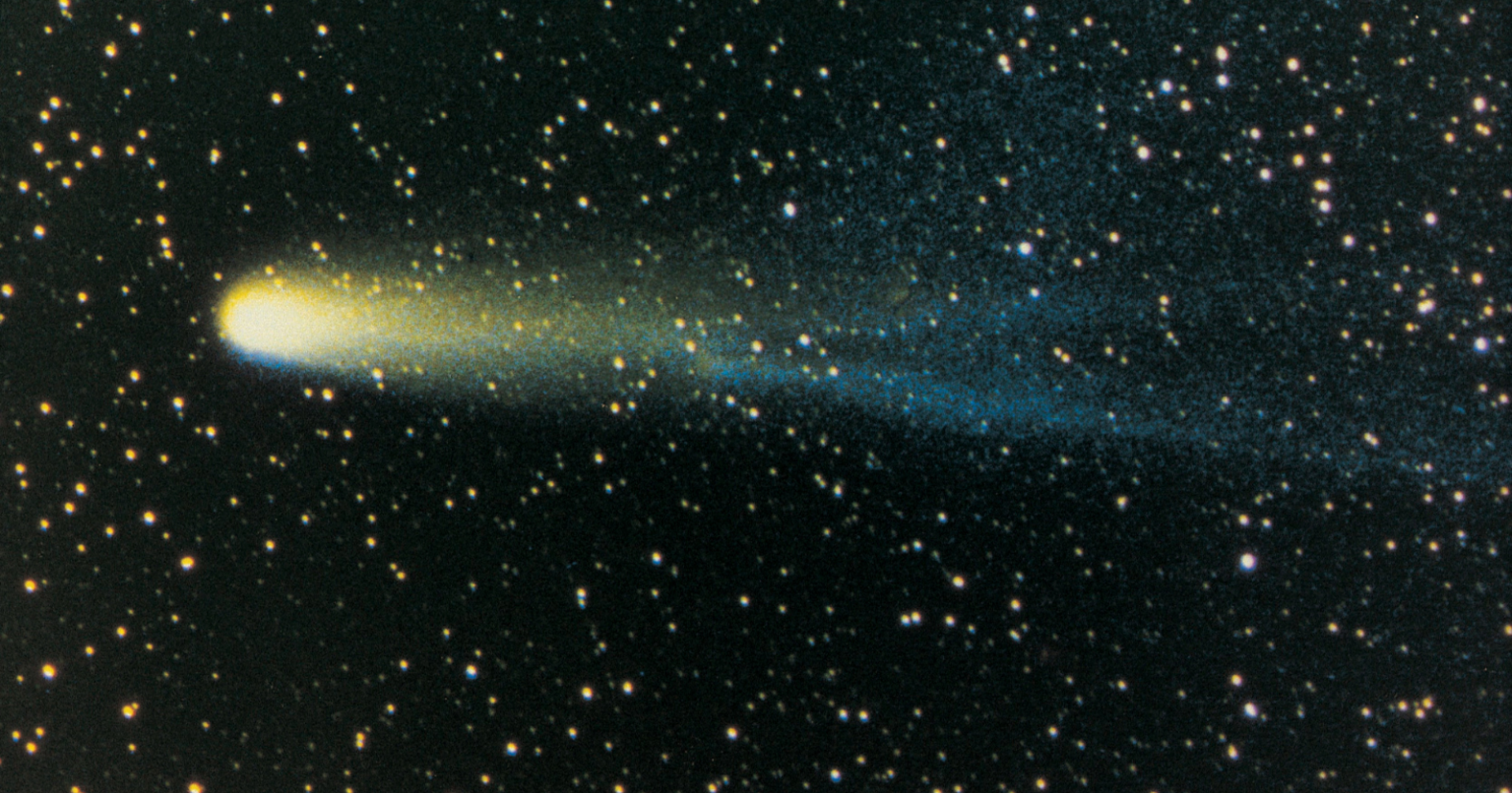
A team of researchers led by Luis Salazar Manzano and Teresa Paneque-Carreño of the University of Michigan Department of Astronomy has measured the water composition of the interstellar comet 3I/ATLAS and found deuterium levels more than 30 times higher than those recorded in comets from our own solar system, and more than 40 times higher than the ratio found in Earth’s oceans. The findings, published in Nature Astronomy on 24 April 2026, represent the first measurement of deuterated water in any interstellar object and, according to the researchers, provide direct chemical evidence that the comet formed in an environment significantly colder than the one that produced our own planetary system.
3I/ATLAS is only the third confirmed interstellar object ever detected passing through our solar system, after 1I/’Oumuamua in 2017 and 2I/Borisov in 2019. It was first spotted on 1 July 2025 by the NASA-funded ATLAS survey telescope in Río Hurtado, Chile, and reported to the Minor Planet Center the same day. Its hyperbolic orbit, with an eccentricity of around 6.14, confirmed immediately that it was not gravitationally bound to our Sun. It made its closest approach to the Sun on 29 October 2025, reaching a perihelion distance of approximately 1.36 astronomical units.
What deuterium reveals about where a comet formed
Deuterium is an isotope of hydrogen. Where ordinary hydrogen contains a single proton, deuterium contains both a proton and a neutron. Water molecules that incorporate deuterium in place of one of their hydrogen atoms are heavier than standard H2O and are sometimes called semi-heavy water or deuterated water (written HDO). The ratio of deuterium to ordinary hydrogen in water is sensitive to temperature: in very cold environments with low radiation, deuterium enrichment in water ice tends to be higher. This makes the HDO/H2O ratio a useful proxy for the thermal conditions present when an icy body formed.
In our solar system, the deuterium-to-hydrogen ratio in cometary water varies but sits within a broadly understood range. Earth’s oceans sit at around 150 parts per million. Comets from our system have been measured at roughly two to three times that value. The figure recorded for 3I/ATLAS, on the available ALMA data, is more than 30 times higher than the cometary range in our own system. That figure, if confirmed on follow-up observation, places the formation environment of 3I/ATLAS well outside the parameter space of conditions found anywhere in our solar system during its formation.
“This is proof that whatever the conditions were that led to the creation of our solar system are not ubiquitous throughout space,” Paneque-Carreño said in the ALMA press release accompanying publication. “That may sound obvious, but it’s one of those things that you need to prove.”
How the measurement was made
The key instrument was the Atacama Large Millimeter/submillimeter Array (ALMA) in Chile, specifically ALMA’s Atacama Compact Array, which is capable of resolving the spectral signature of HDO and distinguishing it from ordinary water vapour. The observations were made just six days after 3I/ATLAS reached perihelion, when heating from the Sun was driving outgassing at high enough rates to make the comet’s coma detectable at millimetre wavelengths. Salazar Manzano had earlier detected the first gas emissions from 3I/ATLAS using the MDM Observatory in Arizona, which provided a foundation for the ALMA follow-up work.
The measurement was possible because 3I/ATLAS was discovered early enough in its approach to the Sun to allow coordinated observation campaigns. 1I/’Oumuamua, by comparison, was detected only as it was already leaving the solar system, and yielded almost no compositional data. The timing of 3I/ATLAS’s detection gave researchers a window that has not existed with any previous interstellar object.
According to the University of Michigan press release accompanying the paper, the research team also received support from NASA, the U.S. National Science Foundation, and Chile’s National Research and Development Agency. ALMA itself is operated under a partnership involving the European Southern Observatory, the NSF, and Japan’s National Institutes of Natural Sciences.
Age estimates and what is, and is not, known about the comet’s origin
3I/ATLAS arrives with a velocity of approximately 58 km/s relative to the Sun at large distances, which is substantially faster than expected for an object originating from the nearest stars. Its trajectory suggests it came from the direction of the constellation Sagittarius. At the July 2025 Royal Astronomical Society National Astronomy Meeting in Durham, University of Oxford astronomer Matthew Hopkins presented a statistical analysis suggesting the comet is very likely over 7 billion years old, and possibly considerably older. Coverage in Phys.org citing that work noted estimates extending toward 11 to 12 billion years. These age estimates are probabilistic and based on the object’s kinematics and inferred stellar origin region; they are not direct measurements.
What the origin star was, and whether it still exists, is unknown. The comet’s trajectory has been traced back toward the Milky Way’s thick disk, a component of the galaxy associated with an older stellar population than the thin disk where our Sun resides. If the age estimates are broadly correct, the object formed around a star that predates our Sun by several billion years. That star may or may not have since expired.
The question of which specific planetary system produced 3I/ATLAS cannot be answered from the available data. The Nature Astronomy paper by Salazar Manzano and Paneque-Carreño does not attempt to identify the origin system. It characterises the formation conditions as inferred from chemistry, not from orbital backtracking.
What the composition data shows beyond water
The deuterium result is not the only unusual chemical feature reported in the ongoing study of 3I/ATLAS. Separate observations, also using ALMA and reported in The Astrophysical Journal, found elevated levels of methanol (CH3OH) relative to hydrogen cyanide (HCN) and a high carbon monoxide to water ratio, with CO/H2O measured at roughly 28%, considerably above what is typically observed in solar system comets at comparable distances from the Sun. This was reported in work by Nathan Roth and colleagues, also published in 2026.
Earlier, the Subaru Telescope in Hawaii observed 3I/ATLAS on 7 January 2026, after perihelion, and found a lower carbon dioxide to water ratio than earlier space-based measurements had suggested. That discrepancy, reported in The Astronomical Journal by Yoshiharu Shinnaka of the Koyama Astronomical Observatory and colleagues, is consistent with the comet’s exterior and interior having different compositions: the outer layers, which had been subject to billions of years of cosmic radiation, show different chemistry from the material being driven off from deeper within the nucleus as it heats.
Taken together, these measurements describe a chemically unusual object. None of them, individually or combined, allow a definitive account of the conditions in the system where 3I/ATLAS formed. What they permit, according to the researchers involved, is a set of inferences: it formed in a cold environment, with different thermal and radiation conditions from those that produced the comets and planets in our solar system.
What comes next
3I/ATLAS has now passed perihelion and is moving away from the Sun. Follow-up observation becomes more difficult as the object recedes and its outgassing diminishes. The research community has been working to extract as much data as possible from the existing observation window, and several papers remain in the pipeline based on datasets already collected.
The broader significance of 3I/ATLAS for the field depends partly on what comes after it. The Vera C. Rubin Observatory in Chile, which began science validation in mid-2025 and imaged 3I/ATLAS before its official detection date without initially recognising it, is expected to significantly increase the rate at which interstellar objects are found once it enters full operation. Estimates cited in the research literature suggest Rubin could, over the course of its planned ten-year Legacy Survey of Space and Time, detect roughly one interstellar comet per year on average.
If that rate holds, and if early detection is achieved consistently, the water isotope analysis applied to 3I/ATLAS could become a repeatable method for sampling the formation conditions of other planetary systems across the galaxy. That is speculative, and depends on both detection timing and instrument availability. But the Salazar Manzano and Paneque-Carreño paper establishes at minimum that such analysis is technically feasible. That was not demonstrated before.
The full paper, “Water D/H in 3I/ATLAS as a probe of formation conditions in another planetary system,” is published in Nature Astronomy, 2026, with DOI 10.1038/s41550-026-02850-5.