
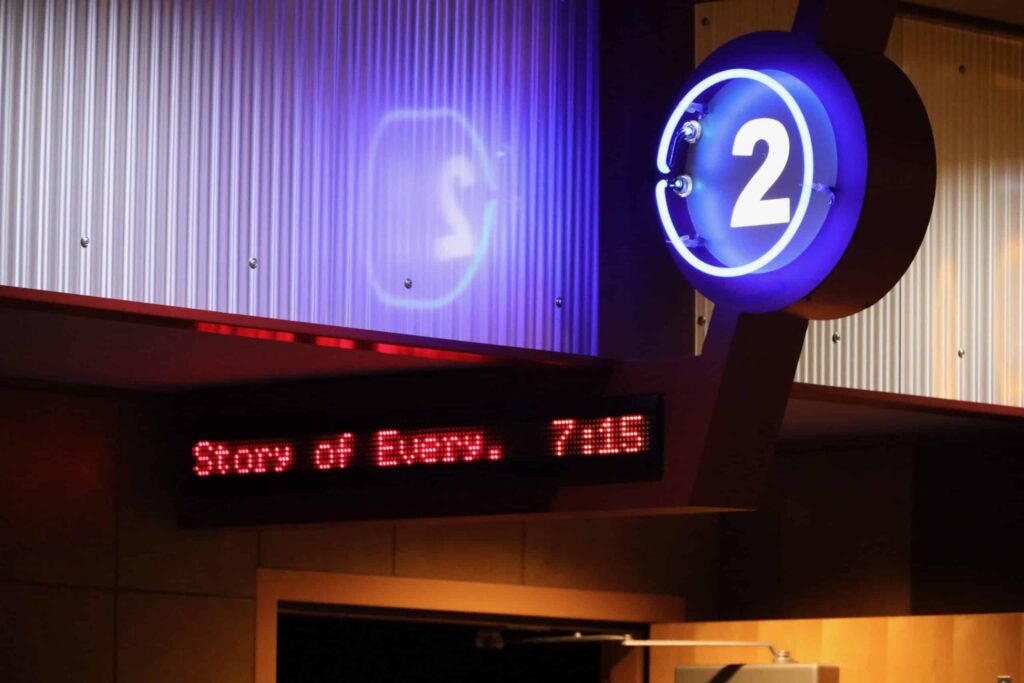
The other evening, I attended a late show of the new Star Wars installment, The Mandalorian and Grogu. The visuals and music were great. The trademark Star Wars styling was fun. But what kept me in my seat for over two hours was the compelling story of Mando trying to protect Grogu while working for the new republic to rid the galaxy of evil. I don’t count myself a Star Wars fan in general, but I enjoyed the night’s entertainment.
As I walked out of the theater after the movie, I heard a familiar voice. I smiled as I realized it was our colleague Jay Richards, talking about the lifelessness of Mars while Earth is suffused with life. In the theater adjacent to mine, The Story of Everything was playing. It turned out they were testing it to make sure it worked fine for a private screening. I stood at the back of the theater to watch a few scenes and relish seeing it again on the big screen.
Chatting About the Simulation Theory
As I did, a young man, who had watched the Star Wars movie along with me, stopped in the hallway. He had heard something that caught his attention as he walked by.
“Did you hear that?” he asked his wife. “It’s a movie talking about the simulation theory.”
Hearing that, I stepped out of the auditorium. He asked me what movie was playing in there. I briefly introduced the young man and his wife to the film, the theory of intelligent design, and the film’s website where they could learn more. Both of them seemed intrigued.
“Very cool,” she said.
“Yeah,” he added as he noted the film’s details on his phone. “I heard them talking about simulation theory and I follow that stuff.”
Display “The Story of Everything | Official Trailer” from YouTube
The Power of Story
It was a brief interaction, but it reminded me of the power of story and the impact a cinematic experience can have on people who are already hungry for answers to questions about reality, origins, meaning, design, and human uniqueness. Like The Mandalorian and Grogu, The Story of Everything has compelling visuals, a beautiful musical score, and a talented cast. But the biggest thing going for it is the monumental story it tells of the powerful evidence of design in nature, in life, and in the universe. And though the Star Wars universe is captivating, here’s the story of our actual universe, where truth is more spectacular than fiction.
The movie had a strong run in theaters, with great reviews and an excellent score at Rotten Tomatoes, and an exciting part is that this is only the beginning! Through August 31, it’s now available for churches and other organizations who want to host their own screening of the movie. After that, the film will launch on a streaming platform for more to watch at home. It will continue to be a powerful tool in our arsenal for a long time to come, changing lives as we introduce the evidence for intelligent design to an ever-wider audience.
An Awesome Opportunity
I love movies. I love that I can escape for two hours and be moved by memorable stories and great filmmaking. Film remains one of the last broadly shared artistic experiences where people gather physically, focus their collective attention, and contemplate questions larger than themselves. What an awesome opportunity we’ve had to share the evidence cinematically in theaters across the country.
I’m proud to have played a small part in the journey of this movie. As Stephen Meyer’s assistant for over a decade, I was there for the very first meetings in 2018 with the filmmaking team who would bring the movie to life. I was privileged to work on photo permissions and the bibliography of Dr. Meyer’s book Return of the God Hypothesis, the source material for the film. And I’m looking forward to sharing The Story of Everything with more people in the near future. I hope you’ll join me.