
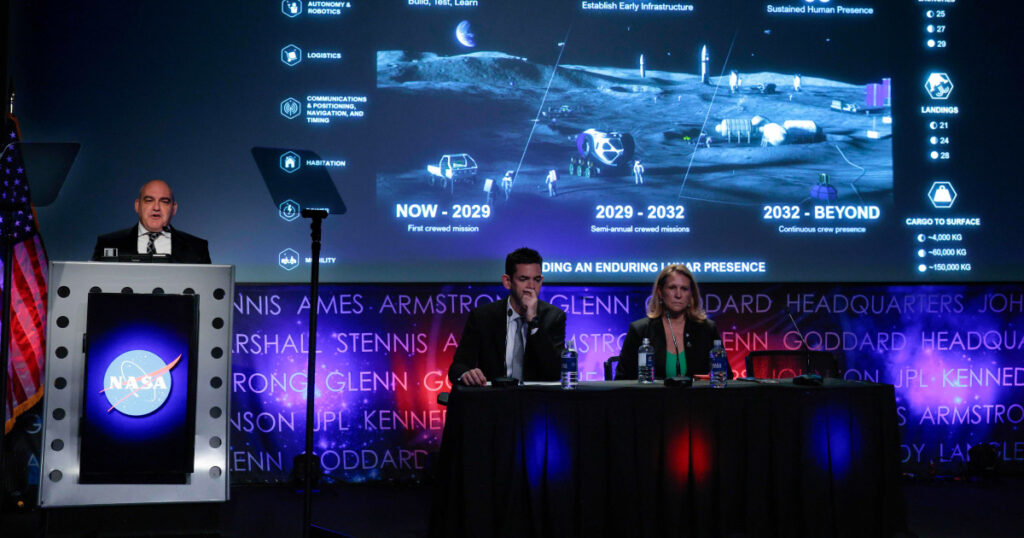
Just weeks after the success of the Artemis II mission, NASA is rolling out its ambitious plan to establish a permanent base on the surface of the moon.
The agency has unveiled its blueprint to launch the first of multiple missions as early as this fall, with a goal of astronauts living and working on the moon by 2032.
Here’s what to know about NASA’s plans.
When Will the Mission to Build a Moon Base Begin?
NASA announced at a press conference at its Washington headquarters on May 26 that it aims to launch three unmanned missions by the end of this year to bring lunar landers and automonous rovers to the moon.
The landers and rovers will be testing out the communications and navigation capabilities to see what works and what doesn’t work on the surface of the moon.
NASA aims to build out the base in three phases, starting with the robotics landing on the moon in 2026.
The agency announced it will use a lander from Blue Origin, the space technology company founded by Amazon’s Jeff Bezos, to deliver rovers and drones that will be contracted from other private companies.
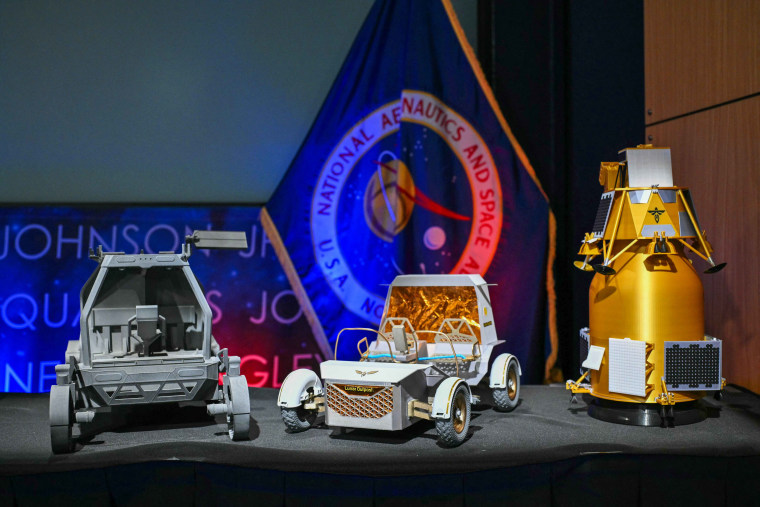 Models of lunar rovers and landers are displayed during a news conference at NASA headquarters in Washington, DC, on May 26, 2026, to outline plans for NASA’s “Moon Base” lunar base and progress toward a sustained human presence on the Moon.MANDEL NGAN / AFP
In a mission dubbed Moonfall, four drones will scout landing sites for Artemis astronauts near the lunar South Pole, where NASA believes there may be water ice. The launch for that is targeted in 2028, according to a news release by NASA.
A second launch is planned for later this year in which 1,100 pounds of cargo will be delivered on a lander, including a rover, according to the news release.
A third launch is also projected to occur before the end of this year and will also include a lunar lander, per NASA.
When Will the Moon Base Be Built?
The base is expected to start taking shape in 2029, with the goal of the first astronauts living there in 2032.
What Will the Base on the Moon Look Like?
NASA envisions essentially a city-sized base on the lunar surface.
Carlos García-Galán, NASA’s program executive for the moon base, said at the press conference that the agency envisions it to be “hundreds of square miles” in size.
The plans include housing for astronauts, lunar vehicles for exploration and solar and nuclear power stations.
“We’re in the business of expanding our horizons, doing the near impossible — building the moon base,” García-Galán said at the news conference.
NASA previewed what the base on the moon might look like in a photo from the press conference.
 Moon Base Program Executive Carlos Garcia-Galan (L) gives a presentation about plans to establish a permanent presence on the lunar surface during a news conference with Administrator Jared Isaacman (2nd L) and Exploration Systems Development Mission Directorate acting Associate Administrator Lori Glaze at NASA headquarters on May 26, 2026 in Washington, DC.Chip Somodevilla / Getty Images NewWhat Challenges Will NASA Face in Building the Moon Base?
In trying to establish a permanent human outpost on the moon, NASA will face hurdles like exposure to radiation, temperatures that can vary dramatically and micro meteorites that are constantly raining down.
The goal is to use the base for exploration beyond the moon and Earth.
“That will be necessary for when we send astronauts to Mars, paint the stars and stripes, build our outpost there and then be able to bring them home safely to tell us about it,” NASA administrator Jared Isaacman told Gadi Schwartz of NBC News during NBC’s “Stay Tuned Now.”
Future NASA missions are part of answering whether there is life beyond our own planet.
“Going back to the moon, taking what we learned there to learn about how all solar systems form, going to Mars, where we might find evidence of past life in our own — it’s pretty exciting stuff,” Artemis II astronaut Christina Koch said on TODAY April 30 after returning from the mission.