
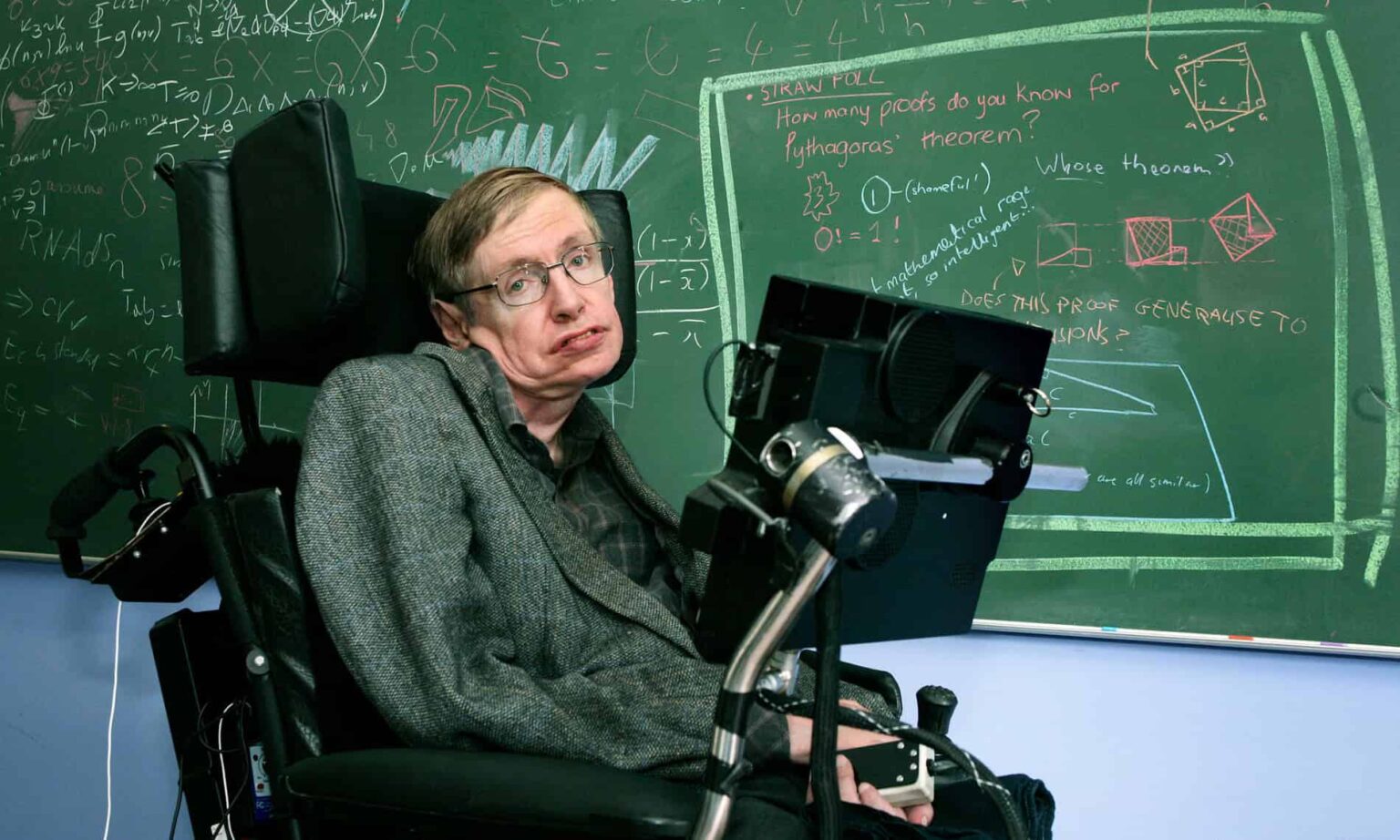
 Stephen Hawking at his office at the department of applied mathematics and theoretical physics at Cambridge University in 2005. Photograph: Murdo Macleod/The Guardian
Before he unraveled the mysteries of black holes, Stephen Hawking presented a far more terrestrial puzzle to his family. To his father, he was a nineteen-year-old undergraduate who drifted around the house, avoided his studies, and openly doubted his own future in physics. What a pity, Stephen’s old man would have probably said.
To most of us, Dr. Hawking was the epitome of science in popular view, sort of like Einstein was in the last century. So, we tend to view his legacy through a polished lens of destined greatness and superhuman endurance.
But in a private diary entry from 1961, his father, Frank Hawking, did not see a future icon of physics.
Frank kept a diary for more than 60 years and wrote many entries in a secret code using Greek letters. The code has recently been cracked by science writer Graham Farmelo, who is now working on Stephen Hawking’s first authorized biography. The diaries are part of a larger trove of family papers that have been made available to Farmelo.
The book, Hawking, is scheduled to be published by John Murray on Sept. 24. Until then, we’re served with a teaser from the diaries of Hawking senior, who was trying to understand a difficult son, later grappling with a devastating diagnosis, without any knowledge of the extraordinary life still ahead.
“We are a little worried at the way Stephen is turning out,” Frank Hawking wrote, according to newly surfaced diaries. “He hangs round the house with little initiative and does not study much.”
A Private Archive Opens
 Extract from diaries kept by Stephen Hawking’s father, who wrote many entries using a secret code in Greek script. Credit: Graham Farmelo.
The material had been kept at the home of Hawking’s sister, Mary. It includes diaries written by Frank Hawking, as well as letters and journals from Hawking’s mother, Isobel. Farmelo decoded Frank’s diaries written in Greek script, translating more than 200,000 words about Stephen Hawking’s childhood, illness, marriages and scientific career.
Farmelo described the archive as unusually revealing. “It was a wonderful, completely unexpected bonus to be given access to these diaries and papers,” he told The Guardian. “They are a 24-carat source of information about Stephen Hawking’s life, especially his formative years and the harrowing months after his diagnosis of motor neurone disease when he was only 21 years old.”
×
Thank you! One more thing…
Please check your inbox and confirm your subscription.
He also called the papers a “raw and honest insight” into Hawking’s early life.
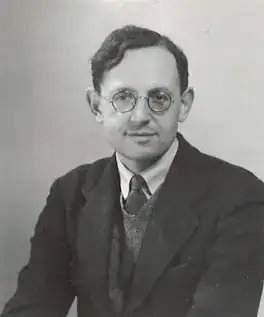 Frank Hawking, a tropical-disease specialist. Credit: Vixorio.
Hawking did not appear, at least to his father, as a boy marching inevitably toward greatness. Frank certainly didn’t think his son was a genius. Stephen seemed bored, detached, and not really serious about making something of himself. At Oxford, he had begun to lose faith in physics, Frank wrote, preferring “the arts.” Stephen also seemed intimidated by his father, a feeling which the latter later acknowledged.
“[Isobel] says he has an inferiority complex to me (he has no need to) and he has lost faith in physics at Oxford, thinking it is inferior to arts,” Frank wrote in 1961. “This is a great pity if so. At his age I had a burning ambition to get on, and if only I had had half his advantages, I should have done much better.”
The Making of a Myth, Before the Myth
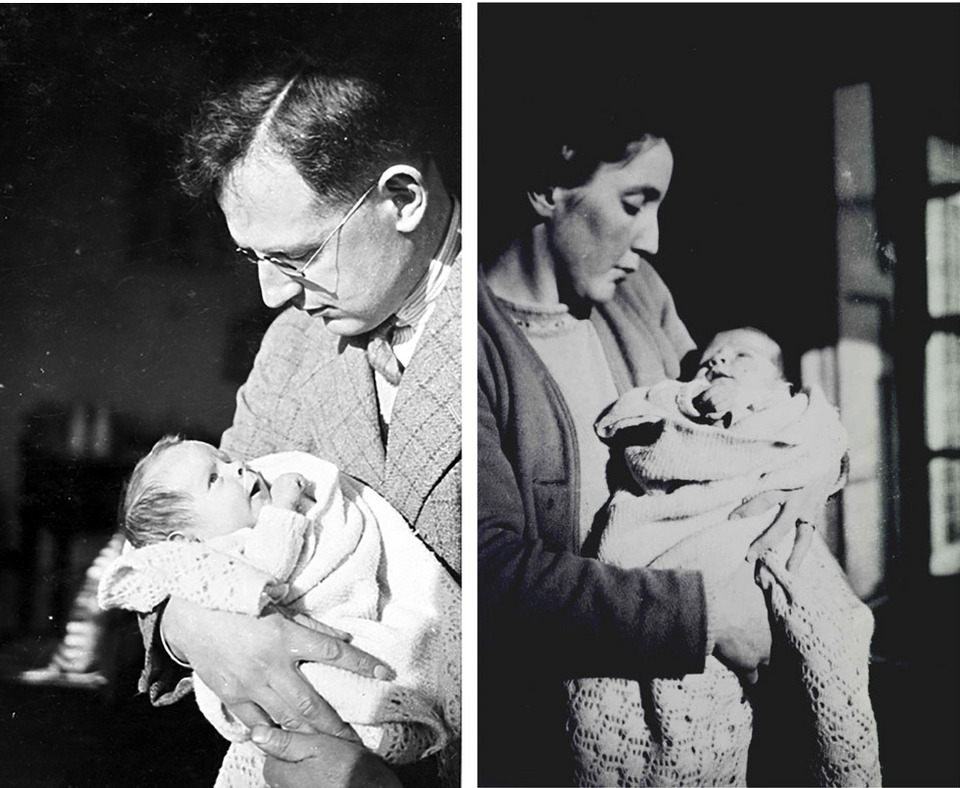 Stephen Hawking with his parents Frank (left) and Isobel (right). Credit: Wikimedia Commons.
Those lines may surprise readers who know Hawking mostly through the heroic frame of his later life. But they fit what Hawking himself sometimes acknowledged: as an undergraduate, he was bright, restless and not especially disciplined. Oxford physics did not always stretch him. Mathematics had been his first love, but Oxford did not offer the degree he wanted, so physics became the path he was forced to take rather than the one he chose.
Frank Hawking, an accomplished scientist educated at Oxford and Cambridge, and an expert in tropical diseases, had wanted his son to study medicine. Stephen eventually wound up in physics instead, and not the small kind. He went after the largest questions available: whether the universe had a beginning and whether the laws of nature break down at the edge of a black hole.
His early work helped give the Big Bang a harder mathematical foundation. Building on ideas developed by Roger Penrose, Hawking showed that if general relativity was right, and if the universe met broad physical conditions, cosmic expansion could not be traced backward forever into a smooth, ordinary past. It pointed instead toward an initial singularity, a state where density and gravity became extreme and Einstein’s equations themselves reached their limit. This was during a time when some physicists still favored the steady state model, in which the universe had no beginning.
Many years later, Hawking changed gears entirely. Together with James Hartle, he put forth the Hartle-Hawking “no-boundary proposal” where the physicists tried to go beyond classical general relativity by bringing in quantum ideas. In that model, the universe is finite but has no boundary in imaginary time — often explained by analogy to the Earth’s surface: it is finite, but you do not fall off an edge at the North Pole. So, the universe may not have a “before the Big Bang” in the ordinary sense, because time itself behaves differently near that limit. Hawking’s own lecture says the evidence indicates the universe has not existed forever, but the deeper question is whether “time itself has a beginning.”
Then Hawking turned to black holes. Hawking studied their event horizons, the invisible boundaries beyond which escape for matter or energy becomes impossible, and showed that black holes behaved like physical objects, defined by temperature and entropy. His most famous result came in the 1970s, when he used quantum theory to argue that black holes are not entirely black. They should give off a faint heat, now called Hawking radiation, and slowly lose mass. In one stroke, he connected three great pillars of physics — gravity, quantum mechanics and thermodynamics — in a place where they had no obvious right to meet.
That idea remains one of the deepest clues physicists have about a future theory of quantum gravity. It also created the black hole information paradox: if a black hole evaporates, what happens to the information about everything that fell in? Physics says information should not simply vanish. Hawking’s work made that problem unavoidable, and generations of theorists are still trying to solve it. A later biographical memoir by several leading physicists described his contributions to gravity, black holes and cosmology as “truly immense,” spanning singularity theorems, black hole temperature, primordial black holes, inflationary cosmology and the quantum “wavefunction of the universe.”
But none of that was visible in 1961. To Frank, the future looked uncertain. To Stephen, physics may have looked too small. Within two years, both men would face something far more frightening than academic drift.
A Diagnosis That Changed the Scale of Time
 A young Stephen Hawking.
In 1963, when Hawking was 21, doctors diagnosed him with motor neurone disease, also known as amyotrophic lateral sclerosis, or ALS. The disease attacks nerve cells that control voluntary movement. Many patients lose the ability to walk, speak, swallow and breathe without assistance. Hawking was initially told he might have only two years to live. The public largely knows the sanitized, cinematic version of this period, popularized by the 2014 film The Theory of Everything.
The diagnosis forced the family into a new kind of reckoning. The father who had worried that his son lacked ambition now watched him lose control of his body. Hawking’s speech slowed. Movement became difficult and gradually worse until he lost all control over his limbs.
Frank’s diaries capture that anguish in language striking for its harshness, but this was a private diary after all. In 1967, he wrote: “I find it a slow and ghastly experience with [Stephen]. Everything is so dreadfully slow and long drawn out. And his speech is so slow and difficult to understand that conversation is very difficult.”
He added: “I am very sorry for him and will do all I can for him. But I don’t enjoy being with him.”
Stephen Hawking himself later described the diagnosis as a kind of reset. “My expectations were reduced to zero when I was 21,” he once said. “Everything since then has been a bonus.”
That bonus stretched for many more decades than his doctors had initially prognozed. He married Jane Wilde, had three children, continued his research, built a career at Cambridge and became one of the most famous scientists in the world. As his body weakened, his public presence only grew. The image of him in a wheelchair, always with a computer and a voice synthesiser, somehow entered pop culture and became for many the face of science.
The Physicist Who Made Science Cool
Most theoretical physicists work far from popular attention. Hawking became a celebrity without abandoning difficult questions. He appeared on television, wrote for general audiences — most famously with the runaway bestseller A Brief History of Time, which sold over 13 million copies — and turned cosmology into part of everyday cultural language.
His own words often carried the same mix of severity and wit that shaped his life. “Life would be tragic if it weren’t funny,” he said. He also urged people to keep asking large questions. “Remember to look up at the stars and not down at your feet,” he said. “Try to make sense of what you see and wonder about what makes the universe exist.”
The new biography arrives as society re-evaluates Dr. Hawking’s public image. Recently, his name surfaced in unsealed documents related to the disgraced financier Jeffrey Epstein, noting Dr. Hawking’s presence at a 2006 physics conference in the U.S. Virgin Islands. The Hawking family firmly rejected any insinuations of impropriety, pointing out that he traveled with round-the-clock carers and that no images of the two men together exist.
Dr. Hawking died in 2018 at age 76. His ashes now rest in Westminster Abbey alongside Newton and Charles Darwin. His father, Frank, died in 1986, by which time his son was already a global phenomenon both in academia and public life. We’ll have to wait for the new book to come out to find out what Frank ultimately thought of his son’s accomplishments.