
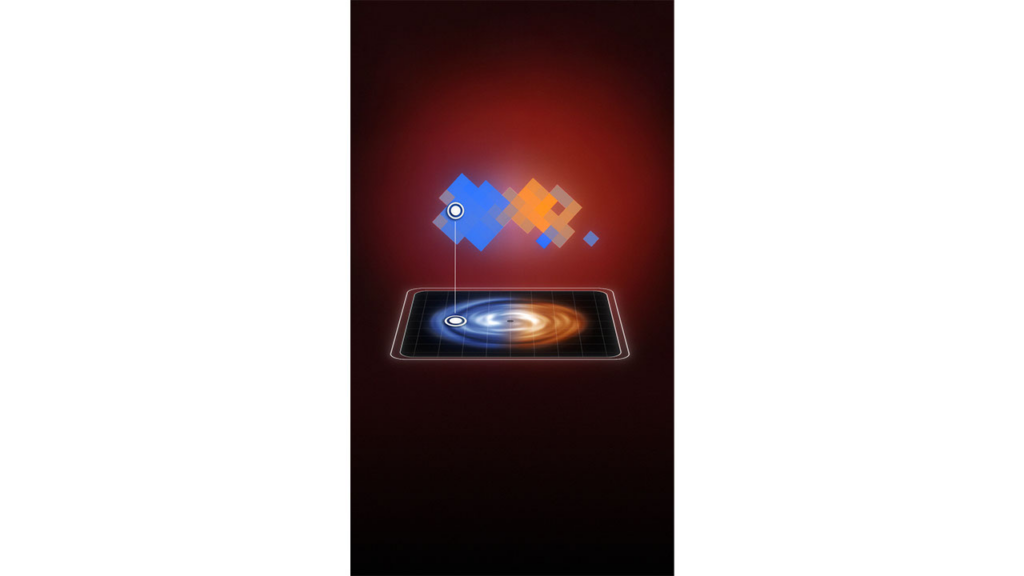
A sonification is a translation of data into sound. In this sonification, the velocity of hydrogen gas moving around a black hole in the center of a Little Red Dot known as Abell2744-QSO1 (QSO1) is translated into sounds of varying pitch (or frequency). The faster the gas is moving toward the telescope, the higher the pitch. The faster it is moving away from the telescope, the lower the pitch.
Notice how the speed of the gas is highest where it is closest to the black hole. This is characteristic of objects orbiting a central mass (like planets orbiting the Sun): the closer they are, the faster they move.
Also notice how the motion of the gas appears to change direction suddenly: The pitch of the sound changes abruptly from high to low. This occurs because the gas is circling the black hole: On the left side of the black hole, the gas is moving toward us. On the right side, it has circled back around and is moving away from us.
Researchers were able to use the simple relationship between velocity and distance to directly measure the mass of the black hole. This was the first direct mass measurement of a black hole within the first billion years of the universe.
The velocity measurements were made using data collected using the NIRSpec integral field unit (IFU) on NASA’s James Webb Space Telescope. Explore this observation of QSO1 on Space Telescope Live.