
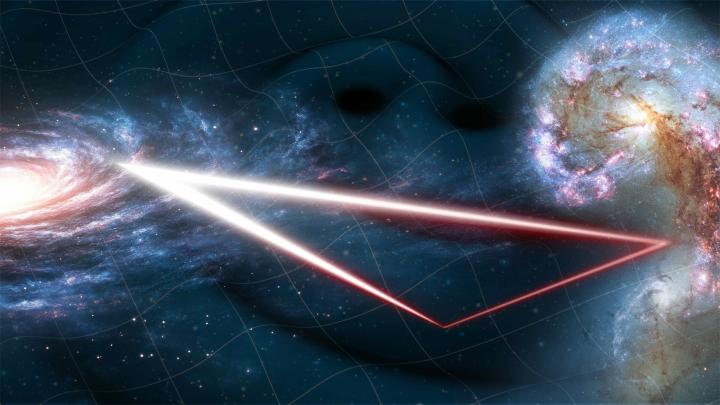
Polish engineers are developing telescope equipment for three satellites in the European Space Agency’s Laser Interferometer Space Antenna mission, known as LISA, which aims to create the first space-based observatory designed to study gravitational waves generated by some of the most powerful events in the Universe.
According to European Space Agency, the Laser Interferometer Space Antenna will detect disruptions in space-time caused by phenomena such as the approach and merger of black holes. The mission is expected to allow scientists to observe events that cannot be detected by conventional telescopes.
Representatives of Sener Polska said in a press release sent to PAP that LISA would enable the study of previously invisible cosmic phenomena, while Polish engineers would develop mechanisms capable of operating with unprecedented precision in space conditions. The company described the mission as one of the most technologically demanding projects in ESA’s history.
The industrial contract involving Sener Polska is worth more than EUR 55 million. “In terms of contract value, this is the largest research mission in which Polish engineers have ever participated”, the company said in the press release.
LISA is expected to expand the possibilities of space research by allowing scientists to detect gravitational waves with frequencies much lower than those measurable by Earth-based detectors.
“For the first time, it will be possible to observe gravitational waves with frequencies much lower than those available to detectors operating on our planet. Thanks to this, astronomers will be able to study events that cannot be observed with any telescope, such as black hole collisions or processes taking place in the early Universe”, the release said.
Jakub Pierzchała, General Manager of Sener Polska, said the mission could transform scientific understanding of the cosmos.
“It will introduce a completely new direction in observing phenomena that we have not been able to see before”, he said.
Sener Polska, working with the Spanish branch of Sener and a network of suppliers, is responsible for developing components for two subsystems of the MOSA (Mechanical-Optical Sub-Assembly) telescopes that will be installed on the satellites.
Each of the three satellites will carry two such sets, including launch-locking mechanisms, a hold-and-release actuator designed to deploy the telescope after reaching orbit, and precision rotation and positioning systems. The subsystems also rely on piezoelectric actuators, devices that convert electricity into motion.
“We are working on solutions that require precision that exceeds the standards used in previous space projects. Achieving such accuracy requires the use of new technologies developed especially for this mission”, said Beata Wiertel, project manager at Sener Polska.
The LISA mission will consist of three satellites flying in formation approximately 2.5 million kilometres apart and linked by laser interferometers to measure gravitational waves. The satellites are scheduled to launch aboard the Ariane 6 rocket from the European Space Port in French Guiana in 2035.
Sener Polska is part of the Sener engineering group, which operates in more than 50 countries. The company’s Warsaw branch opened in 2006 and has specialised exclusively in space-sector projects since 2012, including work for ESA, NASA and the European Southern Observatory. (PAP)
abu/ bar/
tr. RL
The PAP Foundation allows free reprinting of articles from the Nauka w Polsce portal provided that we are notified once a month by e-mail about the fact of using the portal and that the source of the article is indicated. On the websites and Internet portals, please provide the following address: Source: www.scienceinpoland.pl, while in journals – the annotation: Source: Nauka w Polsce – www.scienceinpoland.pl. In case of social networking websites, please provide only the title and the lead of our agency dispatch with the link directing to the article text on our web page, as it is on our Facebook profile.