
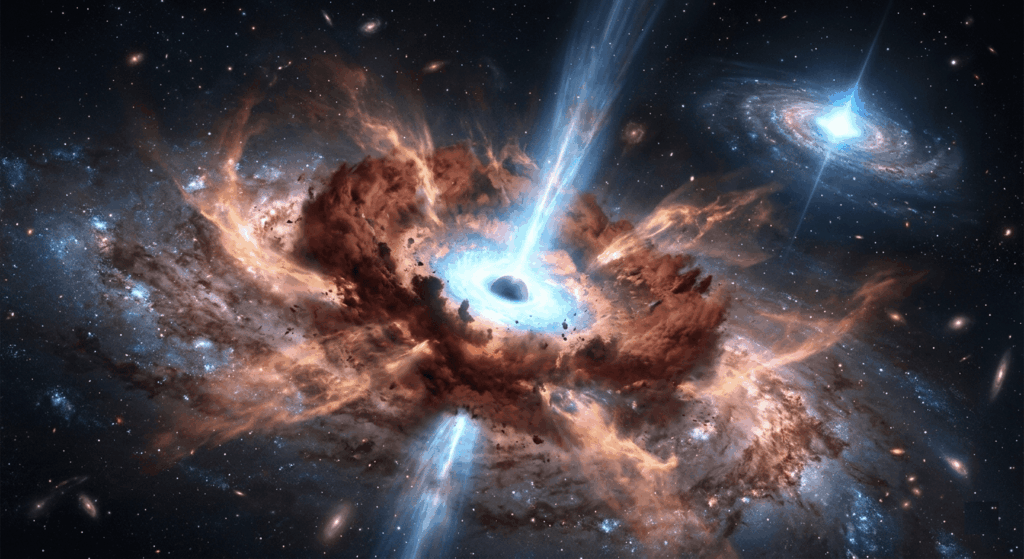
Astronomers have discovered 77 previously unknown quasars hidden behind dense dust clouds. These objects are in a brief transitional phase during which a supermassive black hole is actively blowing away the surrounding dust. The discovery provides the strongest evidence yet that such a phase exists in the evolution of galaxies.
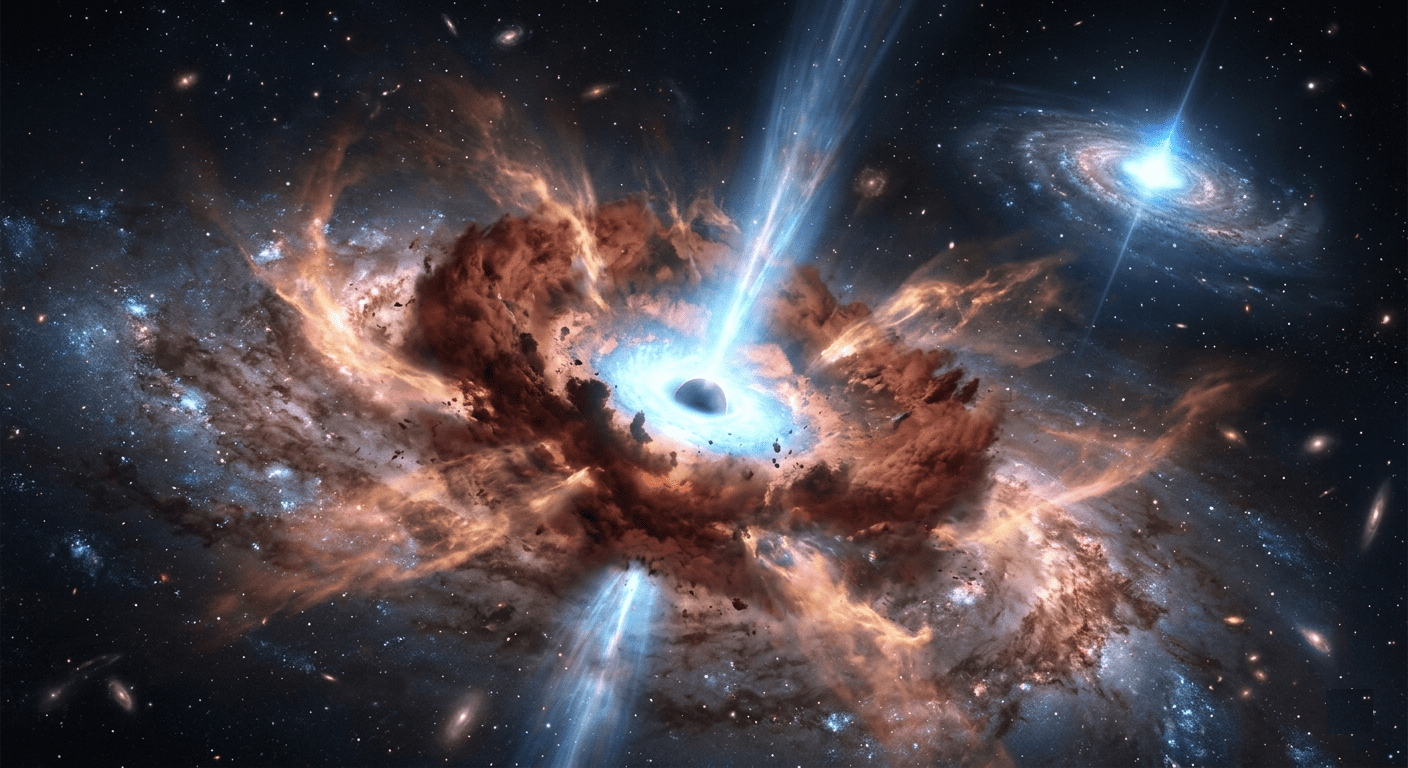 Artistic illustration of the powerful radiation from a supermassive black hole clearing away the dense dust cloud surrounding the galaxy’s core.
Why are they so hard to find?
Most large galaxies have a supermassive black hole at their center. When it actively devours matter, it becomes extremely bright and turns into a quasar.
However, some quasars are shrouded in thick dust that absorbs their light, making them virtually invisible to conventional optical telescopes. Prior to this study, only about 50 such strongly redshifted quasars were known, and each had been detected individually through infrared observations.
How did they double the sample size?
A team led by Matthew Stepney of the Center of Excellence in Astrophysics and Related Technologies in Chile used infrared data and spectrophotometry from NASA’s SPHEREx telescope. The researchers discovered 77 new dusty quasars that existed when the universe was between 1.6 and 4.3 billion years old.
Among them, seven such objects with a redshift greater than three have been identified for the first time—that is, from a time when less than 2.1 billion years had passed since the Big Bang. The study’s findings have been published on the arXiv preprint server.
Blow-out phase
According to the leading theory, supermassive black holes undergo a brief but intense growth phase, hidden behind a cloud of dust. This phase is triggered by a galaxy collision, which channels gas toward the center, simultaneously sparking intense star formation and feeding the black hole.
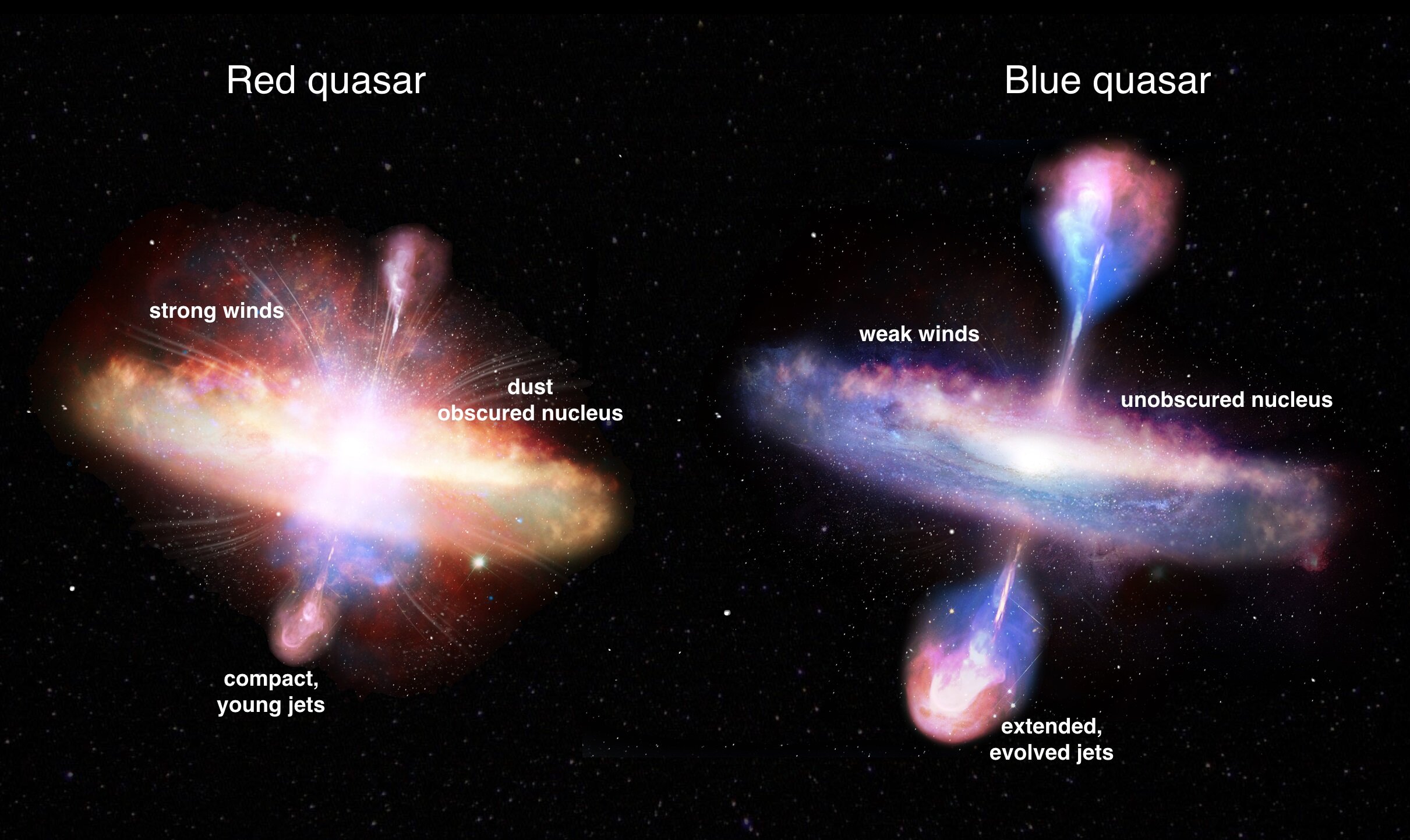 Artistic illustration of a red quasar hidden behind dust and a blue quasar with a cleared-out envelope. Credit: S. Munro. Source: phys.org
After correcting for dust absorption, it turned out that these quasars are among the brightest known. At the same time, they emit less infrared light from the dust structures surrounding the black hole than even open blue quasars.
Astronomers believe that this combination of extreme brightness and a depleted dust reservoir is indicative of the outflow phase, when powerful feedback from the black hole begins to clear away the dust envelope surrounding the galaxy’s nucleus.
Excessive ultraviolet radiation
The researchers also detected an unexpected excess of ultraviolet radiation in about three-quarters of the sample objects. This could be scattered light from the quasar passing through the edges of the dust shell. However, the scientists note that star formation in the host galaxy may also contribute, and in some cases even dominate.
The team plans to expand the survey in the future, taking full advantage of the SPHEREx telescope’s ability to survey the entire sky, in order to estimate the number and properties of such hidden quasars during the cosmic noon—a period approximately 2 to 4 billion years after the Big Bang, when black hole growth and star formation were at their most active.
According to Phys.org