
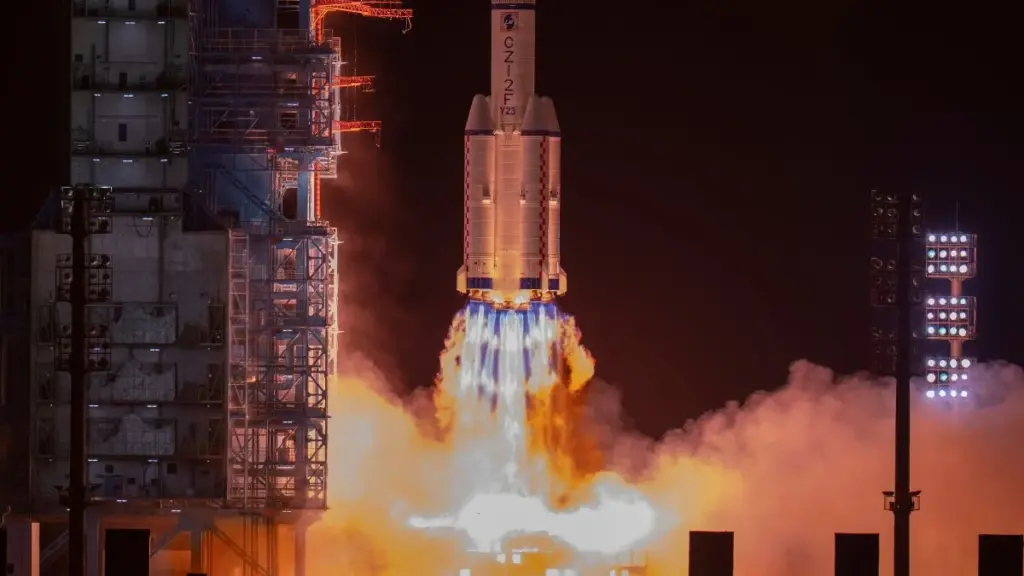
China has taken another step forward in the space race with the United States. The Shenzhou-23 manned spacecraft has successfully docked with the Tiangong space station. One of the three crew members is set to spend a full year at the station, preparing for a moon landing scheduled for 2030.
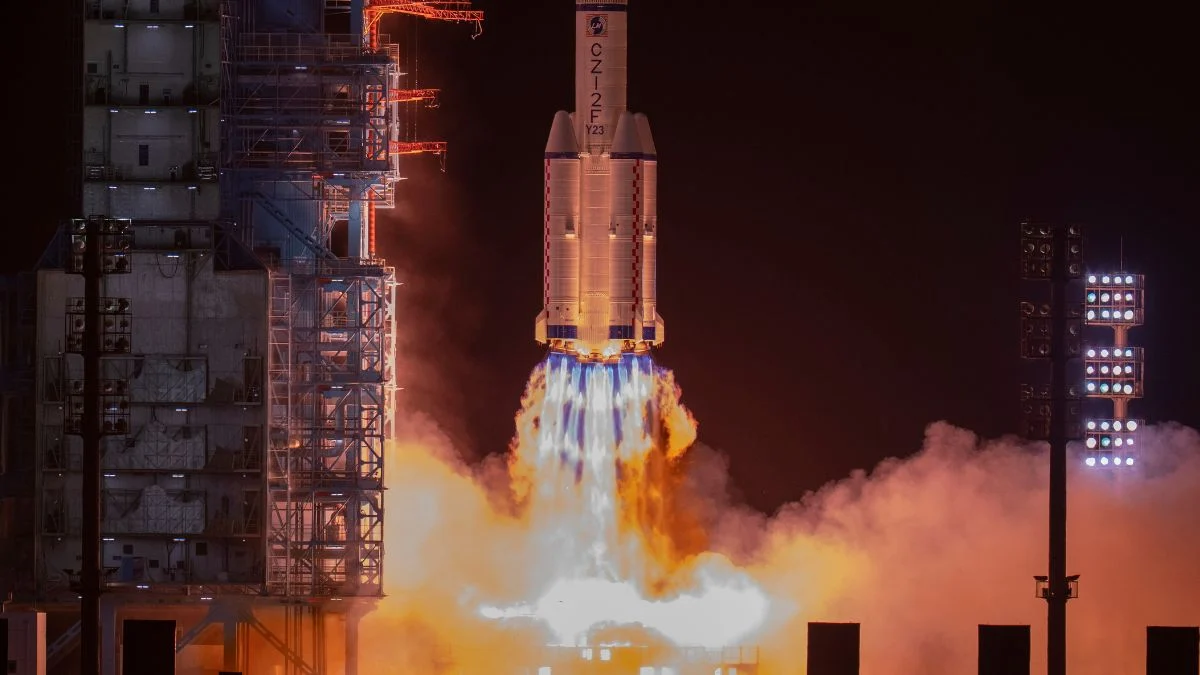 A Long March 2-F launch vehicle lifts the Shenzhou-23 spacecraft into orbit from the Jiuquan Space Center in northwestern China. Credit: AP Photo/Ng Han Guan. Source: sciencealert.com
Crew and launch
The Long March 2F carrier rocket launched on Sunday at 11:08 pm (1508 GMT) Sunday night from the Jiuquan Space Center in the Gobi Desert in the country’s northwest. The spacecraft separated approximately 10 minutes later and entered orbit, according to the China Manned Space Agency (CMSA).
The docking with Tiangong took about 3.5 hours. There are three crew members on board: space engineer Zhu Yangzhu, pilot Zhang Zhiyuan, who is flying into space for the first time, and 43-year-old Li Jiaying from Hong Kong. She became the first person from that city to go into orbit. Li previously worked for the police.
A year in zero gravity
The mission’s key objective will be for one of the astronauts to spend a year on the station. The name of the selected astronaut will be announced at a later date, depending on how the mission progresses. Until now, the crews of the Tiangong station have rotated every six months.
Prolonged exposure to microgravity poses serious challenges for the human body. According to Richard de Grijs, an astrophysicist at Macquarie University in Australia, the main risks include bone loss, muscle atrophy, radiation exposure, sleep disturbances, and psychological fatigue.
Equally important is the reliable operation of water and air recirculation systems and the ability to respond to medical emergencies far from Earth.
Path to the Moon
The annual mission is part of a larger plan. China aims to land astronauts on the Moon by 2030, competing with the United States and its Artemis program. An orbital test of the new “Mengzhou” spacecraft is already planned for this year; it will replace the outdated “Shenzhou” series and transport crews to the Moon.
By 2035, Beijing plans to complete the first phase of the International Lunar Research Station (ILRS). Also this year, the first foreign astronaut from Pakistan is expected to visit the Tiangong space station.
Over the past 30 years, China has invested billions of dollars in its space industry in an effort to catch up with the United States and Europe. In 2019, the Chang’e-4 probe became the first in the world to land on the far side of the Moon, and in 2021, a small rover reached the surface of Mars.
According to sciencealert.com