
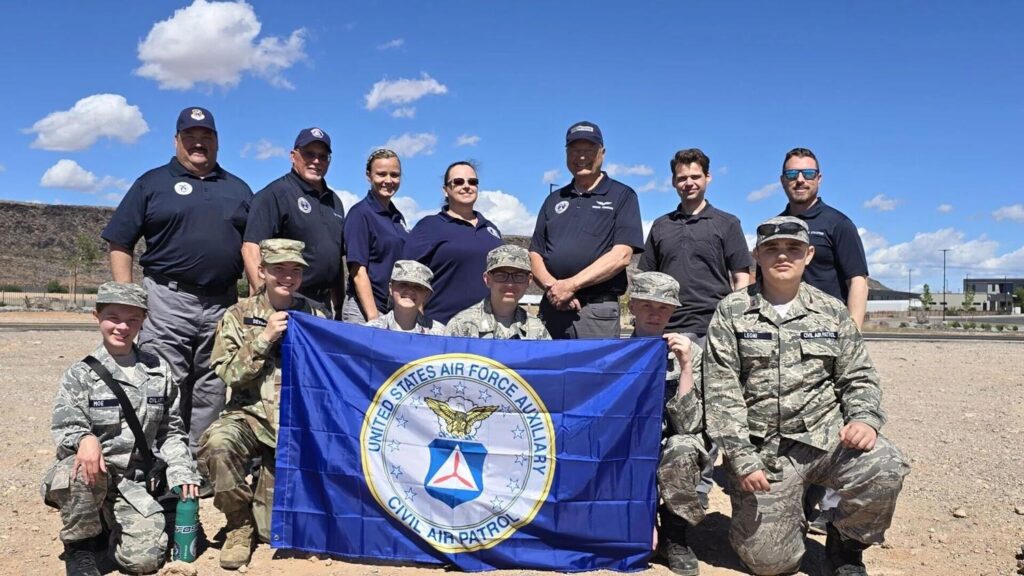
Members of Civil Air Patrol’s St. George Composite Squadron have literally been skywatching in recent months.
Cadets and officers collected ground-based aircraft condensation trail, or contrail, observations on behalf of NASA as part of the 2026 joint CAP/NASA Aviation Skywatch mission. Aviation Skywatch is a nationwide effort incorporating ground observations from more than 100 different CAP teams across more than 30 states on different dates this spring. The observation data, collected by St. George Squadron from atop Tech Ridge on March 14, April 11 and May 16, will be correlated with satellite data by NASA’s GLOBE Cloud Team at the Langley Research Center and used to improve aviation weather forecast models.
The mission, Aviation Skywatch, has its roots in the early years of the US Air Force. From 1952-58, the Air Force and Civil Air Patrol (U.S. Air Force Auxiliary) trained civilian volunteers to observe and report aircraft flying overhead. The program was known as Operation Skywatch.
Even earlier, during World War II, aviation weather science played an important role in the war effort, as weather conditions conducive to forming contrails made military aircraft easier for the enemy to spot. In those days, those same conditions also often led to carburetor icing, potentially causing stalls and crashes. Concerns over aviation weather conditions continue into the 21st century.
Today, NASA, in conjunction with the National Oceanic and Atmospheric Administration and the U.S. Air Force, uses satellites to observe weather from space. However, not all types of useful data can be collected from space as easily, or as effectively, as it can be from the ground. The kinds of data that can be yielded from observing contrails perfectly illustrate why this is the case.
From space, the skies over a particular flight path may appear clear. In such a case, there is no visually observable cue that signals atmospheric conditions, such as propensity for turbulence, in that area. Contrails, especially the short-lived kinds, are not easily visible from space, nor are there resources to allocate to visually tracking hundreds or thousands of airplanes via satellite for several minutes each.
Conversely, from the ground, contrails in clear skies can be tracked easily with the naked eye or binoculars, photographed with a cellphone, matched to flight radar data (plane type, altitude, heading, etc.) and submitted to NASA via an app. Observation and documentation of the nature of the contrail produced by the aircraft can yield a far clearer understanding of those supposedly “clear” conditions. The same can be true when observing contrails in less-than-ideal conditions.

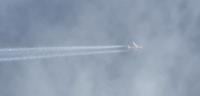
A commercial jet emits a contrail in partly cloudy skies over St. George, Utah, March 14, 2026.
Civil Air Patrol photo by 2nd Lt. Mike Creer
• Contrails can be short-lived, dissipating within seconds. Contrails of this type let us know the air is dry as opposed to humid along the flight path.
• Some contrails last for up to an hour and stay in a straight line. These so-called persistent non-spreading contrails indicate the air a plane is traveling through is cold and humid, but that there is very little wind at that altitude.
• Then there are contrails that last a long time but spread out and lose their shape. These are called persistent spreading contrails. They tell us the air is cold and humid but also windy.
By observing contrails and their remnants as they are emitted, and at regular intervals for several minutes after, ground-based observers can record and document the conditions in far greater detail. From the observed wind and humidity, it is possible to infer things such as density altitude, presence of headwinds, tailwinds, crosswinds, chance of encountering turbulence, likelihood of icing, and even things like expected engine performance and fuel efficiency.
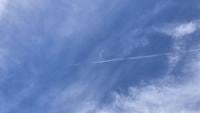
A persistent non-spreading contrail, as observed approximately 15 minutes after emission over St. George, Utah, March 14, 2026.
Civil Air Patrol photo by 2nd Lt. Mike Creer
Furthermore, there is scientific value in correlating and corroborating observations from a different point of view, using a different corollary factor, such as contrails.
And finally, some of this data is simply better collected by trained humans with cellphones than by multimillion-dollar satellites. That’s where the Civil Air Patrol comes in – again.
Civil Air Patrol benefits these agencies through manpower, training, precision and a commitment to a continuous and congressionally mandated mission to provide and improve aerospace education for all. Approximately 70,000 volunteer adult and cadet youth members comprise CAP. Members serve in every U.S. state and Puerto Rico, lending the mission the manpower.
These volunteers must complete training in general emergency services policy, safety and observation protocol specific to the Aviation Skywatch mission to ensure data quality and consistency before they can participate.
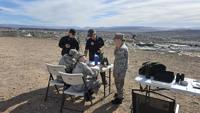
CAP 2nd Lts. Micheline Smith and Tom Palermo relay photo information to mission scribes at Tech Ridge, St. George, Utah, March 14, 2026.
Civil Air Patrol photo by 2nd Lt. Mike Creer
The first observation took place on March 11. It began at 8 a.m. with cold temps and mostly overcast skies that would slowly clear as the sun rose, making observation possible. St. George Squadron team members set up at each station: Mission orienteer/weather observer, mission photographers working with cell phones on tripods, flight tracker, equipped with a tablet using Flightrader24, and recorders/scribes taking down information with pen and paper.
A radio comms post was also established to communicate with higher levels of mission control, and a staff assistant handled other mission data entry as well as public affairs. With two teams tracking, photographing, and recording planes simultaneously, the mission was in full swing. Operations closed down around noon.
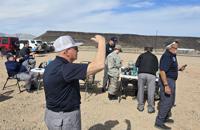
Civil Air Patrol St. George Squadron members spot a plane for contrail observation at Tech Ridge, St. George, Utah, March 14, 2026.
Civil Air Patrol Photo by 2nd Lt. Mike Creer
The second observation session was April 14 at the same time, again situated at the southern end of Tech Ridge. Many of the same participants attended, joined by some new ones. Most of the positions were rotated to give participants a chance to try their hand at different mission stations. The day started overcast, but then grew considerably warmer, clearer, and windier. This time, a canopy was set up to protect against heat and UV. Observations again concluded at noon, with a host of successfully completed observations.
A third and final observation session was at the same location on May 16. Several position assignments were once again shuffled. It would again be sunny and warmer, so much so, in fact, that all contrails emitted dissipated almost immediately. It was on this third day that several of the members present offered their perspectives on performing the Aviation Skywatch mission.
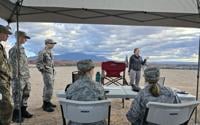
Civil Air Patrol 2nd Lt. Anita McDermith, center right, briefs cadets on their positions, duties and safety prior to the start of observations on Tech Ridge, St. George, Utah, April 11, 2026.
Civil Air Patrol Photo by 2nd Lt. Mike Creer
Maj. Gregg Johnson, Group Commander for Utah Wing’s Southern Group, oversaw the St. George Squadron’s participation in the Aviation Skywatch mission. He noted:
“I think it’s important for each of us volunteering in Civil Air Patrol to understand that the missions we perform are sometimes much bigger than what we think,” Johnson said. “In other words, we do a lot of local training, but when we get the opportunity to perform in a mission like this, with an agency like NASA involved, with a much bigger scope, our role becomes much more significant.
“We have an obligation to help our cadets understand that their training—in all the missions that we perform—will provide them with greater opportunities in the future because what they learn here can help them gain the discipline, focus, and skills they need to pursue those opportunities later in life.”
The discipline and focus instilled in those cadets, with guidance and supervision from the adult members, had already begun to show through by the third observation session. Cadet Airman First Class Bentley Stauffer, when questioned about his role in the Aviation Skywatch mission, offered the following:
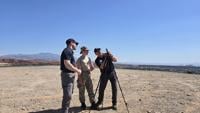
L-R: Civil Air Patrol member Sterling Stauffer, , Cadet Airman First Class Hayley Moe and 2nd Lt. Tom Phalen troubleshoot a camera setup on Tech Ridge, St. George, Utah, May 16, 2026.
Civil Air Patrol Photo by 2nd Lt. Mike Creer
“I’m currently in charge of the flight radar, which means I identify the planes we are looking at, and I read off the information to the recorder, mainly registration number, type of aircraft and things like that,” Stauffer said. “Last time I was the mission photographer.”
Regarding his chance to have an impact, he added, “I’m proud to help contribute to things like this. As a 12-year-old, there aren’t many other opportunities to help others in such a meaningful way.”
Cadet Airman Grace Wolslager, age 13, was busy penning an aircraft registration number when approached for comment. When asked about her role, she said, “I’m a scribe. I write down the flight and observation information for all the aircraft we monitor. I also help the others track the timing of the shots.”
She smiled when asked about the larger impact she was having.
“Helping NASA makes me feel very proud,” Wolslager said. “I’m pleased to help out with all the things we do in Civil Air Patrol, and I’m honored to do this for science and the world. I also like being out here, getting to know everyone better, and learning about teamwork and communication together.”
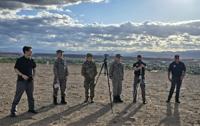
Civil Air Patrol St. George Squadron members stand ready to begin the day’s mission, Tech Ridge, St. George, Utah, April 11, 2026.
Civil Air Patrol Photo by 2nd Lt. Mike Creer
A newer adult member, Alexander Ehlers, was assigned to the weather observation/orienteering role for the third observation session. He echoed the cadets’ sentiments.
“It’s a privilege to contribute to science and the betterment of humanity in any small way I can…and it’s a wonderful experience to be out here volunteering together,” Ehlers said.
Sterling Stauffer, a newer adult member and father of Cadet A1C. Stauffer, also noted the value of participating beyond simply completing the mission.
“It’s important for kids to have things to do that are healthy and productive and meaningful,” he said. “Civil Air Patrol provides an opportunity for that to happen not only for my son, but for a lot of kids in our area.”
Another adult member, Tom Phalen, newly promoted to 2nd Lieutenant, reflected on the teaching aspect of the mission.
“I love volunteering for Civil Air Patrol. I like to give back to senior members and cadets by lending some of my expertise that I’ve picked up over the years—I’m 66 years old, and I have a lot of experience—I want to pass that experience on to others,” he said.
Lt. Phalen had also helped with numerous positions during the mission, including recorder, orienteer and tracking.
The St. George Squadron’s participation in the CAP/NASA Aviation Skywatch mission ultimately reached a successful conclusion, having documented scores of aircraft contrail observations. The data they obtained will be analyzed along with thousands of other datapoints gathered across North America as part of the operation.
2nd Lt. Tom Palermo, St. George Squadron Deputy Commander for Cadets and Aerospace Education Officer conducted much of the training for Skywatch and initiated the squadron’s participation both as an aerospace education opportunity and as a teambuilding opportunity for cadets and adults to do together.
“The 2026 CAP/NASA Aviation Skywatch Mission was a great success because of the participation of CAP units, including overseas units,” Palermo said. “In St. George, our squadron provided NASA with data on all three contrail observation dates, thanks to our mostly clear blue skies—and of course our members.
“As St. George Deputy Commander for Cadets, I was proud of how our cadets very quickly mastered the tools and techniques used to record and photograph the aircraft and contrails! Their willingness to spend multiple Saturday mornings to both learn and assist on this mission is a testament to their dedication to CAP core values of excellence and volunteer service. We look forward to our continued service to NASA, in this as well as other future missions.”
As many members noted, the multiple sessions spent outside together over the course of the spring, working alongside one another, doing something as seemingly simple as watching planes go by and studying their contrails, turned out to be more fun and meaningful than they first thought it would be. Not only were they excited to train and accomplish a mission, or to do something beneficial for NASA and aviation science, they were excited to be doing these things together, young and old, as members of the St. George community, as members of Civil Air Patrol, members of the St. George Squadron, and as members of one exceptional mission team.
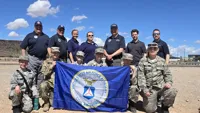
Members of Civil Air Patrol’s St. George Composite Squadron, Utah Wing, pose with the CAP flag at the southern end of Tech Ridge, St. George, Utah, April 11, 2026.
Civil Air Patrol photo by 2nd Lt. Mike Creer
Even though the mission achieved its stated purpose and the observed contrails themselves have long since faded away, the most persistent contrails observed over the course of the mission remain—those are the ones formed by the deepening of bonds; and by service to the community, the country and the future.
Founded in 1941 and established as the official civilian auxiliary of the U.S. Air Force seven years later, Civil Air Patrol is chartered by Congress as a nonprofit organization for the purposes of youth development, aerospace education, and to promote general aviation. In an auxiliary role as a Total Force partner of the Air Force, CAP operates the world’s largest fleet of single-engine aircraft for search and rescue, disaster relief, training, and education. Civil Air Patrol is dedicated to serving America’s communities, saving lives and shaping futures.
Visit CAP.news or GoCivilAirPatrol.com for more information. Follow Civial Air Patrol on Twitter, Facebook, Instagram, LinkedIn and YouTube.
Written by 2nd Lt. Mike Creer, Civil Air Patrol