
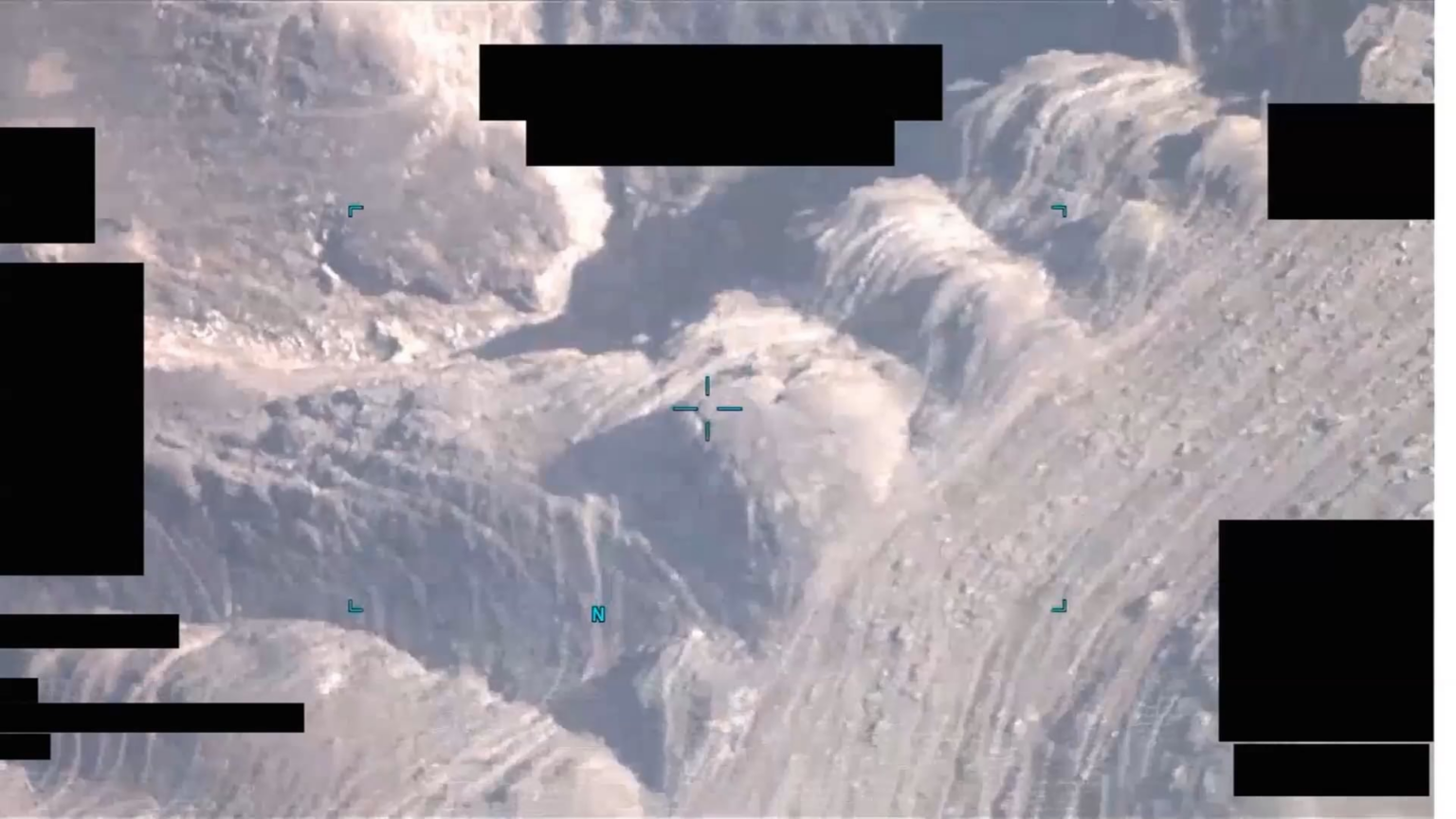
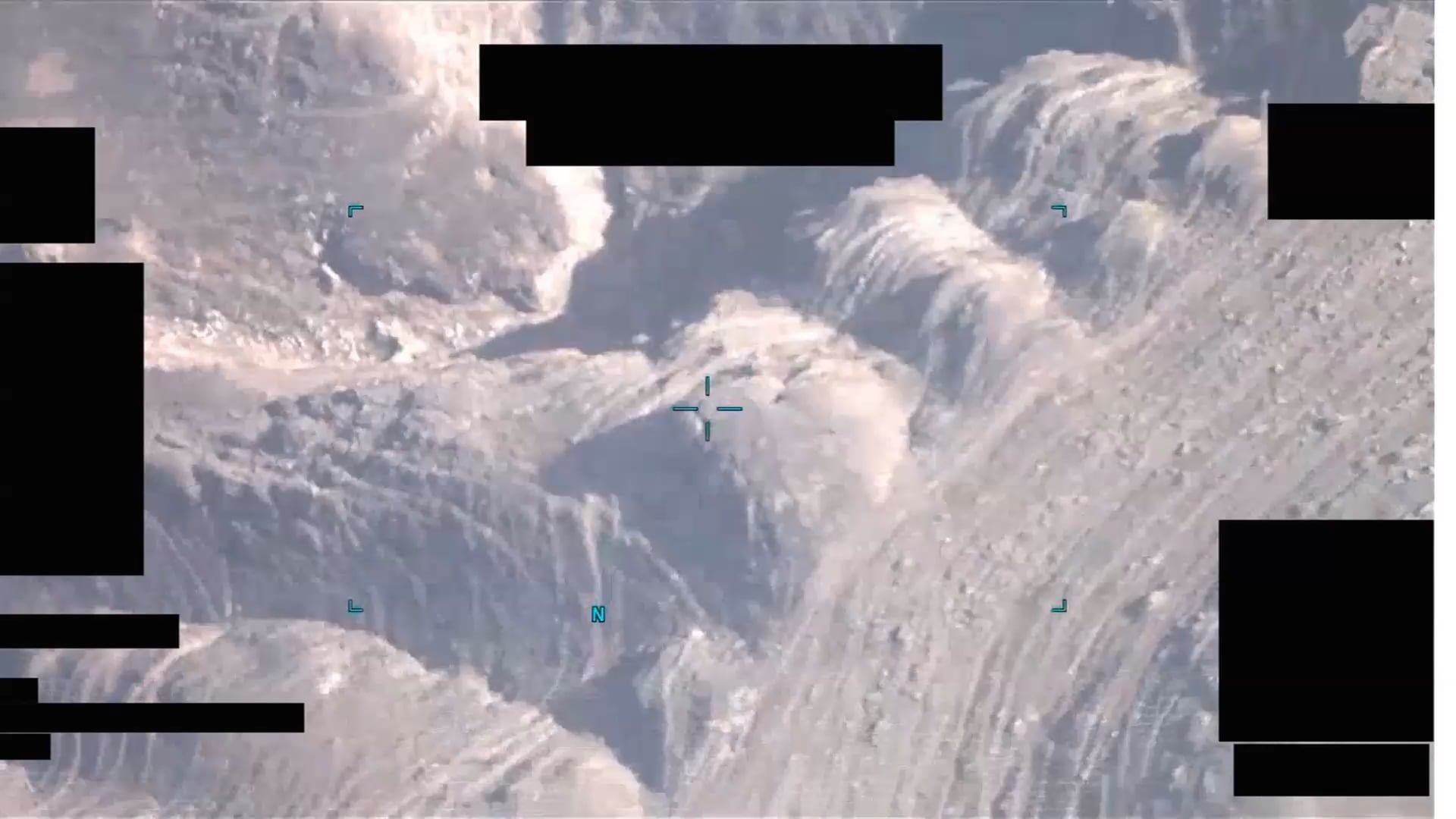
For those who haven't seen all the videos in the second batch of files released yesterday, I've taken the liberty of combining two separate clips that I feel are truly compelling and directly dispute the "it's not a sphere; it's just a bird, dot, or pixel" argument.
The first clip is from DOW-UAP-PR061 which shows a white reflective sphere take a direct path at a high rate of speed for approx. 3.5 minutes before reducing altitude, sharply turning, and disappearing into crevice, cave, or possibly directly into the rock (transmedium travel). Note the spherical shadow that appears as it is arriving and the location details–ridges along the right side of the screen and a large light spot on the hilltop on the left side of the screen.
Immediately following is the second clip from DOW-UAP-PR060 which follows a black reflective sphere for a number of minutes with varying degrees of zoom. No shadow is present on the landscape below signifying high altitude and, most likely, a high rate of speed. Here is the fascinating part: The U.S. platform stops tracking the black sphere and quickly moves the camera to the location that the white sphere disappeared into in PR061–Note the same large lighter spot, this time on screen right, and the ridges, this time on screen left. It is almost as though they were keeping tabs on a possible base of operations and expected the black sphere to make its way there.
They continue to surveil the location for quite a while in both videos.
Note: the full videos are available to download on the Department of War website.
If such objects were advanced Russian, Chinese, or defense-contractor drones—especially ones exhibiting no visible means of propulsion—would we not expect to see some evidence of supporting infrastructure nearby? Roads, facilities, personnel access points, power systems, communications equipment, or other indicators of human activity would presumably be necessary, even in remote areas. Yet some of these locations appear extremely isolated and barren.
There have been unconfirmed reports of UAP appearing to disappear into the sides of mountains, including accounts involving Mt. McKinley/Denali in Alaska. While these reports remain unverified, they raise interesting questions.
To be clear, there are documented examples of hangars or facilities built into hillsides or mountains, sometimes with impressive camouflage. However, those installations are typically located near other military infrastructure, service roads, restricted zones, or visible support networks. That distinction is worth considering.
What I find frustrating is that many news outlets and content creators often focus on the least compelling cases—the obvious misidentifications, vague lights in the sky, or sensational “nothing burger” stories—while largely ignoring the cases that appear more difficult to explain. This does a disservice to the seriousness of the topic.
NASA, Elon Musk, and many major aerospace companies have also been surprisingly quiet on the broader UAP issue. And while NASA long maintained that it had no meaningful UAP-related files, that position has since become harder to reconcile with what has come to light through official records and recent disclosures.
Skepticism is not only healthy; it is necessary. But skepticism should not mean reflexive dismissal. It is worth remembering that senior military officials, intelligence leaders, admirals, government officials, and others in positions of authority have acknowledged that there is a real phenomenon being observed and that some cases remain unexplained.
At this point, the scientific community should be taking the subject more seriously—not by jumping to extraordinary conclusions, but by applying rigorous investigation to credible reports. The goal should not be ridicule or blind belief. It should be honest inquiry.
And yes, that includes the public-facing scientific voices who often seem more interested in dismissing the topic than examining the strongest evidence. Looking at you, Neil deGrasse Tyson.
by dapperpupa
1 Comment
Well, there’s nothing there now.
The formation is readily identifiable, and if this is cleared for public release, we’ve definitely swept that whole area already, before influencers and YouTubers can get out there.
Repeats in the same area, for objects that appear different from one another reduces the odds of balloon to nothing, bird might still be on the table to some skeptics.
However, it costs us money to have assets anywhere, so if there’s no other discernible reason for us to be watching that spot, then I’d say the odds that this is a bird, is way way down, as well.
Could be a genuine hit. Remaining trace evidence is likely zero, but this has shown us some characteristics.
Prefers hard to access middle of nowhere ridges, canyons, mountain ranges, with shadowed valleys. Conceals entry and exit, low traffic, makes sense for added layers of covert concealment. This is the type of behavior I WOULD expect from a low profile ISR by a group “not from around here”. Intelligent signature management, using local environment.
If this is one we can get a lens on, chances are there’s more that we don’t.
Based on this characteristic profile, if we assume this is the real deal, we should be watching these types of areas with more scrutiny.
Low traffic, hard access, low visibility, multiple concealment options, ridges and geologic formations. National Parks, wilderness, badlands, mountain ranges.
They aren’t hiding in plain sight, they’re hiding where it’s smart to hide.