
There has been no definitive signs of extraterrestrial life found in the universe to date, but many scientists believe that if there is life out there, we may be getting closer to detecting its signature on distant worlds as technology continues to advance.
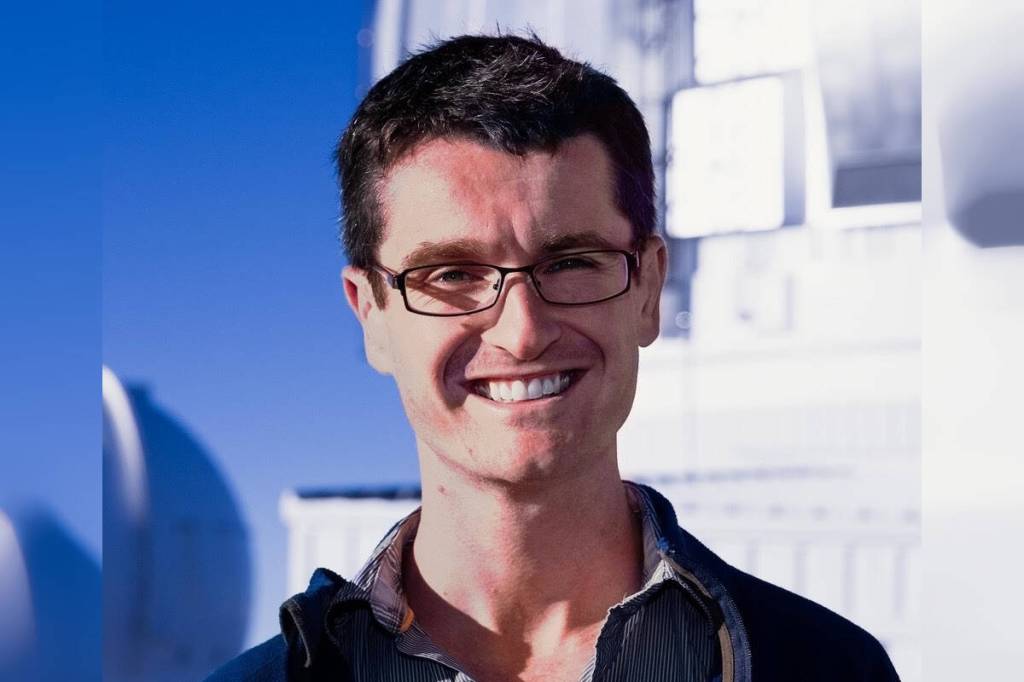
Dr. Wes Fraser will make a presentation, called The Golden Age of Astronomy: New and Upcoming Telescope Projects, at an event hosted by the Nanaimo Astronomy Society on May 28 at the Beban Park Social Centre, beginning at 7 p.m.
Fraser, an observational astronomer at the University of Victoria and the Herzberg Astronomy and Astrophysics Research Centre, said the James Webb Space telescope has captured the starlight filtering through the atmospheres of numerous exoplanets since it was launched in 2021 to try and determine the composition of their atmospheres.
But he said it’s difficult to conclude if the planets host life from the information gathered so far.
“The (atmospheric) pressures, densities and temperatures are all very different on these worlds, which are mostly larger than Earth,” Fraser said.
“We’ve yet to find any Earth-like planets in the habitable zones of their stars in which we can easily penetrate their atmospheres. These are usually tiny planets around smaller and less massive stars that are fainter than our sun, and these planets are also much closer to their star which makes them exceedingly difficult targets for James Webb to penetrate their atmospheres.”
But Fraser said there are many other telescopes that are soon to be operationa; that could help with the search for extraterrestrial life, and the study of many other aspects of the universe as well.
Since earning his PhD from UVic in 2008, he has made extensive use of many of the world’s most powerful telescopes, including Keck, Gemini, Subaru, Magellan, Hubble, and James Webb.
Fraser’s research has been focused on understanding the planet-formation process.
To that end, he has run many telescope programs that focus on the discovery and characterization of the solar system’s icy small planetesimal populations, with emphasis on the Kuiper Belt.
Fraser has also been active in the development of the Canada-Rubin program, working on programs to maximize exploitation of the Legacy Survey of Space and Time.
But he said that the James Webb telescope, with its new ultra-high resolution window in the near Infrared universe, is the one that he is asked about most often.
Fraser said that with so much interest currently on James Webb, it’s easy to forget about the wealth of new telescope projects just coming online, each of which will provide its own previous unavailable new window on the universe.
“In this talk, I will go over many of these new projects, including the Roman Space Telescope, the Vera C. Rubin Telescope’s Legacy Survey of Space and Time, the Square Kilometre Array, the Next Generation Very Large Array, the Canadian Hydrogen Observatory and Radio-transient Detector, and the European Extremely Large Telescope,” he said.
“With a list this long, it’s easy to realize we are entering the golden age of observational astronomy. Unfortunately, astronomers are facing a number of new unprecedented challenges, most notably massive satellite swarms that are polluting up the night sky. I’ll touch on that subject as well and discuss ways astronomers are dealing with this new threat to dark skies.”
Fraser said another of the many pitfalls faced by observational astronomers, like himself, and other scientists in regards to integrating new technologies and having access to new high-tech telescopes in their research is cutbacks to budgets as politicians cite other priorities for the funding.
“That threat is very real, so the development of new telescopes can sometimes be sporadic,” he said.
“Politicians can be wild people sometimes, so it can be very difficult to know what will come online at times. Projects planned for five to 10 years from now can be uncertain as a result, but there are a number of telescopes currently being built that will come online soon. It will be amazing when they do and they will provide us with some great science, so the future looks great.”
After Fraser’s main presentation and a coffee break at the Beban Park Social Centre on May 28, there will be a second shorter presentation by Vancouver Island University computer science students Chris Lawrence and Ethan Ondzik called Visualizing Gravity: From Newton to Einstein.
Lawrence and Ondzik will present their interactive computer simulations exploring gravitational physics in classical and modern viewpoints, along with historical context.
Emphasis will be put on the visualization of gravitational effects with particular focus on the three-body problem, the Big Bang theory, and Einsteinian curvature of space-time.
“Join us in exploring gravitational systems and the struggles and successes of modelling 3D systems on 2D screens, and see through the eyes of the greats from Newton to Einstein,” Lawrence and Ondzik said.