
Back to Article List
Observers and imagers live for comets. Here are the top 20 from the past quarter-century.
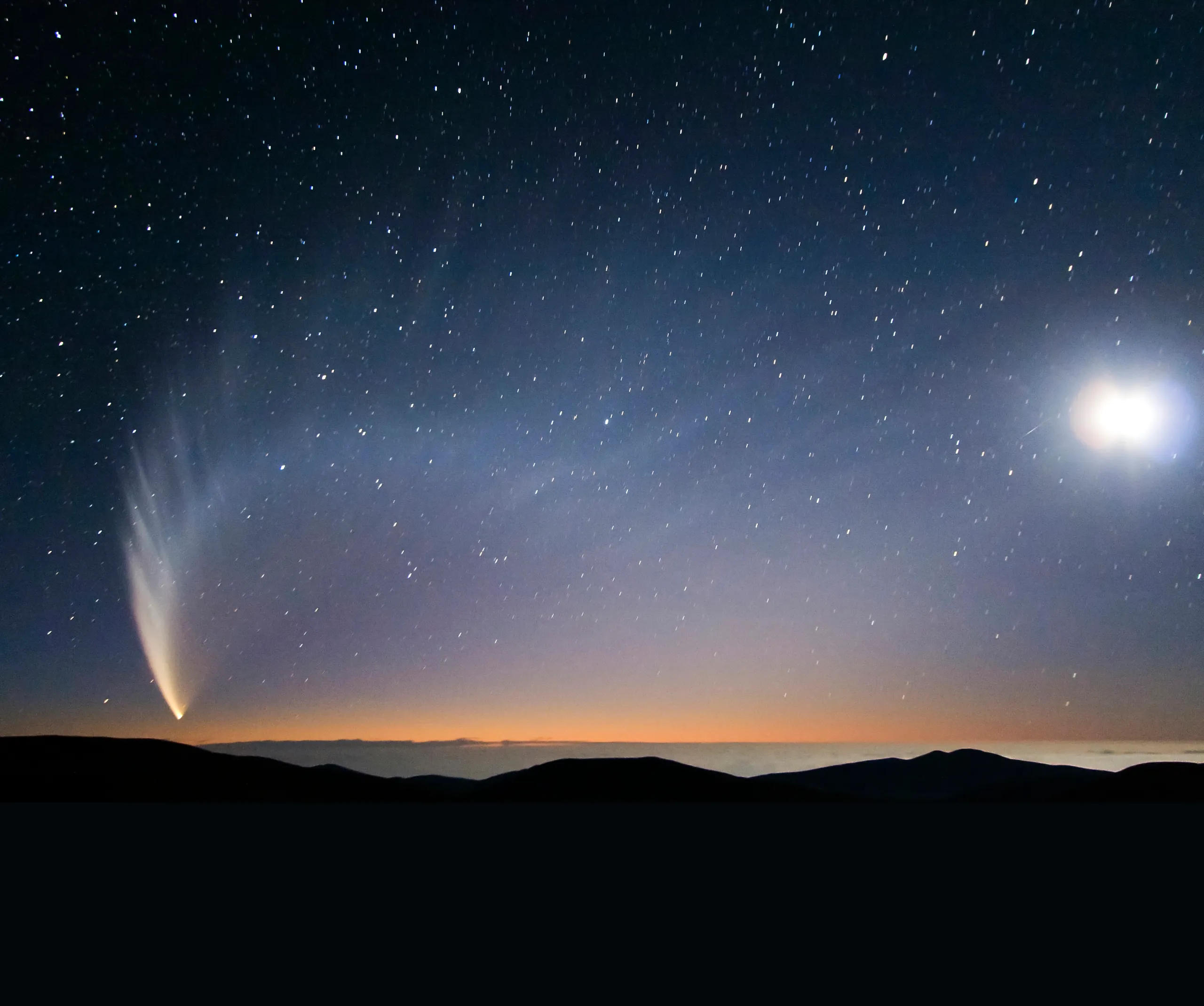
Comet 2006 P1 (McNaught) was a truly spectacular sight throughout the Southern Hemisphere. This image, taken from the European Southern Observatory’s Paranal Observatory in Chile in January 2007, shows the comet and a crescent Moon over the Pacific Ocean. Credit: S. Deiries/ESO, CC BY 4.0
Comets are small, roundish bodies made of dust grains mixed with ice. Most travel along elliptical orbits that occasionally bring them close to the Sun.
The main icy body of the comet is its nucleus. It’s small, generally less than 6 miles (10 kilometers) in diameter. When far from the Sun, comets appear faint because we’re seeing only sunlight reflected off the tiny, frozen nucleus.
But as a comet journeys into the solar system, its radiation begins sublimating the ice, turning it into gas. This forms a cloud of thin material around the nucleus — called the coma — that grows in size and brightness as the comet approaches the Sun. The coma has two ingredients: dust, which reflects more sunlight than the nucleus, and gas, which absorbs ultraviolet radiation and fluoresces.
As comets approach the Sun, they also develop tails of luminous material that extend from the heads. Tails of great comets can be enormous, stretching for tens of millions of miles. The solar wind pushes material away from a comet at different speeds depending on the size and mass of the particles. This can create two types of tails. A dust tail tends to curve because the Sun’s radiation gently pushes on the dust particles; since some dust specks have more mass and are less susceptible to this radiation pressure than others, the dust tail bends and fans out. An ion tail is composed of electrically charged gases with much less mass, so it is swept up in the Sun’s magnetic field along with the solar wind, moving in a nearly straight line pointing away from the Sun.
It’s a sad fact for amateur astronomers that bright comets just don’t come around all that often. And even when one does appear (seemingly out of nowhere), there’s a 50 percent chance that the best views will be reserved for observers on the other side of the equator from you.
PREMIUM CONTENT
This article is for subscribers
Continue Reading
PREMIUM CONTENT
This article is for subscribers