
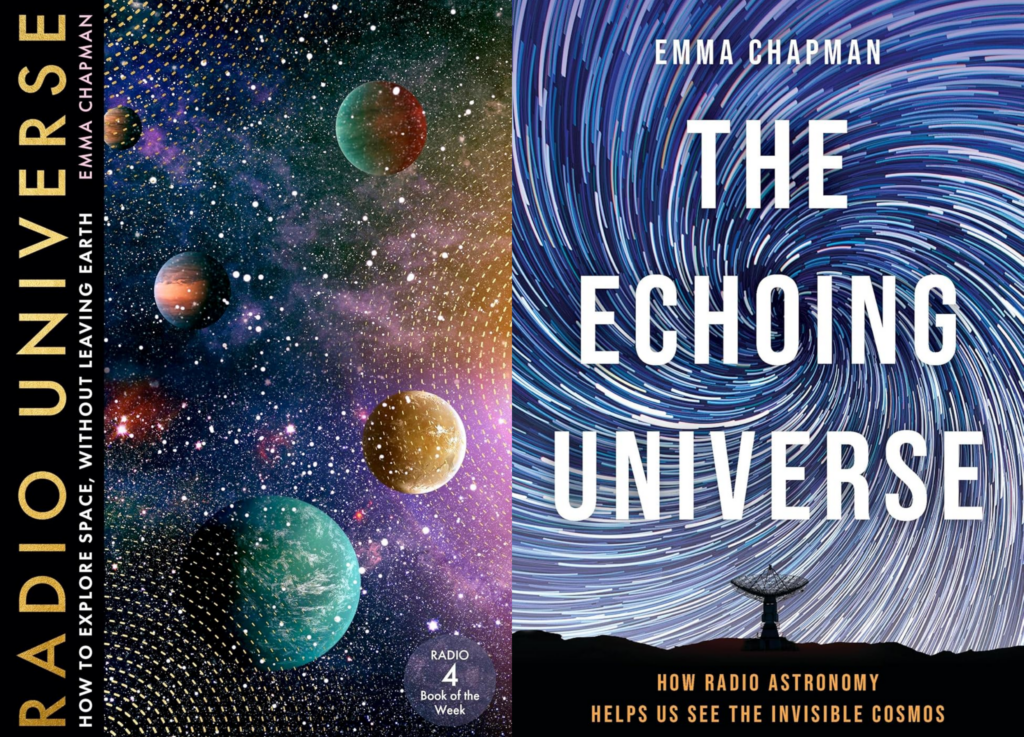
Two days after its publication, Emma Chapman’s new book on radio astronomy is already drawing wide media attention — a SpaceMog YouTube interview is circulating, Live Science published a book excerpt this morning, and Universe Today posted a full independent review yesterday. The timing is not accidental. The Echoing Universe: How Radio Astronomy Helps Us See the Invisible Cosmos arrives precisely as the Square Kilometre Array, the largest radio telescope ever built, is entering its science phase at dual sites in South Africa and Australia.
Chapman, a Royal Society Research Fellow at the University of Nottingham and one of the leading researchers on the universe’s first stars, makes a claim that runs against the grain of how most people picture astronomy: radio waves are not a second-tier fallback for scientists who lack access to prettier instruments. They are often the only tool capable of seeing what matters most.
Mercury Has Ice: Radio Astronomy Found It First
The clearest illustration Chapman offers is not from the edge of the observable universe. It is Mercury.
In a video interview with the science channel SpaceMog, as described by Andy Tomaswick’s review in Universe Today, Chapman named this the single most astonishing fact she uncovered while writing the book. Radio observations — specifically radar returns detected in 1991 using a ground-based radar system with the Very Large Array as receiver — identified patches of anomalously high reflectivity at Mercury’s poles. The explanation: ancient water ice, preserved for billions of years in the permanently shadowed floors of polar craters, shielded from vaporization by a planet whose axial tilt is so slight that sunlight never reaches those crater floors.
Mercury is the closest planet to the Sun. It is not, in any intuitive sense, a place one expects to find ice. But radio waves found what visible light could not.
From Jansky’s Merry-Go-Round to the Event Horizon Telescope
The Echoing Universe traces the field from its accidental origins. Karl Jansky, a Bell Telephone Laboratories engineer, built a rotating antenna in the early 1930s to track sources of interference in transatlantic radio transmissions. The contraption — mounted on Ford Model T wheels and nicknamed the “merry-go-round” — unexpectedly detected radio waves from the center of the Milky Way.
The accidental quality persisted. In February 1942, James Stanley Hey of the British Army Operational Research Group was investigating what initially appeared to be German jamming of Allied anti-aircraft radar. The interference was in fact radio bursts from a massive solar flare — the first confirmed detection of solar radio emission. The wartime discovery remained classified until after the war but established that the Sun was a powerful radio source, and that radio waves could act as early-warning signals for the energetic solar events that damage satellite infrastructure and power grids.
Both threads — planetary science and space weather — run through Chapman’s book alongside a third that is closer to her own research: the extreme deep field of radio astronomy, where instruments can reach back to the universe’s earliest light.
21-Centimeter Hydrogen and the Epoch of Reionization
Chapman’s own PhD research centered on one of the most technically demanding frontiers in astrophysics: detecting the faint 21-centimeter signal emitted by neutral hydrogen during the epoch of reionization — the period roughly 400 million to one billion years after the Big Bang when the first stars ionized the surrounding gas and made the universe transparent to visible light.
This signal is so faint and so contaminated by terrestrial radio interference that detecting it requires purpose-built arrays. The 21-centimeter line is also one of the primary tracers of dark matter distribution across cosmic scales. No optical telescope can access this information; the physics of the emission frequency places it entirely in the radio band. Chapman is directly involved in both the Low-Frequency Array (LOFAR) in the Netherlands and the forthcoming Square Kilometre Array, and she brings that firsthand perspective to the book.
Tomaswick’s Universe Today review noted that Chapman frames the entire book around distance — using radio to probe everything from neighboring planets to the edge of the observable universe — giving it a narrative coherence that popular science books on observational technique rarely achieve.
Event Horizon Telescope: A Black Hole Imaged in Radio
The most recognizable image in contemporary astronomy — the glowing ring of light surrounding the supermassive black hole at the center of galaxy M87 — is a radio astronomy product. The Event Horizon Telescope that produced it is a globe-spanning network of synchronized radio dishes, operating together as a single virtual instrument whose aperture is effectively the diameter of Earth.
That image did not come from a space telescope or an optical observatory. It came from radio receivers coordinated across four continents, combined using a technique called very long baseline interferometry. Chapman uses the Event Horizon Telescope as one of several examples of radio astronomy’s tendency to produce results that were simply not achievable by any other means.
SKA: The Instrument Chapman’s Book Was Written For
The practical stakes of Chapman’s argument sharpen when the SKA enters the picture. Under construction since December 2022 at dual sites in South Africa and Australia, the SKA achieved first light in 2024 and is projected to begin science observations in 2028. The observatory will archive approximately 700 petabytes of data per year — a scale requiring entirely new approaches to data processing and storage. When fully operational, it will be able to survey the sky more than 10,000 times faster than any existing radio telescope, and will pursue science targets ranging from dark matter mapping to pulsar timing to the search for extraterrestrial intelligence.
Chapman — whose own research programs at LOFAR and the SKA focus directly on the epoch of reionization — is not writing about these instruments from a distance. She is writing as someone who will use them, which is precisely why The Echoing Universe carries the weight of argument rather than mere description.
The Universe Today review concluded that the book is a powerful reminder that while optical telescopes and space missions attract most of the public’s attention, the radio antennas spread across the planet are listening to what Chapman calls “the echoes of creation” — and that the best listening is still ahead.
Chapman is also the author of First Light: Switching on Stars at the Dawn of Time, published in 2020 and translated into five languages. Her ability to make the mathematics and physics of the early universe accessible without sacrificing rigor has become her signature. The Echoing Universe extends that approach across the full breadth of radio astronomy — from the solar system to the cosmic dawn.
Publishers Weekly gave the book a starred review, calling it “passionate and witty.” The book was also named BBC Radio 4 Book of the Week under its UK title, Radio Universe. The Echoing Universe: How Radio Astronomy Helps Us See the Invisible Cosmos is available now from Basic Books, a Hachette Book Group imprint, at 352 pages.